Savoring the Moments: Reflections on the 2026-27 Season from Patrick Summers | Part 2 of a Series

Click here to read Part 1 and Part 3 of Savoring the Moments
4
Houston Grand Opera had a unique guardian in the composer Carlisle Floyd (1926-2021). He guided a postwar American operatic repertoire that he helped create, and he also strongly influenced nearly every other late-20th-century opera. At HGO, he quietly fostered young artists for half a century, while subtly steering the company’s aesthetics and values. No other company in the history of opera had such a long creative relationship with a living composer as did HGO with Carlisle Floyd, who also founded the renowned Butler Studio at HGO with then-General Director David Gockley in 1977.
Carlisle’s first two operas were divergent views of a single theme: the corruptive hypocrisy of religion when it is divorced from its theologies. They were Slow Dusk, written when he was 23, and, six years later, by far the most-performed work of his life, and one of the most successful of all American operas, Susannah, set in Appalachia, based on the Biblical tale of Susanna and the Elders, accepted by Roman Catholic and Eastern Orthodox churches as an episode from the Book of Daniel, but still considered part of the Apocrypha by Protestant faiths.
Besides Wuthering Heights (a wonderful opera) and his final chamber opera Prince of Players, all of Carlisle’s major operas were on American subjects: Bilby’s Doll, written to commemorate the American Bicentennial in 1976, was based on A Mirror for Witches, exploring spiritual tensions in the Massachusetts Puritan settlements, themes reminiscent of Arthur Miller’s The Crucible. 1981’s Willie Stark was based on Robert Penn Warren’s All the King’s Men, the incredible story of a life almost too big for opera, that of the Louisiana governor Huey P. Long. The Passion of Jonathan Wade, which Floyd revised for HGO in 1991, is a grand family tragedy of Reconstruction Era America, and the autumnal and joyful Cold Sassy Tree, set near Floyd’s South Carolina birthplace, which was HGO’s first commissioned opera of the new century and was Carlisle’s homage to Verdi’s life-affirming Falstaff.
Handel also wrote an oratorio on the story of Susanna and the Elders, a work of unearthly beauty, largely because it includes the extended aria “Crystal Streams in Murmurs Flowing,” one of the most singularly beautiful of all Baroque arias, one of those moments of Handelian levitation, and it speaks in a way to Carlisle’s Susannah singing of the trees on the mountains lying cold and bare. As preparation for Susannah, listen to Joyce DiDonato or Lorraine Hunt Lieberson sing “Crystal Streams,” and it could change the color of your soul; it is that kind of music.
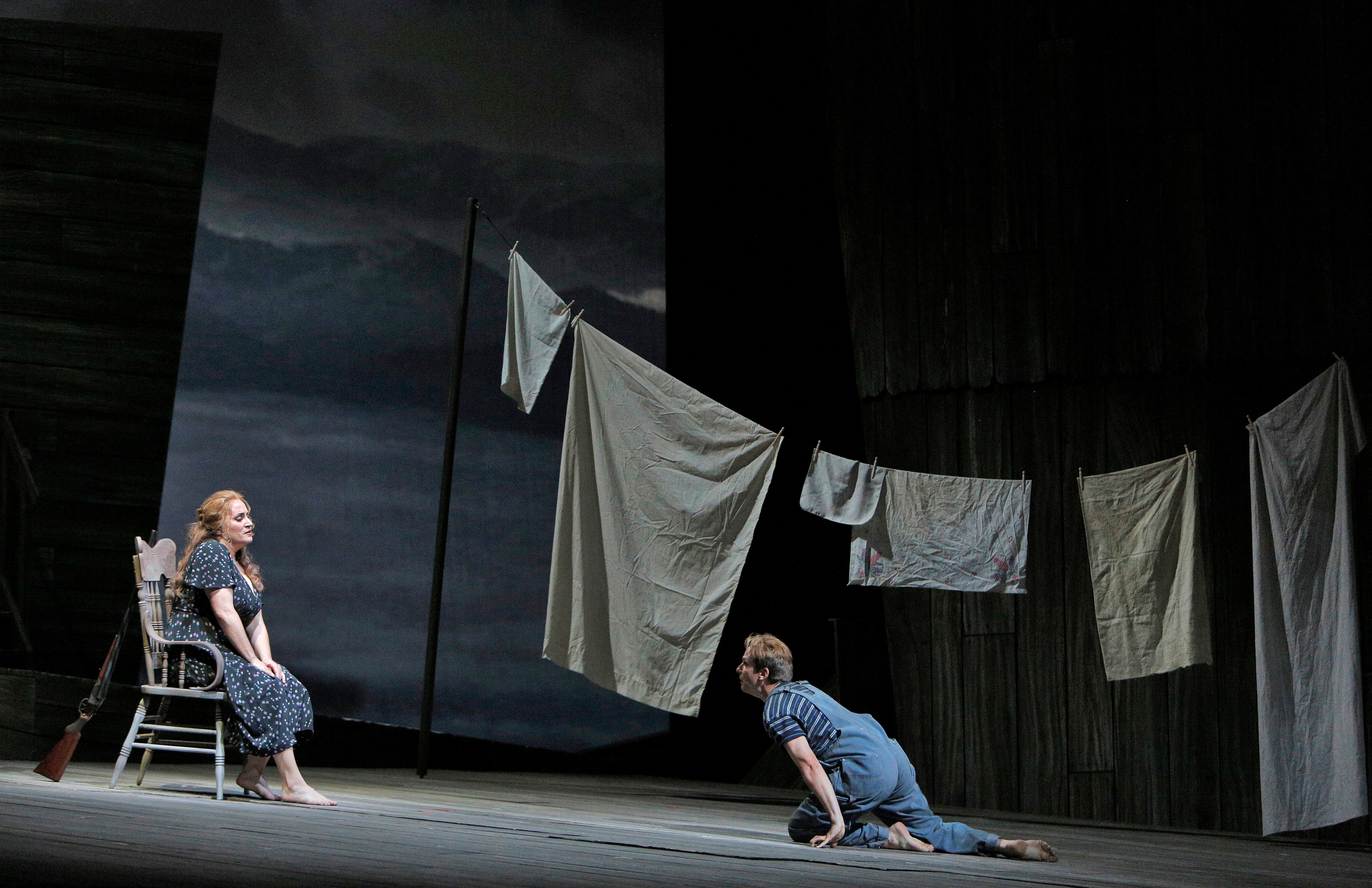
Time plays such tricks on us, that it is hard to imagine that Susannah was composed just 20 years after the Gershwin’s Porgy and Bess, and landing smack in the middle of an artistic revolution on Broadway, one in which Rodgers and Hammerstein were in full flight: by the time Susannah premiered, Oklahoma!, Carousel, South Pacific, and The King and I were all either on Broadway or touring the nation. Hammerstein saw and admired Susannah, thinking it a great new direction for American opera—but this view was quite at odds with the classical music establishment of the time: Aaron Copland gave no attention or time to Carlisle or to Gian Carlo Menotti, thinking them both populists. It wasn’t so often that Carlisle was critically reviled—which he would rather have welcomed—it was that he was dismissed as a tune-writer, someone who trafficked in traditional harmony while the “real” musicians were composing ever-cleverer versions of the Second Viennese School. But ultimately, Carlisle stood his own ground, and he changed the face of American opera with Susannah, and Hammerstein’s view turned out to be prescient.
Susannah in performance has a primal feeling, like attending a barbaric ancient ritual. It is orchestrally heavy and dark, full of weight. We know what will happen to Susannah because we know the nature of people. We have known all of those elders of the inhabitants of New Hope Valley—they are archetypal, individually humorous, even eccentric, but collectively they are vicious. Susannah is a work that constantly tightens the screws of its own drama, and it does it quickly, in under two hours of music, shorter than most films. Oddly, Susannah’s brevity has sometimes been used against it—upon Susannah’s 1999 debut at the Metropolitan Opera as a vehicle for Renée Fleming, Bernard Holland denigrated it in The New York Times, writing “Its 90 minutes could be put inside the first act of Parsifal,” as though length had some correlation to quality. Parsifal is not profound because it is long—indeed, one of the hallmarks of Wagner’s major operas is not their length, but rather how brief they are when set against the breadth of their ideas.
Susannah’s male characters act on their most impulsive emotions and then justify them, all at the expense of one innocent young girl whose only crime was growing up. The opera is essentially about hypocrisy—not of faith, but of the falsely pious and those who use their faith for judgment and power. Susannah is actually a deeply religious work, in that it portrays a community forced to examine its own action; it is a story that demands empathy. The opera ends with Susannah’s tragic madness at the hands of those charged with protecting her.
5
“Ah, c’est la voix du bien aimé!” (“It is the voice of my beloved”), sings Marguerite in the final scene of Gounod’s opera, echoing the thoughts of many generations of opera lovers when thinking of this work. Faust is one of the most vital of operas, only partly because of its timeless, archetypal story. The larger reason is the nature of Gounod’s music itself, which can seem on the surface so perfumed and melodic. There is a metaphysical feeling to Gounod’s music, as though it existed long before he wrote it and lingers long after. I often feel this way when I hear the famous final trio, in which all three major characters, Marguerite, Faust, and Mephistopheles, are each splitting into different directions—one to heaven, one to hell, one in limbo. I always imagine that music lingering high above the theater, vibrating the air long after everyone has gone home. So much of Faust feels that way: omnipresent, just beyond what is real. It isn’t that Faust is the greatest opera ever written; it certainly is not. But it has a particular kind of greatness that few operas have: it lingers.
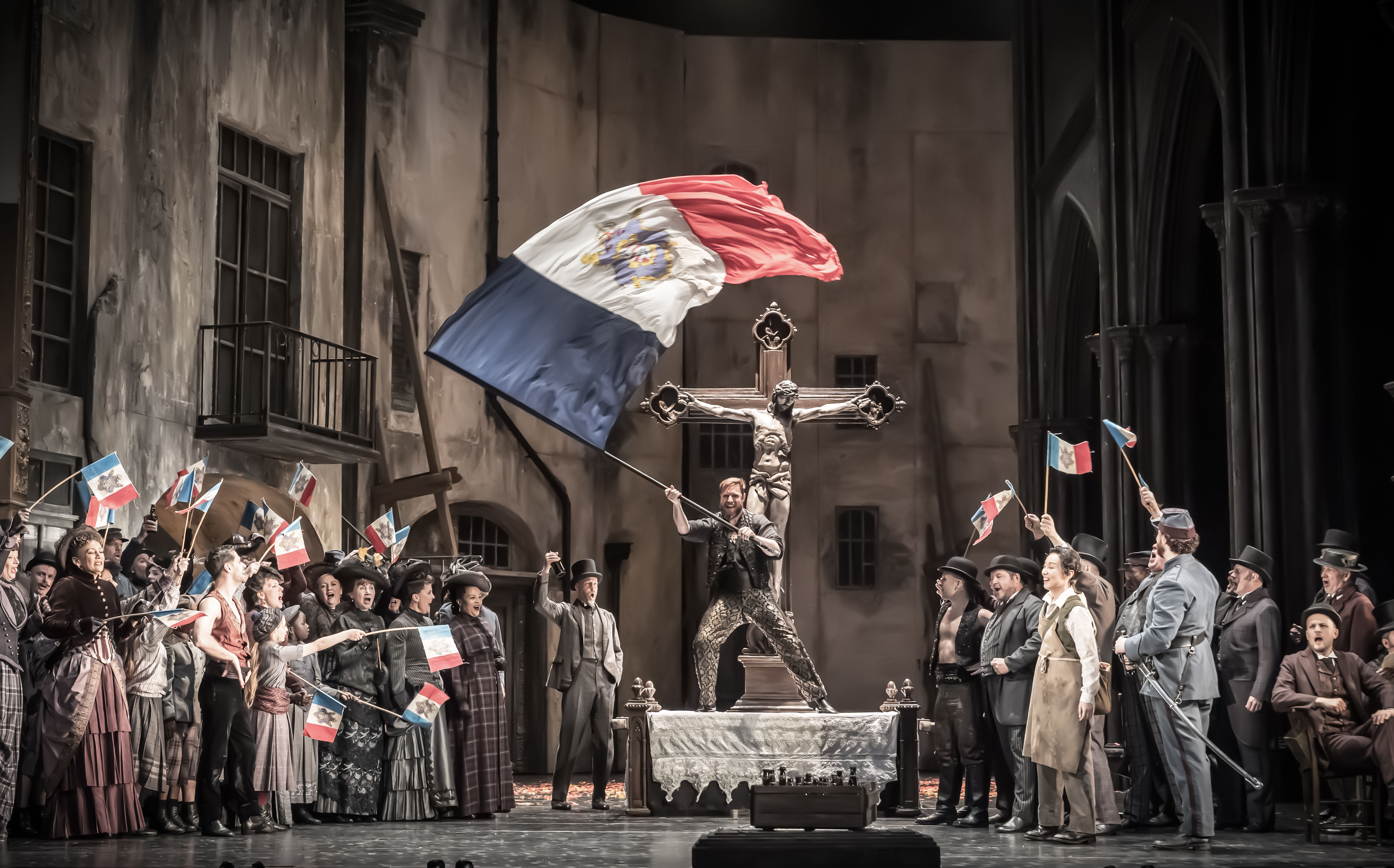
At regular intervals in the 167 years since it premiered, Faust has been the most popular opera in the world. The Goethe play on which Faust is based is more than two centuries old, appearing in the first of its two parts in 1808, though Goethe’s oldest versions even predate the United States, appearing in the early 1770s. It was one of the first books that could easily be said to have changed the world, one of the greatest pieces of literature in German history. Faust is the opera that opened the Metropolitan Opera in 1883, albeit in Italian, and it was presented almost every season for a quarter-century. Incredibly, in Paris, from the 1859 premiere of Faust, Gounod’s opera played every year until the beginning of WWI—imagine an opera playing every season for 55 years!
Gounod’s opera, expertly curated by two French poets, Jules Barbier and Michel Carré, spared no expense, becoming one of the most famous opera productions in history, with five scenic designers who created a set of dazzling scenes. Nothing was left to chance, and David McVicar’s production from the Royal Ballet and Opera, Covent Garden, honors this important part of the opera’s legacy.
Faust’s plot has been re-told so many times in countless ways that we forget how original and inventive it is. Gounod’s opera is now more famous than the epic play on which it is based. An elderly learned man, Faust, has a late-in-life epiphany that all of his accumulated knowledge has only served to distract him from true love, leaving him feeling that he has wasted his life. He curses his life and upon attempting to kill himself, the devil appears in the form of an elegant demon named Mephistopheles, or Mephisto, who promises him youth and love. Faust is transformed into a dashing young man, and Mephistopheles and Faust are quickly in the company of the beautiful young Marguerite, who is seeing her brother Valentin off to war as Faust begins to woo her. The devil tempts Marguerite with voluptuous jewels, and she falls in love, finally, with Faust.
The second half of the opera turns very dark indeed: Marguerite has given birth to Faust’s child, for which she is cast out of society. Valentin returns from war and is killed by Faust in a duel, helped by the devil. Valentin blames his sister for his own death and consigns her to hell as his last words. Marguerite goes to church, but is met there by Mephistopheles and a chorus of demons. The opera ends at the arrival of Easter, with Marguerite ascending into heaven, the devil vanquished by protecting angels, and Faust left in an earthly limbo created by his own desires.
Gounod was among the most religious of the major composers, a deep student of theology, even entering seminary as a young man. He wrote quite a lot of sacred music, and he was unafraid to include sacred music in the secular space of an opera. One of the most popular operas of his lifetime, now totally forgotten, was Gounod’s Mireille. It has a beautifully religious ending, with Mireille being called to heaven by an angel’s voice. Gounod’s operatic version of Romeo and Juliet has remained popular with audiences, but perhaps his most famous piece of music is his superimposition of “Ave Maria” over the first prelude of Bach’s Well Tempered Clavier, 131 years after Bach wrote it. Gounod revered Bach, as nearly every musician in history has, and initially his melody was a free improvisation over the prelude—only later did he add the text of “Ave Maria.”
6
Were I ever handed a Faustian bargain, this is what I would want it to be: I’d like to be able to sing—really sing—for 15 minutes. Were this wish granted, I would choose one operatic scene to sing, with no hesitation whatsoever: Amneris’s Judgment Scene from the final act of Aida—as she tries to save the life of Radamès, reacting to the constant repetitions of “traditor!” (traitor!) from his judges. The scene is one of grandeur and pathos, with all of the Verdian passions: the conflict of public duty at war with private passions. She judges the judges, calling for heaven’s vengeance to rain down on them for their harsh treatment of him—though her own jealousy of his true love, Aida, is what really condemned him. The weight of the music in this scene, particularly in the postlude, with its screaming trumpets over the resolute verdict depicted in the strings—music we hear again, but quietly, at the beginning of the next and final scene, the tomb in which Radamès and Aida will end their life—well, there’s just nothing like it.
Verdi was one of the great melodists in history, and his font of tunes never ran dry. But Verdi’s melodic gift was considerably more than just being able to put together something catchy. All composers have a chief muse—Verdi’s was Shakespeare. Beyond the three operas he wrote directly on Shakespearean sources, Macbeth, Otello, and Falstaff, the specter of the Bard hung over every Verdi opera, including Aida. Verdi’s melodies serve the same dramatic purpose as Shakespeare’s poetry—the emotional punch is so powerful because the emotions are so clear. When, in Hamlet, Horatio intones his quiet epitaph at the moment of Hamlet’s death, “Now cracks a noble heart. Good night, sweet prince; and flights of angels sing thee to thy rest,” few actors in history have been able to get through these brief words without crying, because they are the perfect words, and not a word too long or short. The same is true of the great melody of “O terra addio” that closes Aida—a melody we hear four times, three of them sung by Radamès and Aida, as we hear in the orchestra the thinning oxygen of the enclosed tomb. It is a miraculous, Shakespearean moment—and unforgettable in its intimacy and power.
Aida is everyone’s idea of a grand opera, befitting its commission of opening an imperial opera house—that of the Khedive of Egypt in 1873. Egypt was then part of the vast Ottoman Empire. Aida has been a theater-opener in Houston as well—both Jones Hall in 1966 and the Wortham Theater Center in 1987 opened with productions of Verdi’s grandest, the latter in a production by Pier Luigi Pizzi that was designed to match the rich earth-red color of the Wortham’s Brown Theater. Verdi’s Aida has become a lodestar in the public’s imagination of what the entire art of opera is.
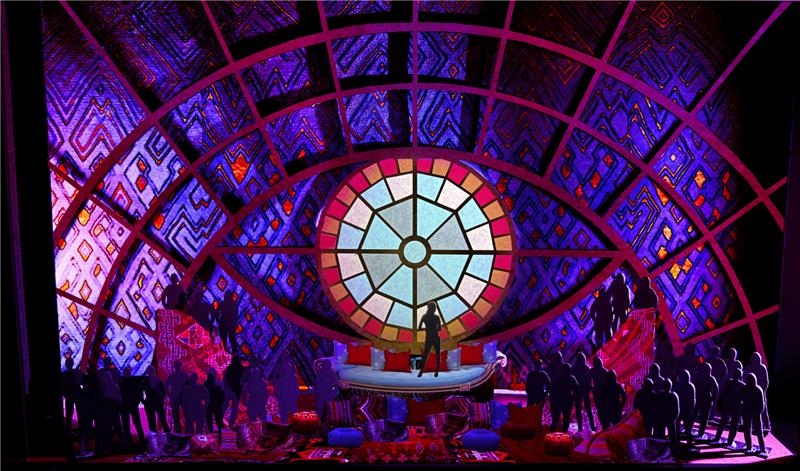
Needless to say, the Egypt of Aida is an imaginary one, set in a past so distant as to be totally unknown, even if it happened to be real. In Kaneza Schaal’s new production for Houston Grand Opera, we will experience an Aida that harkens back to Verdi’s deepest impulses: the oppressive eye of the state watching over the characters, the royal status of the title character, locked in a political struggle, and the profoundly rich colors of all of the Egypts of many artistic imaginations. Aida is an invention, an artistic reimagining of the country as seen through European eyes. Accepting Aida as the profound work of art it is means also accepting what it is not: it is not a documentary or a travelogue. It is an Italian opera.
It was Auguste Mariette, a French Egyptologist in the employ of the Khedive of Egypt, Isma’il Pasha, who suggested the scenario to Verdi, who found the story conventional, but the Egyptian setting compelling. To coincide with the opening of the Suez Canal in 1869, the Khedive was building an opera house which opened with Verdi’s Rigoletto—not quite fulfilling the Khedive’s wish to have a new opera by Verdi set in Egypt, which came with the premiere of Aida two years later, in 1871. The elder composer was slower to work than in his youth. And then in early 1872, Verdi finally heard Aida himself at its first performance at La Scala in Milan. The story of Aida, from the beginning, was a European view, and Keneza’s production will beautifully honor that legacy. This is not a deconstruction of Aida, as has been the more common trend of producing the opera around the world in the last few decades—it is rather a colorful and passionate celebration of Verdi’s opera.