HGO’s Music Library has been Busy Preparing Scores for 72 Arias—Even though Most of Them Won’t Be Heard at Concert of Arias

Last year at the Eleanor McCollum Competition Concert of Arias, the Houston Grand Opera Orchestra—conducted by future HGO Music Director James Gaffigan—took the stage for the first time in the contest’s nearly 40-year history. Up until that point, finalists had only been accompanied by pianists. The introduction of the HGO Orchestra elevated the evening into a grand event.
This year, on February 6, the HGO Orchestra will return to the Cullen Theater for the 38th Annual Concert of Arias, this time led by Patrick Summers in his last season as the company’s artistic and music director (starting next season he’ll become music director emeritus). During the concert, the orchestra will accompany the finalists in two arias each. Depending on the number of finalists—last year there were seven—that comes to around 14 numbers total.
But behind the scenes, HGO’s artistic department has been busy gathering the scores for over five times as many arias. Eighty percent of this music won’t actually be played by the orchestra—or at least, not this year. Why this over-preparation? It has to do with the tight turnaround between the announcement of the finalists and the date of the concert.
This summer, approximately 1,000 applicants uploaded video entries, and 250 of them were offered live auditions in cities across the country. Ultimately, 18 singers were selected and invited to compete in the Houston semifinals, which take place this afternoon (Jan. 30). Each semifinalist comes with four arias—any two of which they might be called on to perform if they’re selected to sing at Concert of Arias a week later, on Feb. 6.
HGO Director of Artistic Operations Joel Goodloe, who oversees the score preparation for Concert of Arias, refers to this Saturday, Jan. 31, as “D-Day.” That’s when the final repertoire is decided and Goodloe’s staff springs into action to distribute parts to the orchestra. With only six days for the players to practice and rehearse—on top of performances of Hansel and Gretel and Silent Night—you can see why it’s worth planning ahead. All 72 potential arias need to be ready to go, even if the overwhelming majority of them will be left unsung.
Score preparation kicked off in mid-November, when the 18 semifinalists were decided (one has since withdrawn due to illness). After each submitted their four arias, Goodloe began to source parts from publishers. “We have a music library in-house to draw upon,” he explains. “But there are some more far-flung selections or newer things that we wouldn’t necessarily have.”
This year, for instance, a contestant requested an excerpt from Massenet’s rarely heard Hérodiade—a retelling of the Salome story in which Salome is (bizarrely) one of the good guys. Patrick Summers admitted it was the only entry on the list he had never conducted.
Goodloe and his colleagues sometimes have to choose between multiple versions of a piece, which might be pitched in different keys or come with passages cut. For Wagner or Strauss operas, which are scored for enormous orchestras, they may seek out a reduced arrangement. Moreover, while standard arias typically exist in standalone concert editions, there are cases when Goodloe has to order parts for an entire opera so that the selection can be extracted.
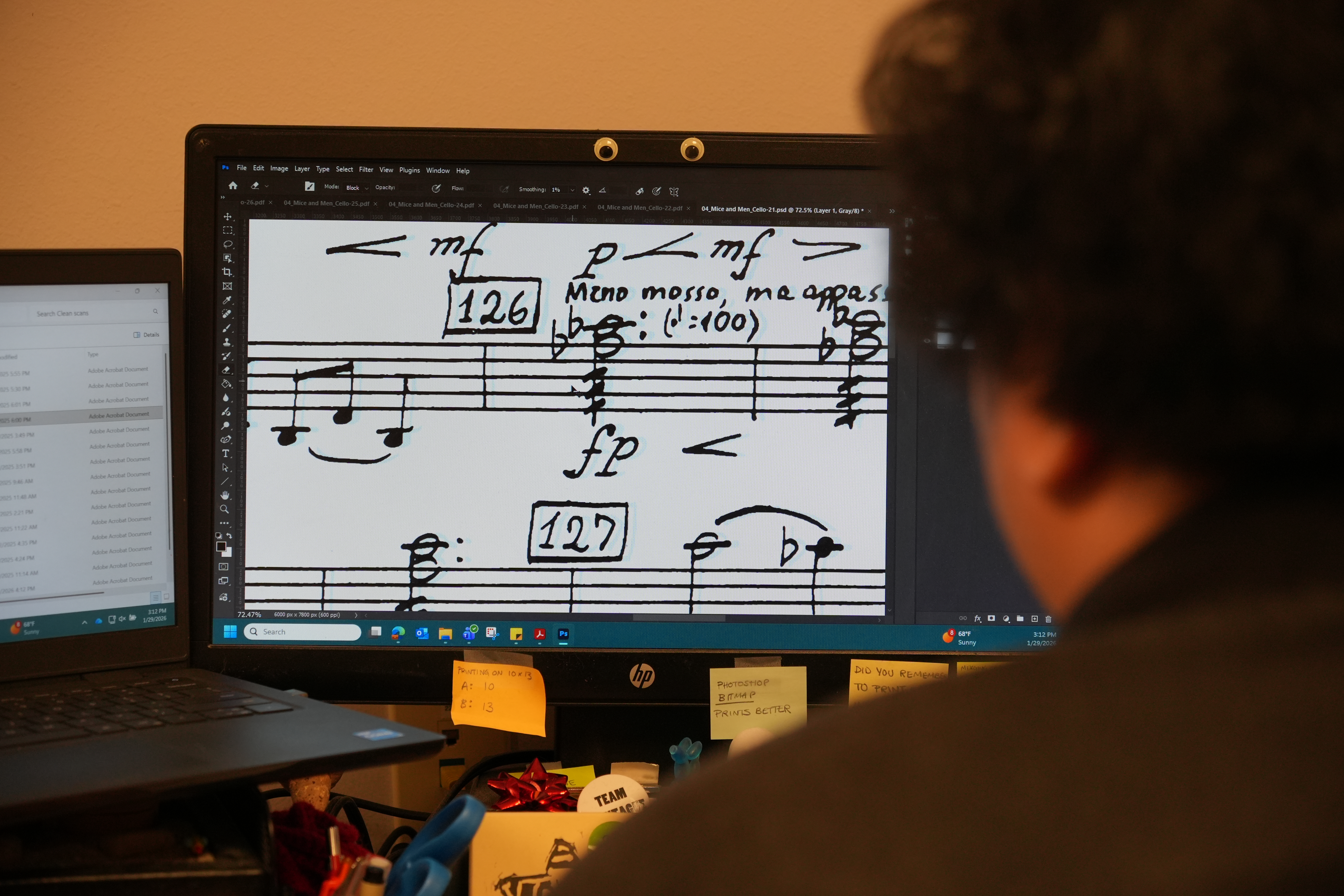
Once the scores arrive, Music Librarian Lucas Nguyen takes over. This year, he has some much-needed help. “For the first time, we hired an extra full-time music-library assistant, Rachel Jacobson,” says Goodloe. She’s been here since December first, basically to start working specifically on this project.” The librarians scan everything—every string, wind, percussion, and keyboard part needed for each of the 72 arias.
Unfortunately, these parts don’t always arrive in pristine condition from the publisher. They might be covered in handwritten notes from a previous renter, or the notation might be illegible in places. “And so, one big thing Lucas and Rachel do is go into Photoshop with the scans to clean things up,” says Goodloe.
The parts are then printed, but they still aren’t completely ready. Cuts may need to be marked. And the string parts require additional treatment. To ensure that the players bow together, special symbols have to be placed above certain pitches—a bottomless rectangle to indicate a downbow and a V-shaped symbol for an upbow.
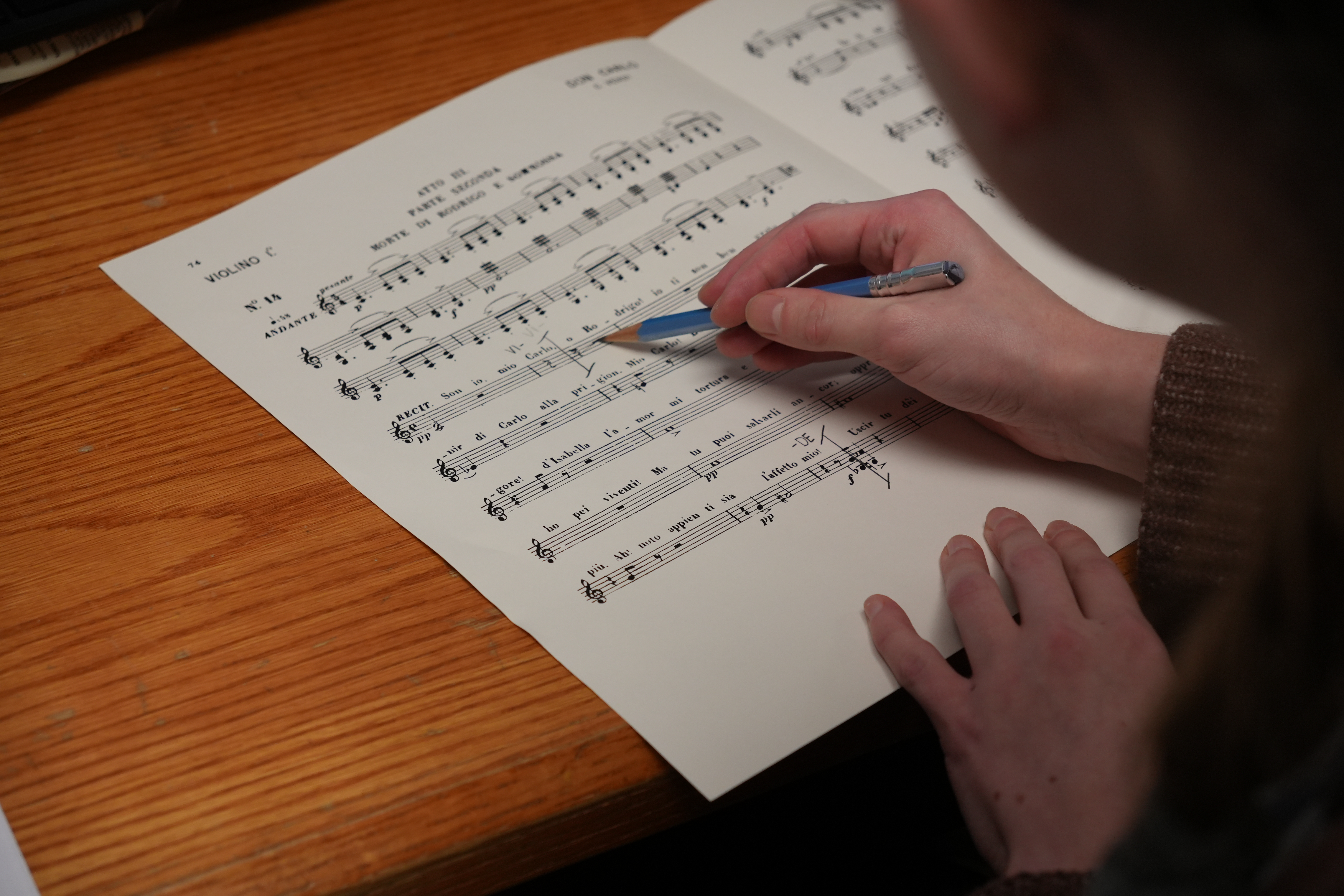
“Often, if HGO has done the opera, we’ll have the bowings already,” says Goodloe. “But again, there are more unusual pieces for which we don’t. There’s a group called the Major Orchestra Librarians’ Association (MOLA). It’s the professional organization of music librarians. There’s a forum on their website, so you can talk to other librarians to source bowings. Or sometimes we reach out to the librarians at other opera companies directly to see what they can share with us. In this case, Lyric Opera of Chicago came through with a lot of help because their digital library is robust and well maintained.”
After the bowings are added, the scores are re-digitized and uploaded to a shared folder that the orchestra members have access to. “They can’t necessarily learn all the music in a day, so they have to look at a lot of things in advance and see what’s unusual. If it’s Bohème and they’ve played it a million times, then it’s fine. But if it's an aria they've never heard of, or something composed in the last several decades, maybe they will check it out to make sure they know what to expect. Players would want to know about prominent solos or extended techniques required.”
But what about all those arias that go by the wayside? While it may seem excessive, the music librarians’ scanning, Photoshopping, printing, and marking isn’t all for naught. As Goodloe explains, “The great thing about doing this multiple years in a row, of course, is that we build a library of aria extracts. When we got our list for this year, I think eight of them were already complete from last year. The vast number were not. But now we have double our library again. In three or four years, we will have a huge amount to pull from. We’ll probably still have to extract some things here and there. But a lot of the golden oldies will be ready to go.”
Whichever of those 72 arias make it to Concert of Arias next Friday, they’re sure to sound glorious in the hands of Patrick Summers and the HGO Orchestra—not to mention the international assembly of young finalists that are being chosen today. Which of them will take first place and a prize of $25,000? Purchase your tickets now to be there when the winners are announced, or watch online. Either way, you’re invited to vote for your favorite singer for the Audience Choice Award. But don’t dilly-dally—there are fewer than 50 seats left, beginning at just $30.