David Maloney’s Psychedelic Program Covers for HGO’s 1971-72 Season

Throughout the 1950s and ’60s, Houston Grand Opera’s program books featured rather generic covers—typically, just the title of the opera accompanied by a black-and-white image of Jones Hall, where HGO performed until the opening of the Wortham Center 1987. That all changed in the 1970s, when the programs suddenly burst into vivid color, like the famous scene in The Wizard of Oz.
In 1971, the program was expanded into full-scale publication titled Opera (unrelated to the British magazine of the same name). As part of this rebranding, HGO began commissioning original artwork to adorn the covers. Over the next two decades, dozens of artists brought their unique visions to the season repertoire. The covers of the 1970s and ’80s featured a huge range of styles—everything from geometric designs to surrealist dreamscapes to storybook-style illustrations.
Some of the most imaginative contributions came from the first artist HGO hired, illustrator David Maloney. Much like Nestor Topchy, who created a suite of paintings for the company’s 2025-26 season, Maloney illustrated all five mainstage operas in the 1971-72 season. Maloney’s Opera art is clearly indebted to the psychedelic era, calling to mind the work of Peter Max and the animation of the Beatles’ Yellow Submarine.
An art director for an ad agency, Maloney brought a bright and bold style reminiscent of pop art or comic books. His restricted color palette—limited mostly to yellow, blue, and green—helped to visually unite all five covers into an integrated set. “Someone else, I guess, might have chosen to use an older style,” Maloney said in an Opera interview,” [But] I feel that opera as an art form should be seen through contemporary eyes.”
Maloney remained involved with HGO during the next two seasons, creating new covers for the 1972-73 and 1973-74 programs and selecting other cover artists to contribute their talents—including his wife, Carrie Hines Maloney. Read on for more about Maloney’s concepts for his groovy designs, which put a psychedelic spin on classic operas.
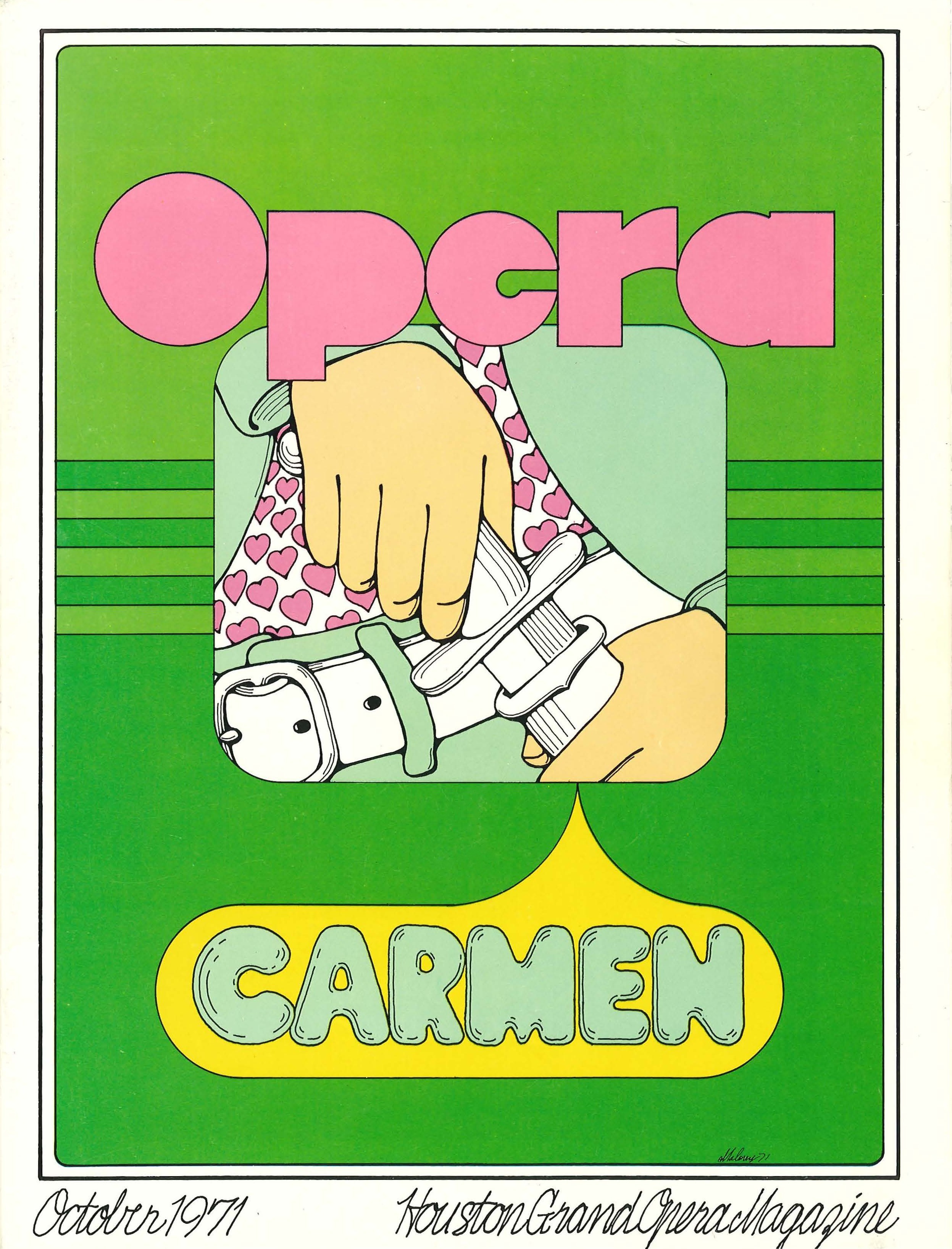
At the climax of Bizet’s opera, the titular Roma woman is cornered by her jealous ex-lover Don José outside a bull-fighting arena. “I tried to find critical times in the opera to represent,” explains Maloney. “The moment, the exact instant before [Carmen’s] death as Don José reaches for his knife, would be that time.”
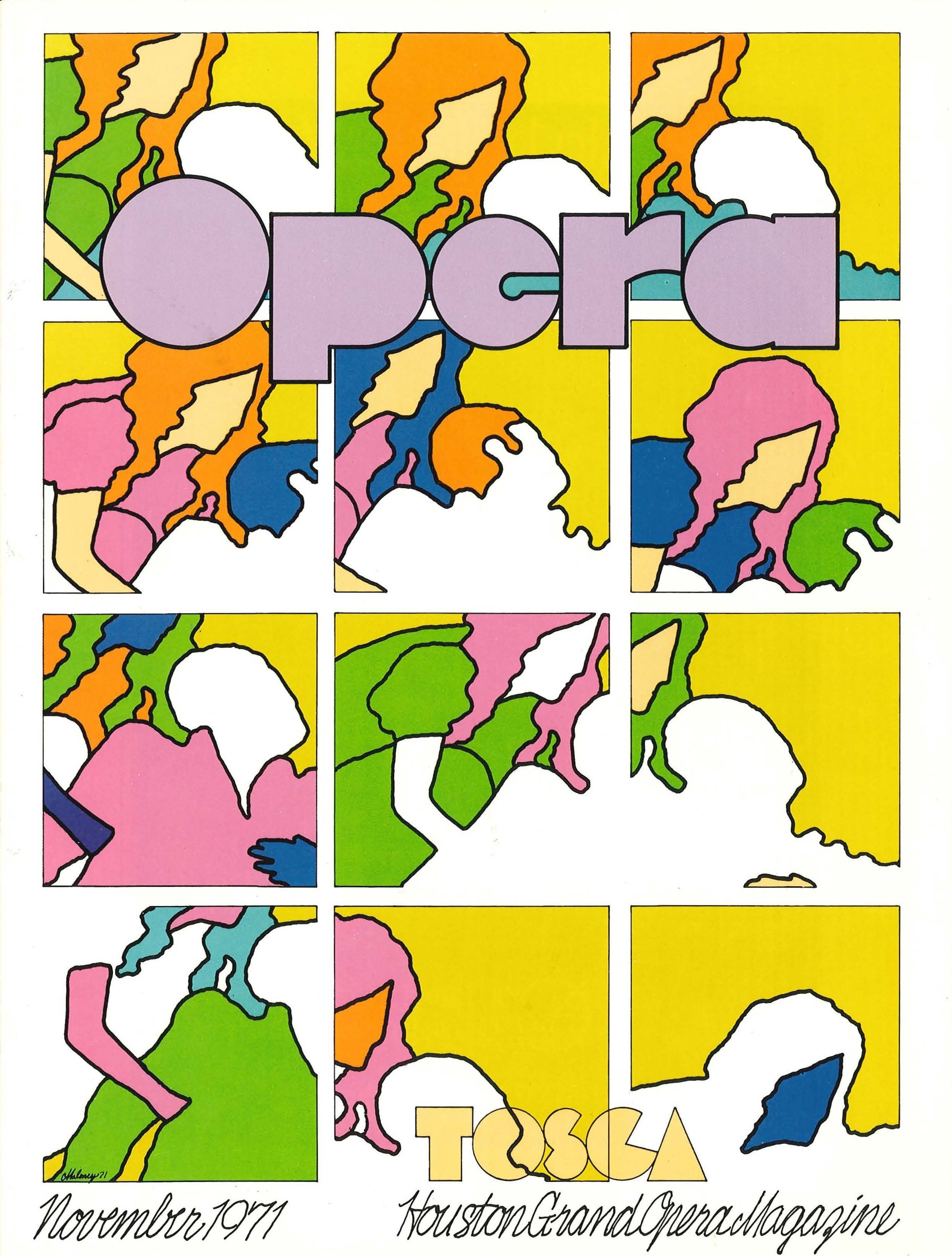
In Puccini’s opera, Tosca’s lover Mario is sentenced to death by firing squad. However, Tosca is led to believe that the executioners will be firing blanks. To her horror, she discovers that their guns were loaded. “The realization that Mario is actually dead is the most chilling, emotional moment of the entire opera for me,” says Maloney. “I used this in a film strip idea to visually slow down the steps of Tosca’s realization.” The artist evokes Tosca’s shift in emotions with Warhol-like changes in color to her hair, skin, and dress.
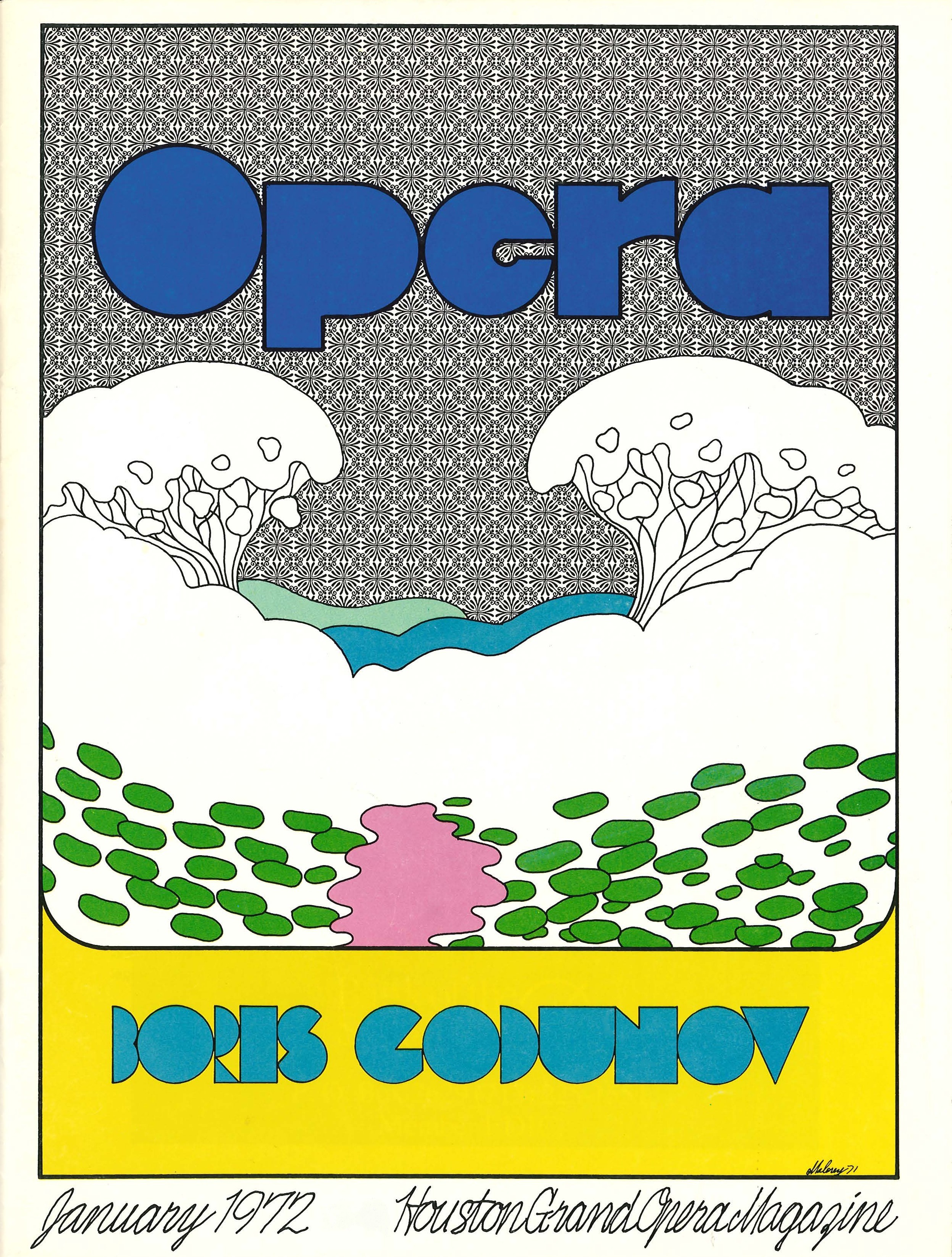
The titular tsar of Mussorgsky’s opera rises to power after he orders the murder of the tsarevich—the 8-year-old son of Ivan the Terrible, who was next in line to become tsar. “Even though that happened before the opera opens, it’s the reason for the opera,” says Maloney. “The whole idea of Boris Godunov is, I feel, the guilt and death. So I showed that.” Maloney’s cover depicts the aftermath of the murder—a snowy landscape dotted with the assassins’ footprints, and in the center, a pool of the tsarevich’s blood.
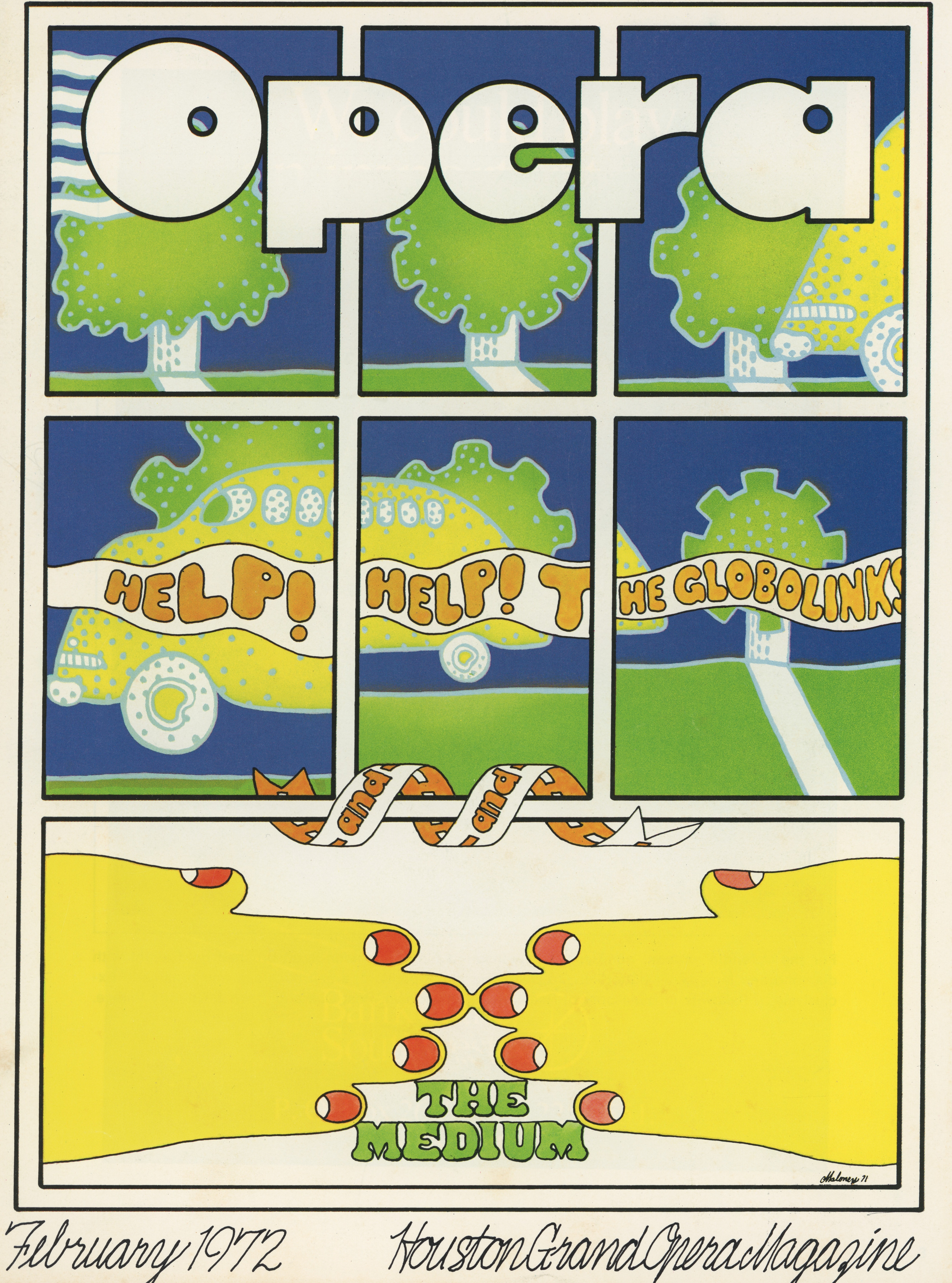
This double-bill opened with Gian Carlo Menotti’s Help, Help, the Globolinks! It’s a children’s sci-fi opera about an invasion of aliens who are allergic to music. Instead of depicting these extraterrestrial beings, Maloney illustrates the bus that breaks down in the opera, endangering a group of schoolchildren. As he explains, “For The Globolinks, the animated bus idea was a good was a good way to capture the fun and keep the art relative to the tone of the opera.”
The pair of hands on the portion of the cover representing Menotti’s The Medium are purposefully cryptic. “The opera is so mysterious,” says Maloney. “Even at the end of the opera there is still a mystery. So I used a sort of blank graphic style for that.” The illustration might depict the participants of the Act I séance joining their hands together. Or it might show the ghostly hands that the medium Baba feels at her throat.
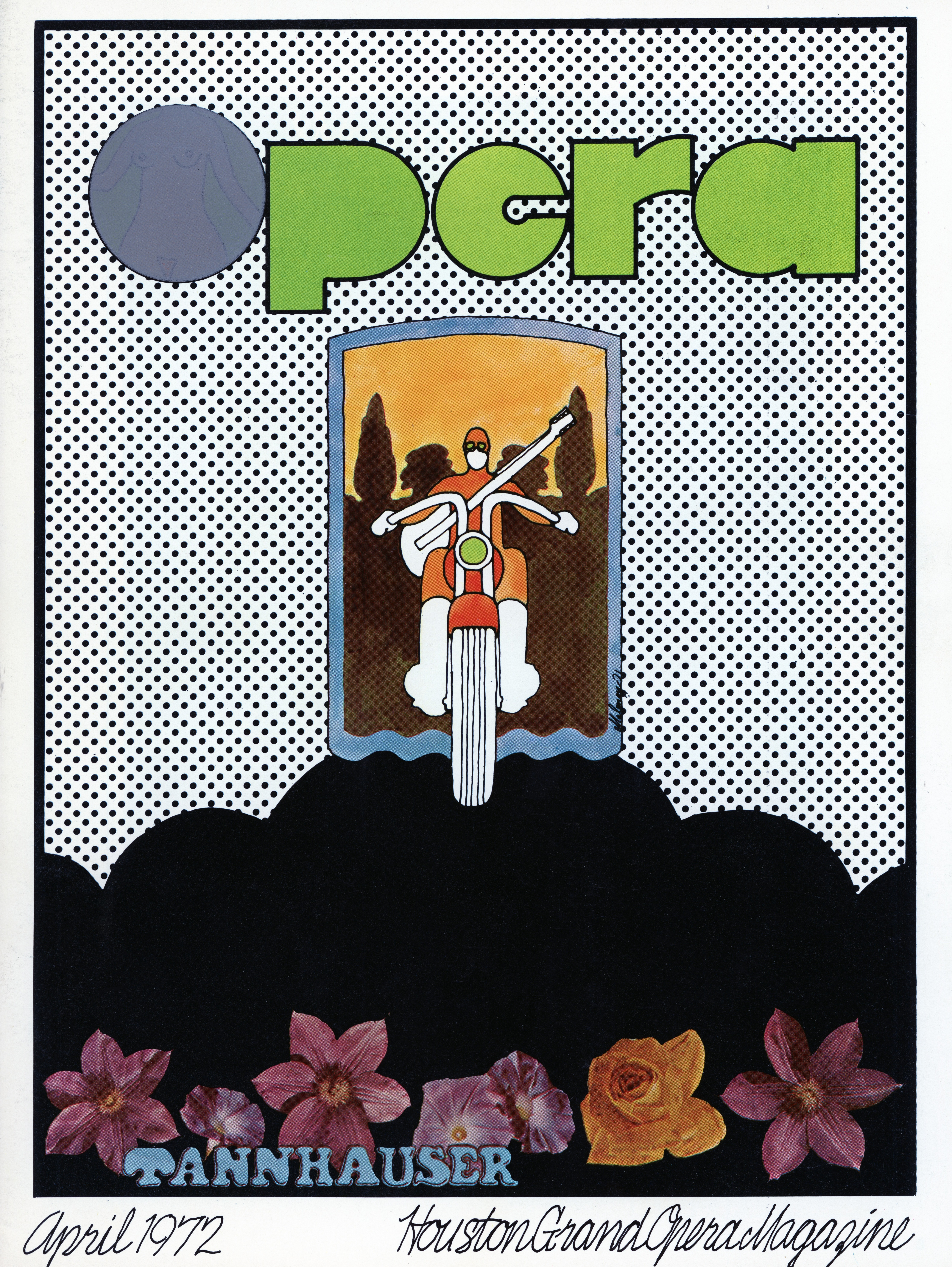
Maloney’s psychedelic design reimagines the titular minstrel of Wagner’s medieval epic as a rock star astride a motorcycle, his harp traded in for an electric guitar. “Much of Tannhäuser is highly relevant today, particularly in regards to the romanticism of the youth,” says Maloney. “So my design is aimed at capturing that.” The blossoms at the bottom are a nod to the flower-power movement of the 1960s and ’70s, while the sexual revolution is evoked in the naked torso of Venus hidden in the “O” of Opera.