An Inner Light
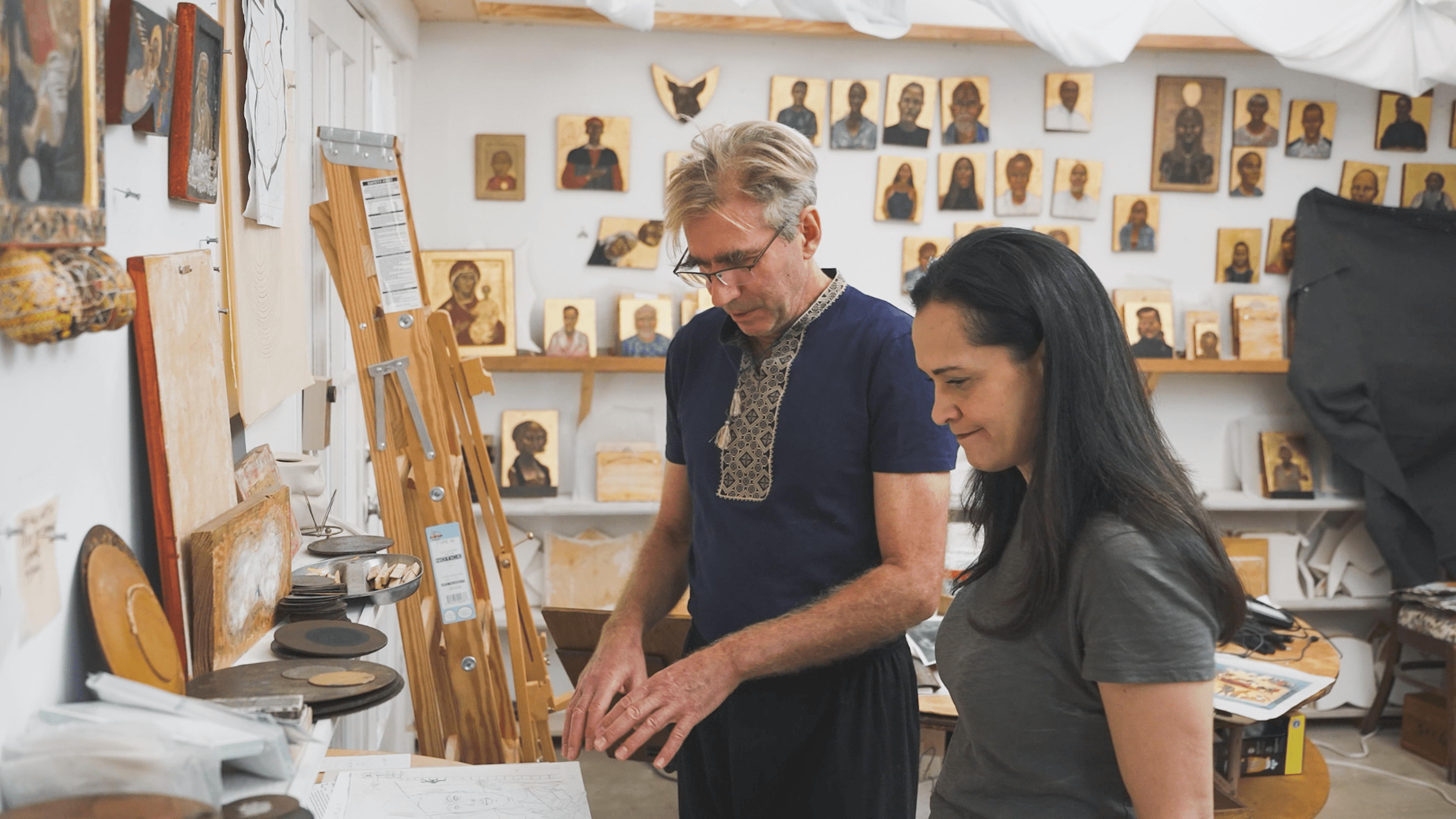
Tucked away in the Houston Heights is a strange little utopia that resembles some kind of scrap-metal monastery. This is the compound of painter and sculptor Nestor Topchy. He deals in a variety of mediums—everything from dyed eggs to welded orbs. One might argue that his greatest creation is the property itself, which comprises a complex of whimsical buildings he constructed out of recycled materials.
But Topchy is best known for his gilded portraits, which draw on traditions of Eastern Orthodox iconography. Houston Grand Opera commissioned a series of seven original paintings by Topchy in this style to be featured as artwork for the company’s 2025-26 season.
Topchy doesn’t consider his paintings to be icons. While some of them depict religious figures, most are representations of average people. But because they’re created using the same methods and materials as Orthodox icons, he refers to them as “iconic portraits.”
HGO General Director and CEO Khori Dastoor and Artistic and Music Director Patrick Summers first encountered Topchy’s work at the Menil Collection in 2024. “Patrick and I both had the same thought after visiting Nestor’s solo show,” recalls Dastoor. “We knew we wanted him to create a body of work that captures the spirit and emotion of the incredible operas we’ll be staging for our city.
“The resulting suite of paintings is stunning,” adds Dastoor, “a wonderful reflection of the great art to come on the Wortham stage, made by and for Houstonians.”
Topchy’s art is rooted in his Ukrainian heritage. His father’s family hailed from Korsun, a city southeast of Kyiv. After fleeing both the Soviets and the Nazis during World War II, Topchy's father settled with his new wife in New Jersey. The couple gave birth to Nestor in 1963 and raised him in the Orthodox faith. At the family’s church, Topchy first saw icons assembled on a wall known as an “iconostasis.”
Icons flourished as an art form in the Byzantine Empire and spread with Christianity to Slavic regions near the end of the first millennium. In both Old Greek and Old Russian, the verb for “to write” was identical to the word for “to paint.” For this reason, even in English, icons are often said to be “written”—a reflection of their original function as tools for religious instruction. “In the early days, it was the priests that were literate, and the masses looked at icons and saw a story on the iconostasis,” explains Topchy.
In 2004, Topchy studied with master icon artist Vladislav Andrejev, who introduced him to the aesthetic, technical, and deep theological symbolism of icon-writing. “The process is probably the same since about 700 A.D., or even longer,” says Topchy.
An iconic painting begins as a wooden board stretched with canvas, to which Topchy applies a glue known as “gesso.” He then carves an outline of the portrait into the bone-like surface of the hardened gesso. The background is covered in a clay called “bole,” which serves as a backing for the layer of gold leaf.
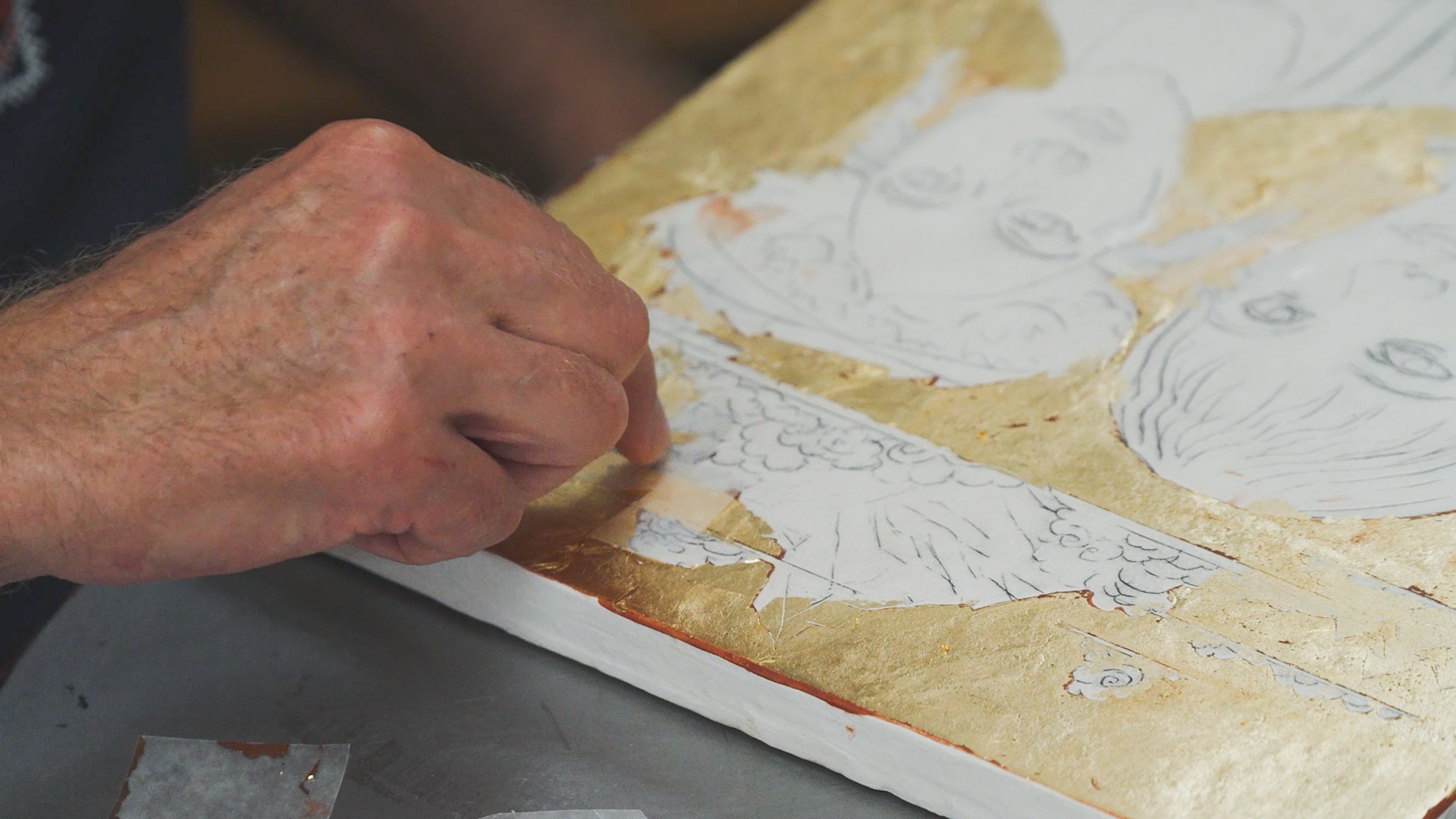
“Only after the gold leaf is attached does the painting begin, with at least seven layers of egg tempera”—i.e., paint made from mixing egg whites with powdered pigments. The figures are represented in a flat, geometrical manner. Rather than linear perspective, Topchy’s portraits exhibit what he calls “hierarchical perspective”: “What’s important is larger, but if something is of secondary importance, we make it a little bit smaller.”
To make the works his own, Topchy deviates from convention by incorporating aspects of other religious iconography, especially Buddhist imagery. He possesses an intense curiosity for East Asian art and philosophy.
In exploring these cultures, Topchy seeks out what Carl Jung dubbed “archetypes”—basic symbols and stories that can be found in every human society and unite us as a species.
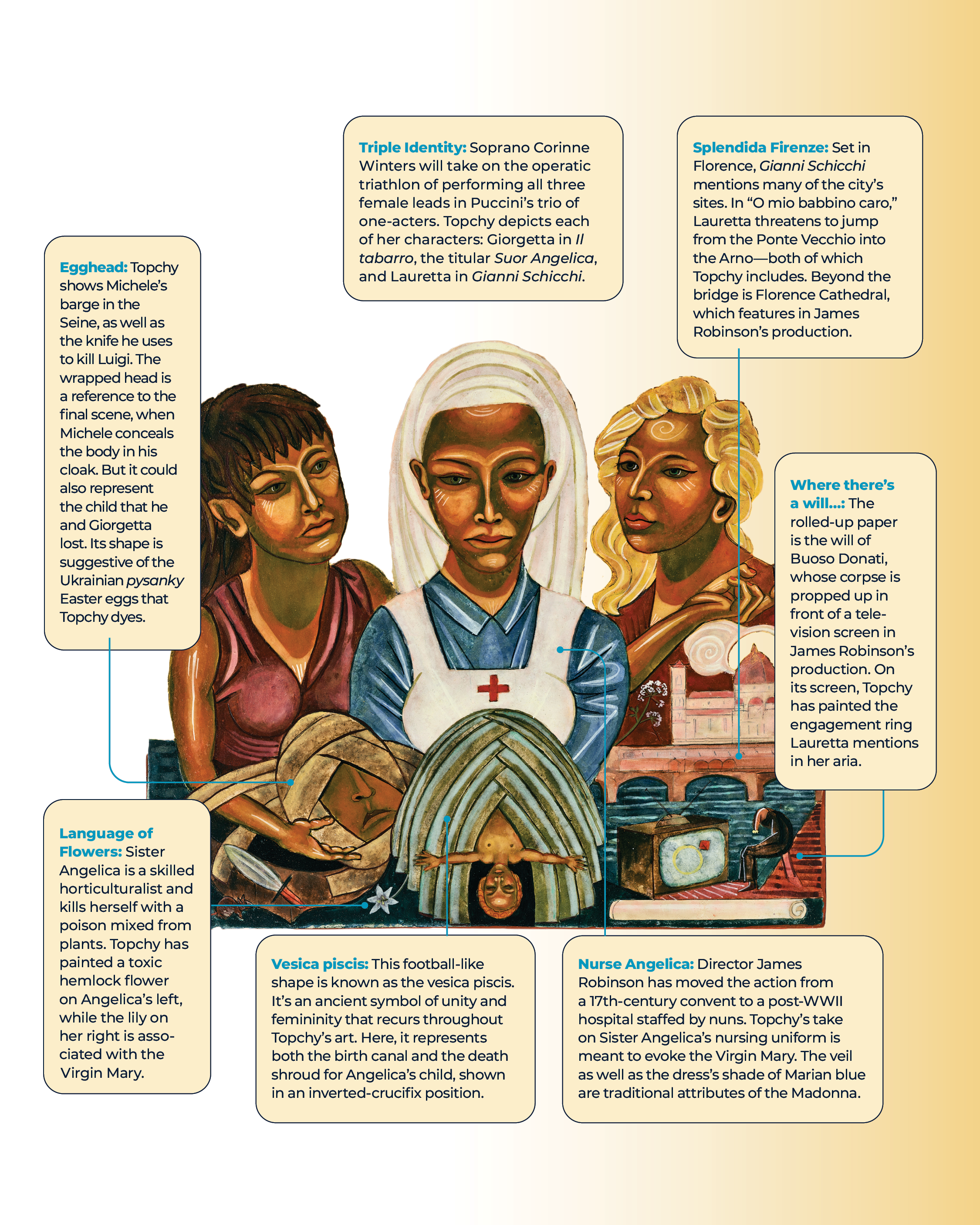
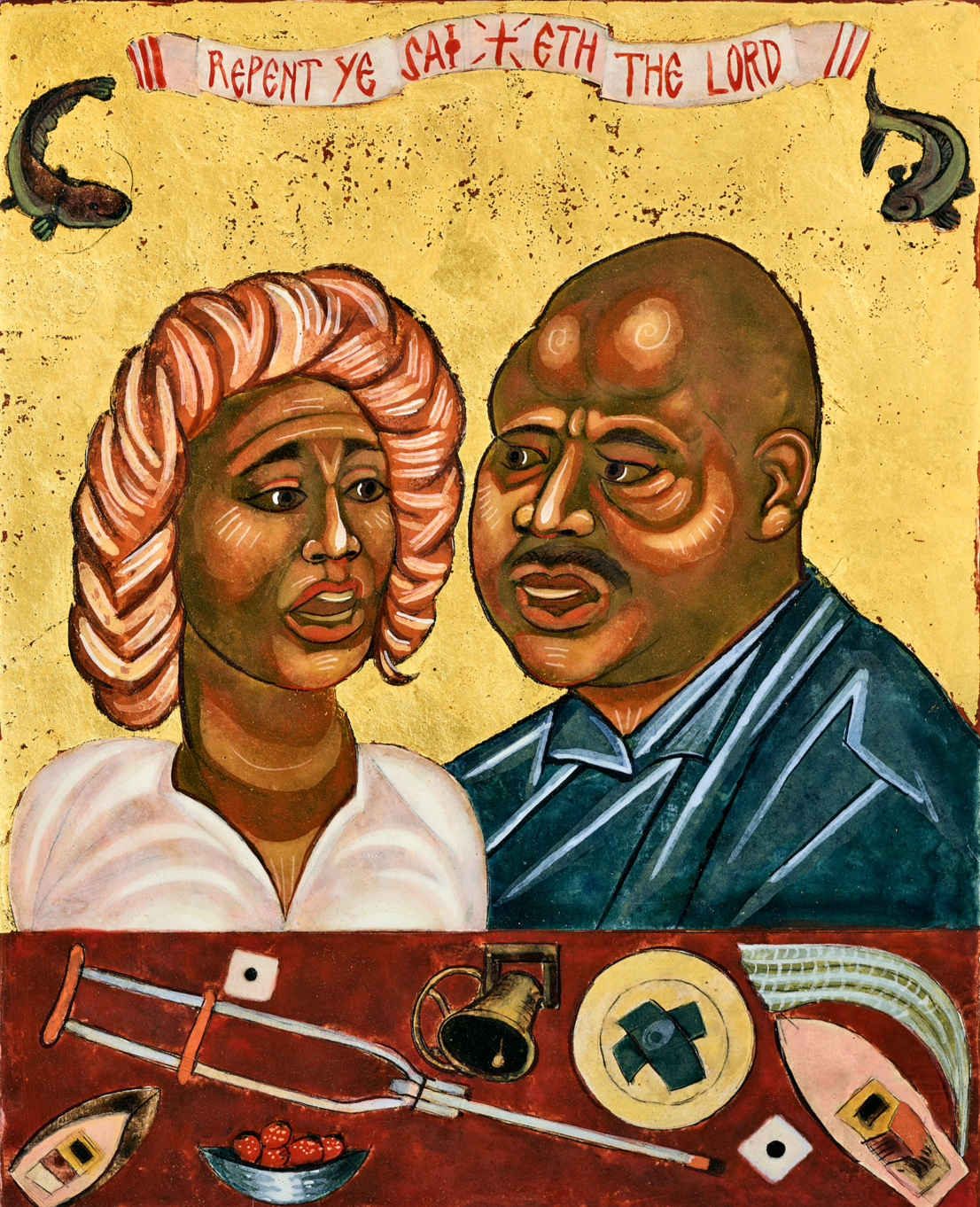
Such archetypes served as a starting point for Topchy’s HGO artwork. Each of the seven paintings portrays characters from the season repertoire, most modeled after the singers who will play the roles. Topchy surrounded these figures with props and scenic elements from the operas, carefully selecting emblems with universal meanings.
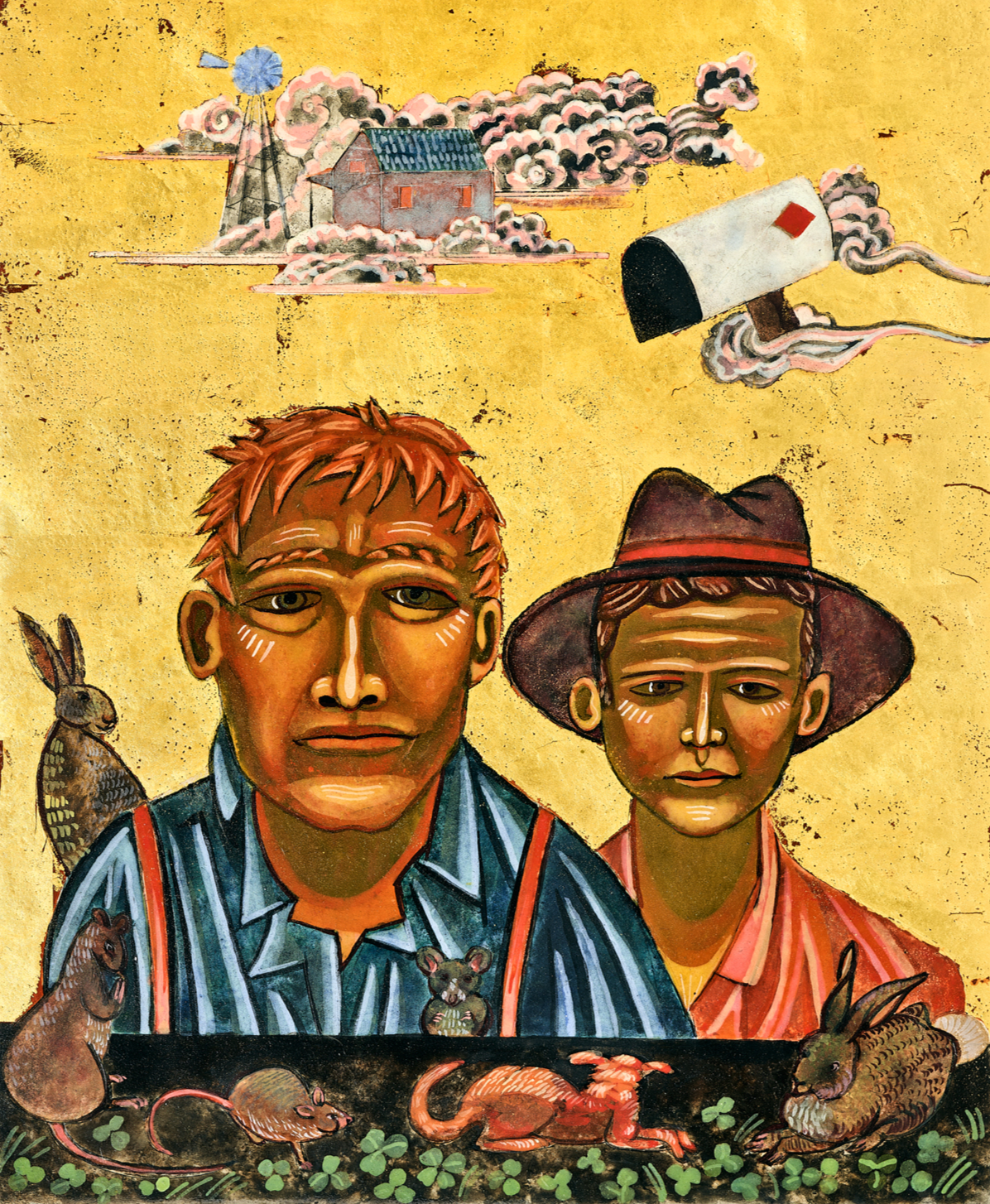
For instance, the pair of dice on the poster for the Gershwins’ Porgy and Bess has landed on snake eyes—a reference to serpents as the embodiment of evil. For Carlisle Floyd’s Of Mice and Men, Lennie and George’s dream farm rises behind them like Shangri-La. Topchy envelops the property with the kind of curlicued clouds found in Tibetan art. But the tomb-like mailbox angled toward Lennie foreshadows his fate.
 |
 |
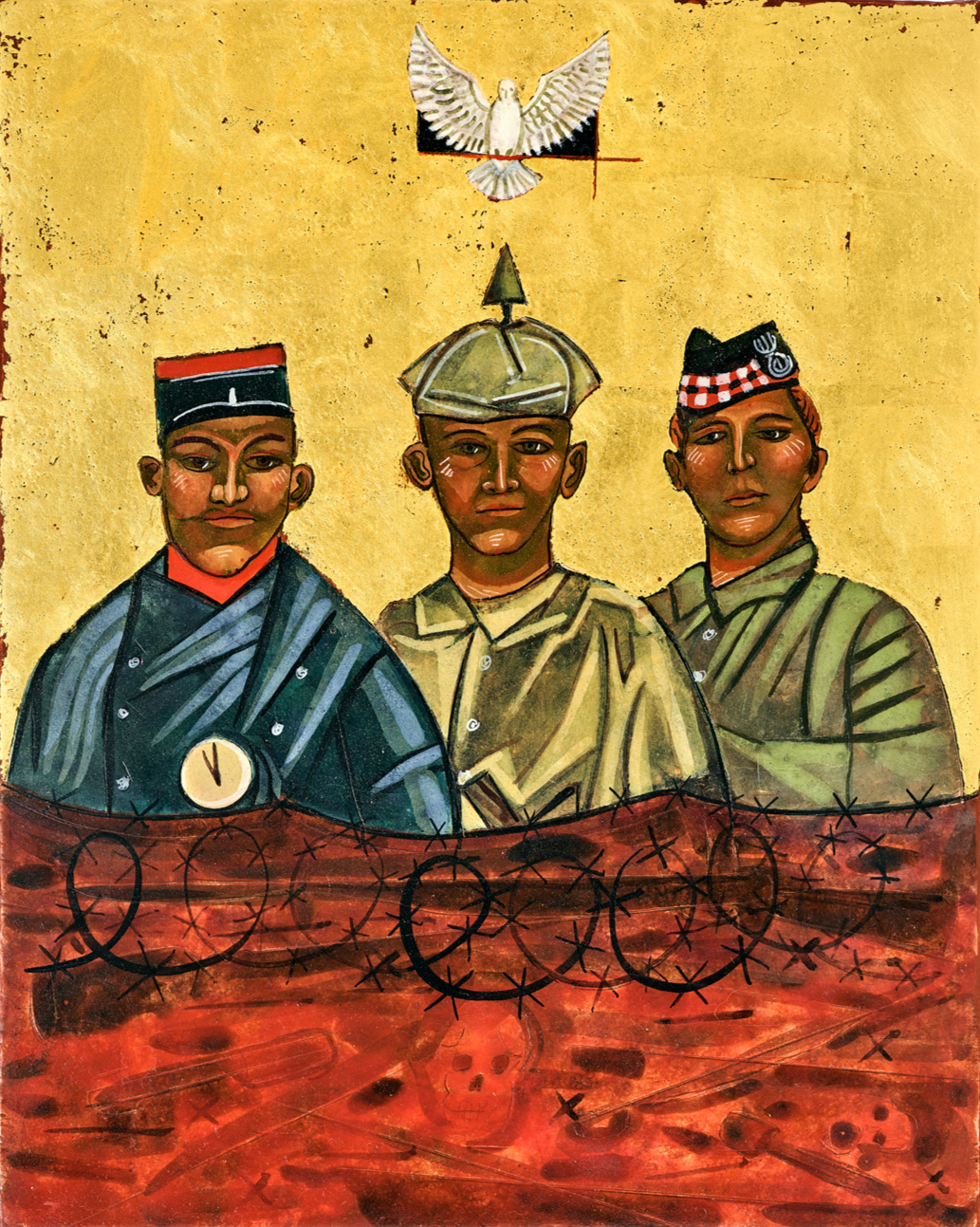
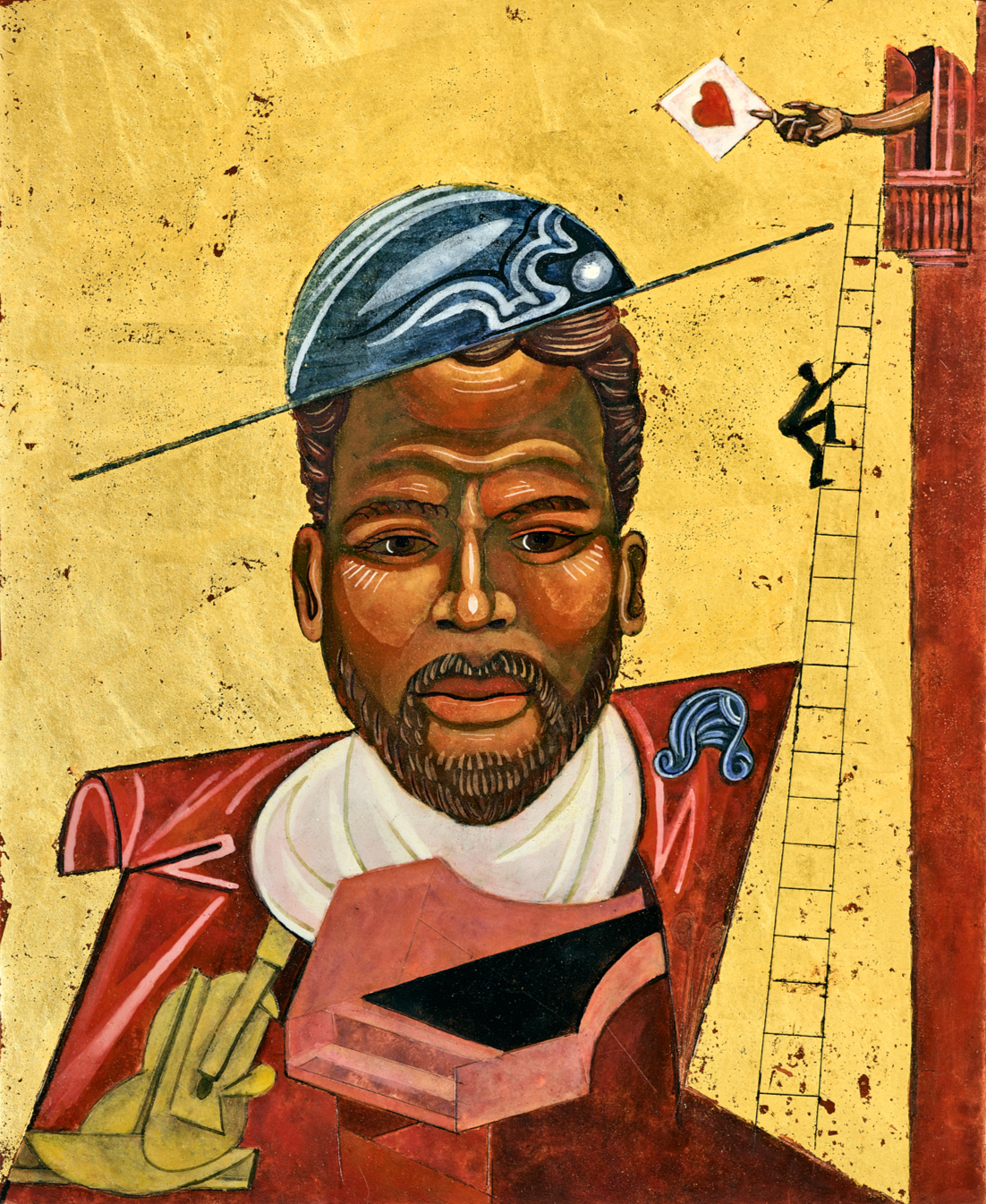
Very often, Topchy incorporates symbols that intersect with those found in Orthodox icons. In his poster for Kevin Puts and Mark Campbell’s Silent Night, peace is symbolized by a dove that resembles iconic depictions of the Holy Spirit. For Rossini’s The Barber of Seville, Topchy paints Almaviva climbing a ladder. Likewise, a favorite subject for icon-writers is Jacob’s dream of angels ascending a ladder to heaven.
 |
 |
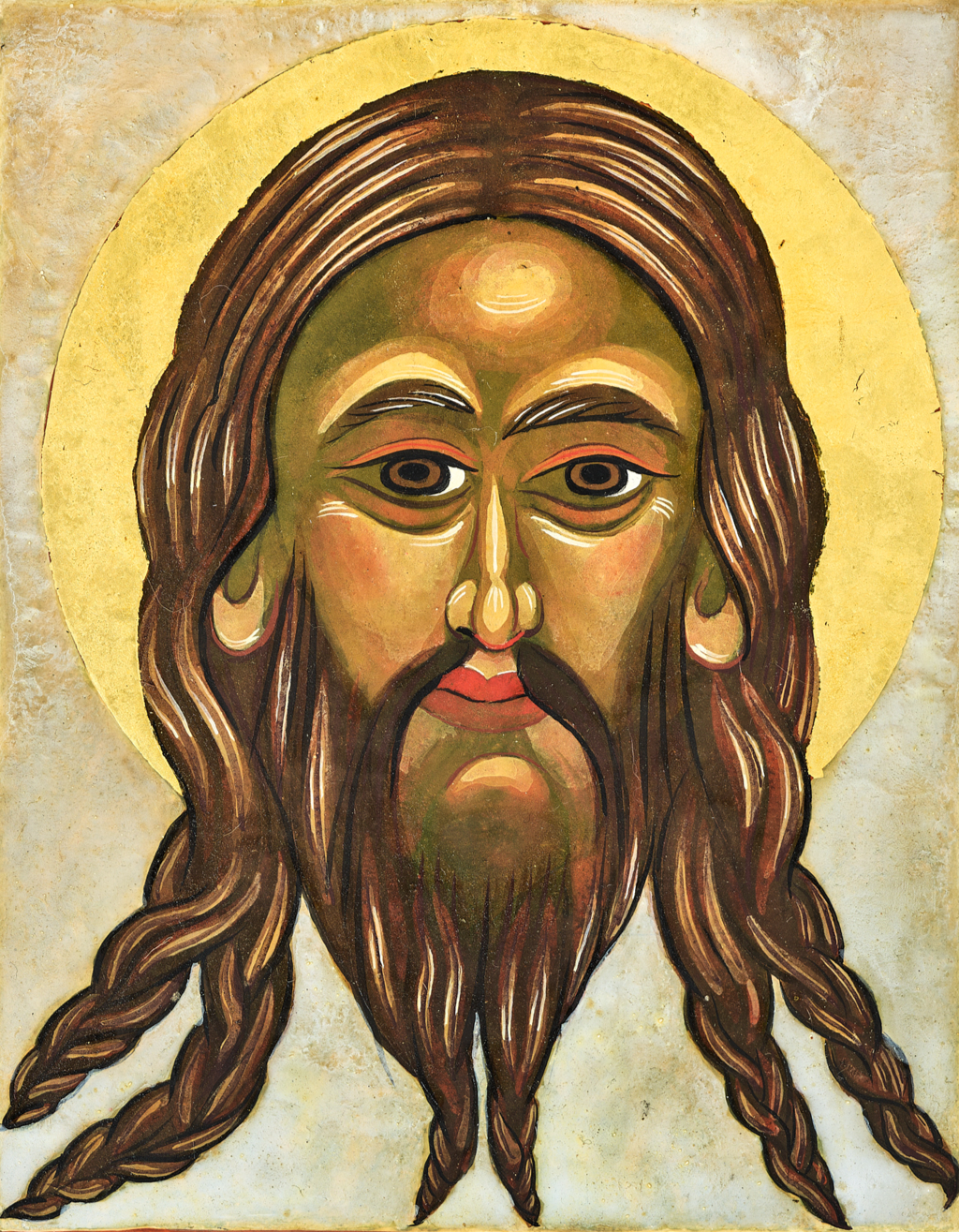
For Handel’s Messiah, Topchy used an image of Christ he had painted previously. It’s inspired by acheiropoieta—miraculous icons that, according to tradition, aren’t painted by human hands. However, Topchy puts his own twist on Jesus’s likeness. The eyes, which belong to the Buddha, are copied from a stupa Topchy saw during a pilgrimage to Nepal.
As in Orthodox icons that illustrate biblical episodes, Topchy’s artworks have a narrative dimension. “Operas, just like fairy tales, are personifications of archetypal wisdom which could help us learn from the lives of others through tragic stories,” he observes. Each of his paintings is a “portrait of phenomena that tell a story—putting a visual reality in just one moment.”
 |
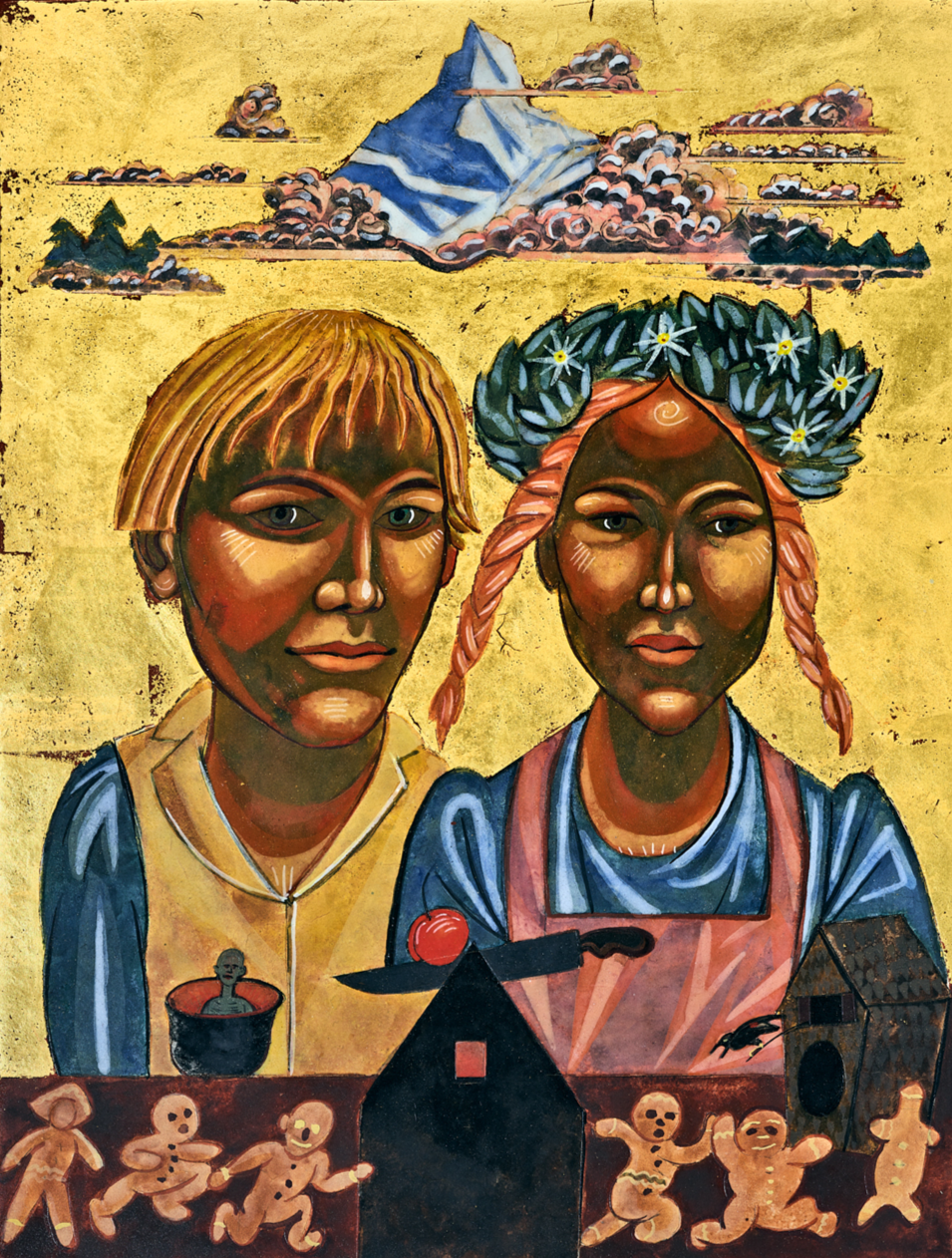 |
One could imagine an audience member using Topchy’s poster for Humperdinck’s Hansel and Gretel to tell the plot to a child, in the same way that an Orthodox priest would have interpreted an icon’s message for a congregant. All the essentials of director Antony McDonald’s production are there: the Witch’s house, the vat of chocolate she’s pushed into, and the gingerbread children that Hansel and Gretel free.
But these literal objects are only the surface of Topchy’s paintings. What sets his portraiture apart is his ability to convey the unseeable—to use humble materials and age-old methods to capture the divinity at the core of every person. In fact, the process of preparing the canvas is meant to evoke God’s creation of Man: “You breathe the life into the clay, and then the spirit comes—that’s the gold leaf that sticks to it.”
This shimmering gilt aura seems to emanate from the subjects themselves. In Topchy’s iconic portraits, we get the sense that the stylized faces are only masks concealing the true essence of a person’s being. “I’m not trying to provide a naturalistic depiction,” Topchy explains. “I’m looking for an inner light.”