We Shall Be Changed

Before the overture to Messiah begins, we are in an otherworldly vaulted space of horizon ratios created by clean strips of light, light so beautiful that you could, to paraphrase Shakespeare’s Juliet, “cut it out in little stars” and take it home. Are we on Earth, or on some other temporal plane?
Handel’s music, orchestrated by Mozart, begins. We are brought into the elemental stuff of life: air, water, ice, fire. Through the duration of the work, we experience slowly-morphing images of decay—the skeleton of a great fish, a suspended nugget of gold, tree trunks mysteriously floating through an invisible river—and other elements in transition: icebergs melting or water evaporating.
There is enormous liberation in sometimes letting go of realism. A Robert Wilson production is like trying to crack a code, and the moment you think you’ve got it, the code changes. Think of his productions not as distractions, but abstractions. The less you interpret and the more you just feel, the deeper your experience.
This production of Messiah, which Bob created for Mozart’s birthplace in Salzburg, is the last of my long tenure as Artistic and Music Director of HGO, and it was supposed to be an opportunity for Bob and I to work closely together on this work we both so love. Since he unexpectedly died last summer, it now becomes, in part, a celebration of the long and multifaceted creative life of this famous Texan.
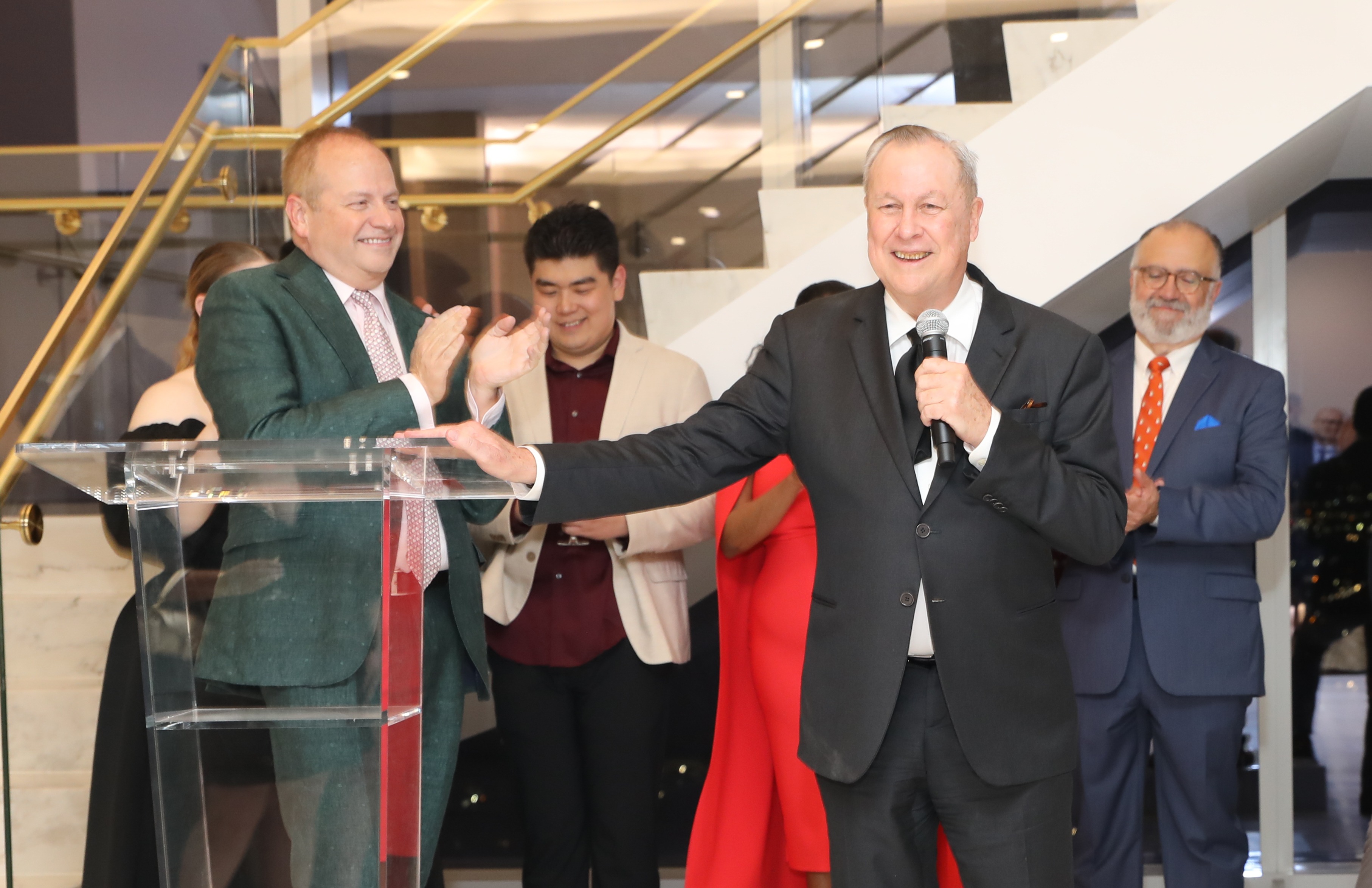
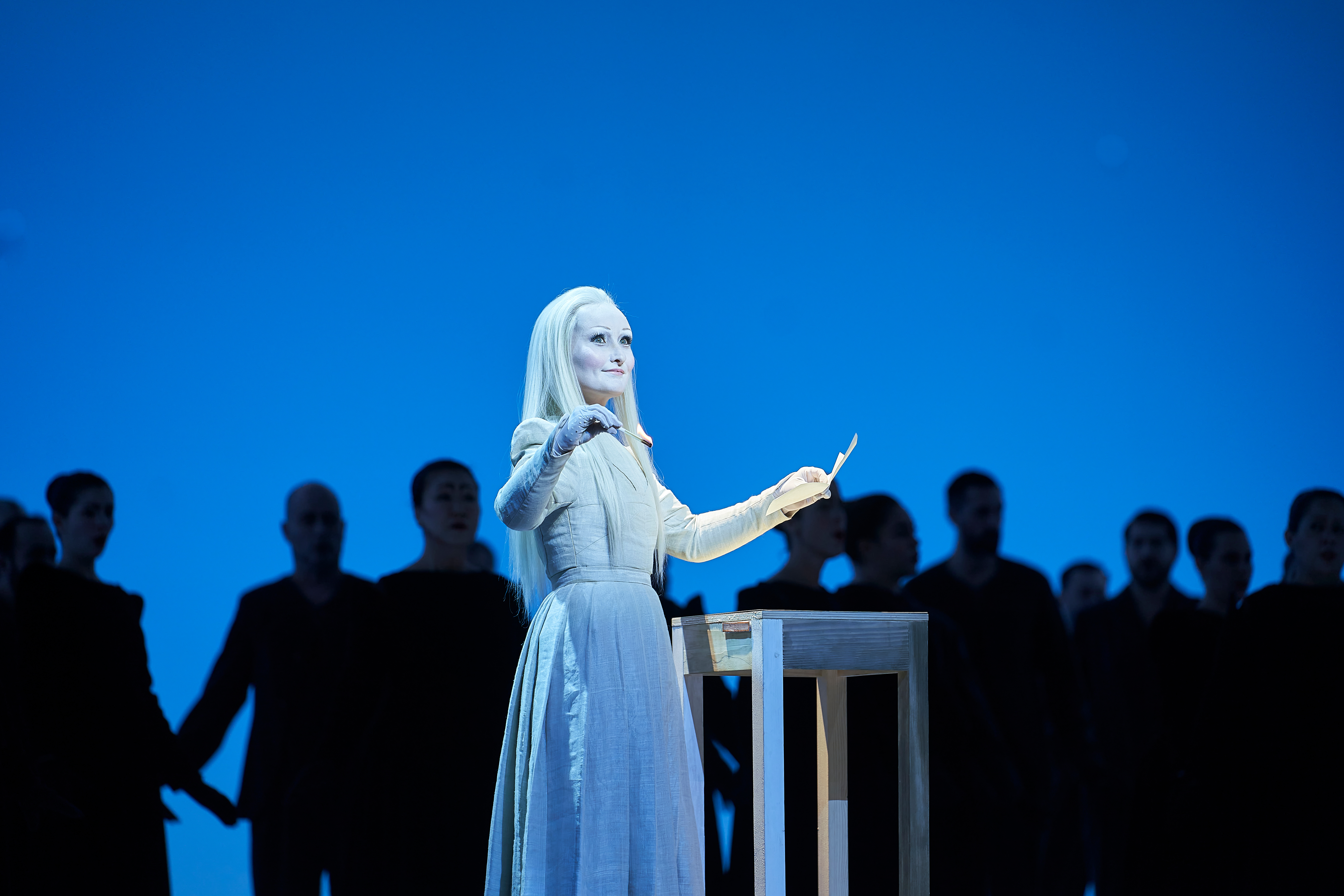
Robert Wilson’s production of Messiah will be controversial. It will both thrill and baffle; it may possibly even offend some who find abstraction irritating. But Messiah, on the page, is a transcendent work of musical art with no narrative; it does not even have named characters. So, too, is Wilson’s production of it—he theatricalizes Messiah as a magnificently strange work of art, a dreamscape constantly in motion, giddy and complex. The production employs no religious imagery at all, yet it is a profoundly spiritual experience, ranging from joyful to meditative to whimsical.
Performances of Handel’s Messiah each holiday season are always a thrill, but its familiarity risks diminishment of what a monumental and rich work it is. Engaging deeply with Messiah begins with what it is not: conceived as a type of declamatory theater, it was not intended for church services. It presents a series of abstract meditations based on arranged readings from the King James Bible, but nothing in it, artistically, is literal. Handel faced criticism around the time of Messiah’s London premiere for presenting Biblical text in the secular space of a theater.
The three parts of Messiah define birth, death, and resurrection. The title character of Jesus Christ is constantly sung about but mentioned by name only once. He is never depicted as a character, but is symbolically present even in absence. “Part the First,” as Handel titled it, is all prediction, a set of announcements of the arrival of an unnamed Messiah. The second section is about iniquity—our collective responsibility for the death of the man at the hands of mankind. The final act is a long, prayerful meditation on possible events in the future.
Throughout its early history, Messiah was most often an Easter staple. In the last century, it has become more of a Christmastime tradition, up there with the secular Tchaikovsky ballet The Nutcracker in the United States. Parts of Messiah were heard and enjoyed by the first President of the United States, George Washington, in Boston in 1789, the very year Mozart arranged his version of the work. Messiah is woven through Western history as very few works of musical art have been. Its stirring music is of incredible vocal difficulty. The choruses are nearly impossible for amateur choruses to effectively execute, but that has simply made Messiah a beloved Mount Everest for choruses all over the world. Because it is there and is loved, one must climb it.
Mozart was highly schooled in the music of Bach and Handel, most especially in the writing of fugues—then, a much more foundational skill than it is amongst most composers today. Mozart’s major musical influence besides his own father was Johann Christian Bach, the youngest surviving son of the more famous Johann Sebastian. J.C. Bach was known as the “London” Bach, even taking an English name, John Bach, upon his arrival in the British capital in the 1760s—just a bit too late to have met the titanic Handel, who died in 1759, but not too late to have been highly affected by the London operatic life that Handel had dominated for a generation. Mozart became a supreme composer of operas because of his exposure to J.C. Bach and the Bach/Handel tradition he so admired. His arrangement of Messiah is his homage to all of them.
The work of very few people in theater's history has had such a legendary effect as that of Robert Wilson.
Mozart’s Messiah is a complete re-orchestration of Handel’s oratorio for double winds: pairs of flutes, oboes, clarinets, bassoons, horns, and trumpets, and three trombones. Handel never heard a modern clarinet, as the instrument was invented after his lifetime. Handel’s orchestration, standard for his era, would have a wind contingent of only two oboes, each doubling a violin part, and a single bassoon playing parts of the bass line. Handel composed a famous solo trumpet for the work’s penultimate aria, “The trumpet shall sound,” which Mozart moves to the French horn. Handel did not score Messiah for trombones, so Mozart’s addition of them gives a fuller, richer feeling to the whole work. Mozart filled his version of Messiah with unexpected musical delights, especially in his busy and bubbly wind parts that dart around the air joyously.
The work of very few people in theater’s history has had such a legendary effect as that of Robert Wilson, whose career will be studied for generations. He was both controversial and meaningful: those who experienced his intensely abstract versions of Parsifal or Lohengrin heard something new in Wagner’s time-altering philosophical and musical worlds, and those productions became unforgettable moments in an opera-goer’s life. Think of the Watermill Center, Wilson’s creative think-tank and artistic home in eastern Long Island, the place where he chose to accept the death he was told was imminent in the summer of 2025. Think of his multi-part, seven-day theatrical work from 1972, KA MOUNTAIN AND GUARDenia TERRACE, which was presented on an Iranian mountaintop and featured one play, Jail, about his experience being jailed for possession of hashish in Crete (he was out on bail at the time). Think of his play, Letter for Queen Victoria, which transferred to Broadway in 1975 after touring for a year and became one of the most famous of all theatrical disasters, an infamy Bob greatly enjoyed.
Think of the opera he wrote with Philip Glass, Einstein on the Beach, one of the iconic events in the history of the art form. The audiences for it at the (rented) Metropolitan Opera House in the 1970s were famously small, though you would never know that now, considering how many people claim to have been there. Like Messiah, Einstein on the Beach has no traditional narrative, and is also a series of thoughtful meditations of indeterminate length.
Wilson and Glass chose Albert Einstein as the title character precisely because he was a figure who could be freely associated with rather than explained. Everyone has an idea of Einstein, yet those ideas are all projections onto him, which explains Bob’s theatrical aims completely. What he did over the course of his career was reject the idea that audiences needed to be told or shown what to think and feel. He felt his role as a director was solely to ask, “what is it?” He led theater into mystical and spiritual directions, but he did not glibly want theater to be a religion; he wanted it to be an empty church with magnificent light, where you could safely contemplate yourself.
Robert Wilson’s aesthetic is totally contrary to the world’s current trends of acting, an art now obsessed with realism. Bob sought a disciplined opposite of the relentlessly literal: his ideas of acting stretched far back into theater’s history, and his productions celebrate the falsity and artifice of acting because he believed, as did the ancient Greeks, that an extreme formality invites audiences closer to their own emotions. The Wilson theatrical gestures require enormous physical discipline from actors, and it is a style decidedly not to everyone’s taste, but the seriousness of his intent is undeniable.
What will you see in this production? An audience is certainly justified in wondering why a faceless human made of wheat moves mysteriously throughout Messiah’s first act. Does the wheat-person represent the bounty of the earth? Who knows? Audiences may wonder why Charles Darwin dances during “Rejoice greatly,” or why a man tethered to a lobster makes an appearance at all. (He is, by the way, Gérard de Nerval, a forgotten French eccentric from the 19th century; Bob just thought he was interesting.) What is the reason for these bizarre and incongruous images, and what is an audience to make of them? Is it a party or a hangover? Are we in a dream where everything we see stands for something we can’t see? Are we even meant to know where we are?
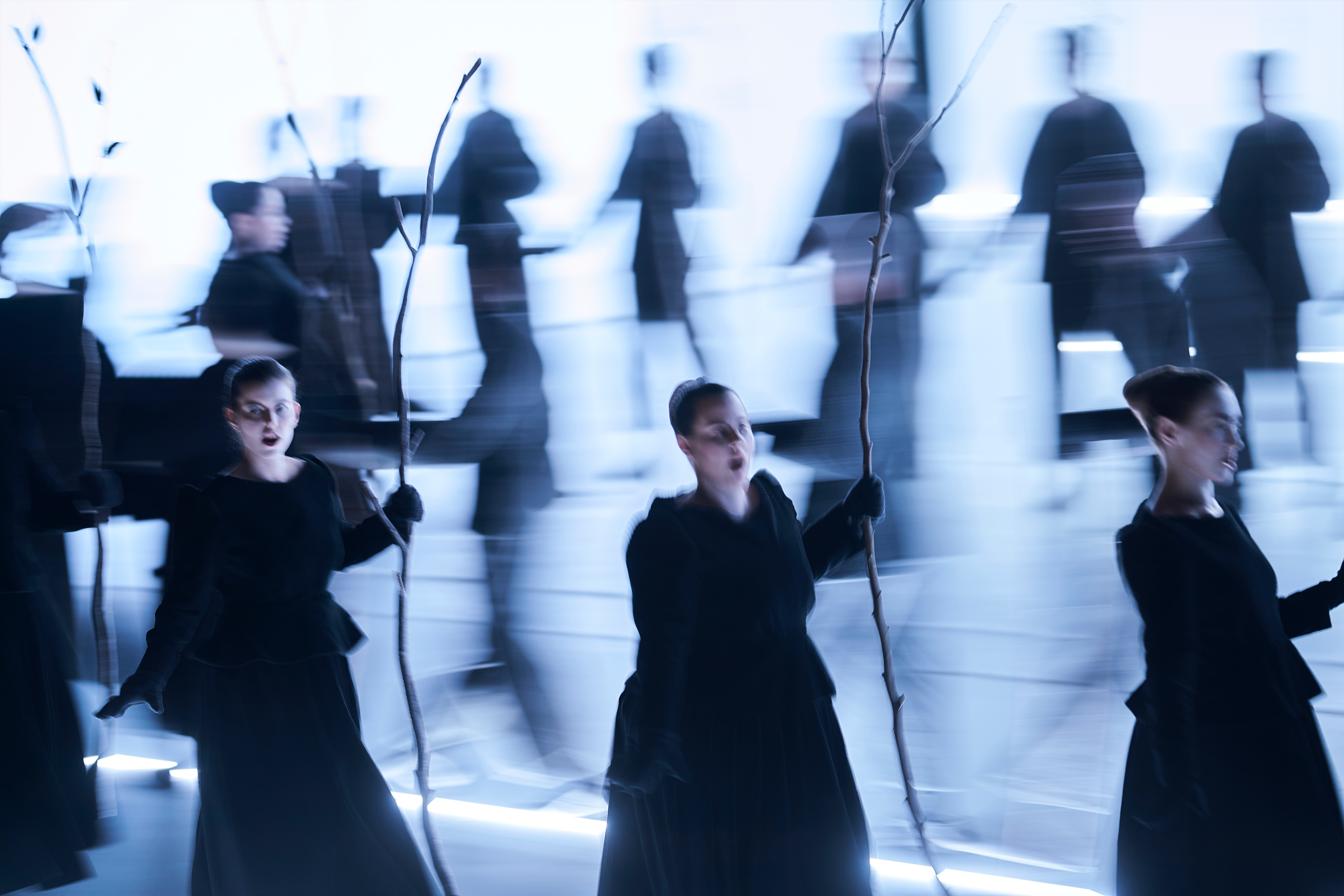
Since I first saw and began studying Wilson’s Messiah, and asking him questions about it—at its 2020 premiere in Salzburg—I often found myself returning to the production’s final image: a large tree with both branches and roots exposed, which slowly turns over until the roots become the branches. This image appears as the chorus sings a text from the Book of Revelation 5:12: “Worthy is the Lamb that was slain to receive power, and riches, and wisdom, and strength, and honor, and glory, and blessing.”
Bob was fond of saying that the light was the most important actor on any stage.
For Christians, this passage is literal; Jesus Christ was the literal Lamb of God, and the lamb’s innocence and purity represent the uncomplaining face of suffering. For non-believers or non-Christians, the lamb can abstractly represent the unblemished perfection of nature, which in turn is the symbol of a godly presence, a spiritual rather than a religious feeling. That final tree of Messiah, reversing itself from leaves to dirt, reminds us that we are all both root and branch; the moment poetically unites many strands of thought and belief together.
Perhaps the most unexpectedly peculiar part of Wilson’s staging, a stroke of real theatrical genius (though opinions will vary), arrives during Messiah’s most famous music, the great chorus of “Hallelujah!” that closes the second act. An astronaut enters the acting area and spins with joy through the famous repeated phrases of “King of Kings, and Lord of Lords!” What could this mean? Like many of the texts of Messiah, a new world is arriving, and astronauts discover new worlds. But they also did, and do, something perhaps equally important: astronauts were the first people ever to look back onto the world they left behind. Fine, but what does that have to do with Messiah?
There is no right or wrong answer. I can offer what the spinning astronaut did for me: he made me recall an iconic photograph from the time of Bob Wilson’s younger days, the one taken by Michael Collins in 1969 on the Apollo 11 mission, famously beamed back to NASA in Houston. Collins snapped a photograph of the Lunar Module when he was himself in the command module. Inside the capsule, Buzz Aldrin and Neil Armstrong were working away, preparing to land on the moon—Earth behind them. So Collins was the only person in all of Earth’s history, up to that moment, who was not contained inside the frame of that single photograph. How must that have felt?
What Messiah is “about,” in a concert setting or on a recording, is obviously up to the listener. In the Wilson production, its meaning is the same: whatever you want it to mean. Throughout his career, Wilson simply asked that we never sit benignly in front of a monumental work like Messiah. Wilson’s art is about illumination, with his unparalleled connection to the intricacies and subtleties of light. Bob was fond of saying that light was the most important actor on any stage. In a Wilson production, the imagination is often transported to that enigmatically beautiful spot underneath Main Street at the Museum of Fine Arts, Houston: The Light Inside, the gorgeous tunnel designed by James Turrell, in which a visitor is pinioned between light and space, unmoored and grounded all at once.
Over 100,000 days have transpired in the world since Handel’s Messiah was first heard in 1742, and how extraordinary to imagine that on each of those days since, possibly even every hour, some moment of Handel’s oratorio has been sung, practiced, thought about, or listened to. For a few short hours this spring at HGO, we will experience Messiah in a different way than at any other time in that history. What a wonder and a privilege.