The Eerie Magic of the Forest

In a diary entry from 1879, Engelbert Humperdinck copied down a phrase he found in a history book: “the eerie magic of forest solitude.” The German composer had been occupied at the time with writing a forest soundscape for orchestra, and these words no doubt resonated with him. Two evenings later, perhaps inspired by the woodland music swirling in his head, Humperdinck read from the Brothers Grimm before bed. The sylvan fantasies conjured by these fairy tales kept him awake that night.
Although Humperdinck’s forest piece never materialized, he would again wander into the Grimms’ dark woods over a decade later, when he began composing Hansel and Gretel. Much like Hansel, he was joined in this journey by his own Gretel—his sister Adelheid Wette, who wrote the libretto. Drawing on both the Grimms’ original text and a later retelling by Ludwig Bechstein, Wette envisioned the work as a children’s Christmas play with a handful of songs by her brother. But the humble project grew into a full-sized opera that, after its 1893 premiere, transformed Humperdinck into an overnight success.
Though the composer remained something of a one-hit-wonder the rest of his life, he produced three other fairytale operas and musical plays based on Grimm stories: Snow White in 1888, Sleeping Beauty in 1902, and Königskinder in 1910 (the last loosely adapted from the Grimms’ “Goose Girl”). But none of these replicated the success of Hansel. In that opera, more than any other, Humperdinck truly captured the music of his subject: the simple fears and joys of children as they navigate the “eerie magic” of the forest.
The forest in German Romantic opera before Humperdinck could be filled with mystery and wonder, but also monstrous terrors. In the famous “Wolf’s Glen” scene of Weber’s 1821 Der Freischütz, invisible spirits cry out and a demonic ritual unfolds at midnight. And in Wagner’s 1876 Siegfried, the title hero ventures deep into the forest to slay a dragon. Home to devils and beasts, the woods were no place for children in opera.
By contrast, the Grimms’ tales were rife with instances of children encountering nasty creatures in the forest. It’s common today to mock the more gruesome elements of German folktales as wholly inappropriate for little ones. But even in the Grimms’ day, finger-wagging moralists objected to depictions of cruelty or evil. Bourgeois parents wanted “clean” versions to read to their children. We can see this reflected in the changes to the plot found in Wette’s libretto: the parents don’t voluntarily leave Hansel and Gretel behind in the woods, and the Witch turns children into gingerbread before gobbling them up.
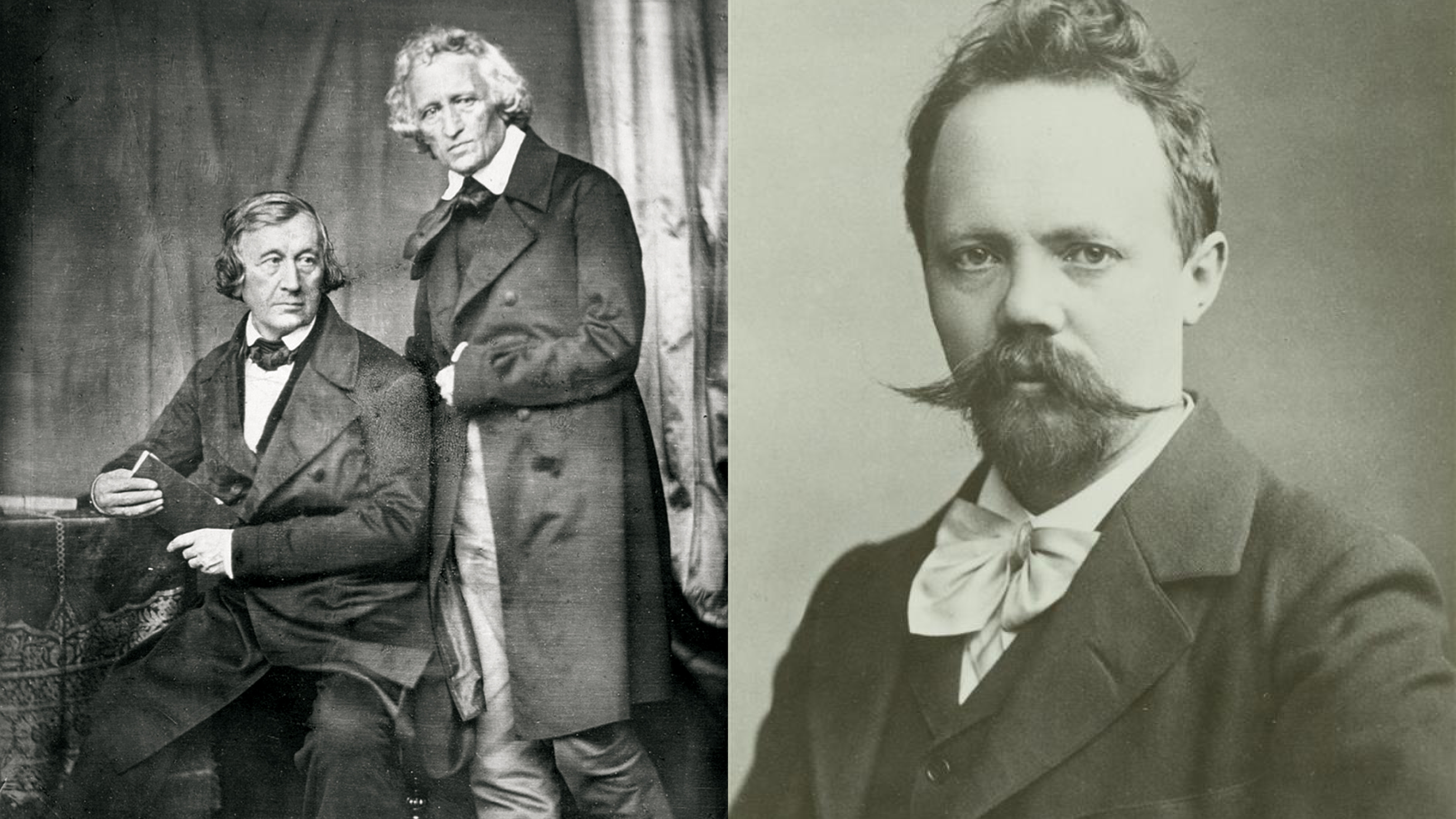
But it was the Grimms’ mission to get as close to the original oral narratives as possible— even if that meant including bawdy or violent material. Many of the tales were recorded second-hand from middle-class or aristocratic women who had heard them told by nannies and servants. For the Grimms, these rustic people represented the German Volk, and their tales addressed issues that concerned the early-19th century peasantry, such as starvation and child abandonment. In the days when many women died in childbirth, men would often remarry. The cruel stepmother who mistreated her new stepchildren was a very real figure.
Besides these more localized concerns, the Grimms theorized that the folktales they collected—many of them likely hundreds of years old—were an expression of an ancient and innate Germanic spirit. They observed that certain stories, including “Hansel and Gretel,” appeared in multiple variations throughout the Vaterland. But the Grimms later tempered this nationalist interpretation after noticing that similar stories could also be found beyond Germany.
They reasoned that folktales, which crop up again and again in different guises across the world, must contain some universal human wisdom. Writing in the introduction to the first edition of their collection in 1812, they argued that the stories “moved people and taught them something that… has certainly emanated from that eternal source that moistens all life.”
In this “eternal source” we can see the forerunner of Carl Jung’s concept of “archetypes”—i.e. stories and symbols that unite us as a species. In his books and essays, written in the decades following Humperdinck’s Hansel and Gretel, the Swiss psychiatrist specifically addressed the archetype of the primeval forest.
Jung noted that among traditional African peoples, the jungle was a dangerous and evil place—a realm of spirits, animals, and magic where man was no longer in control. For Jung, the woods represented the forest of the unconscious, where fears, psychoses, and instincts lurked in the shadows. “The forest, dark and impenetrable to the eye…is the container of the unknown and the mysterious.” They reasoned that folktales, which crop up again and again in different guises across the world, must contain some universal human wisdom.
For all its “sanitizing” of the story, Humperdinck and Wette’s Hansel does contain frightening scenes. There’s an unsettling moment in Act II when Hansel and Gretel realize they are lost in the woods. “Do you hear what the forest is saying?” Hansel asks his sister, “‘Children, are you not afraid?’” Rather than bombarding us with scary sounds, however, Humperdinck reduces the score to near silence. Hansel and Gretel cry into the night, “Is someone there?” An echo—sung by offstage voices—answers back. Unable to see in the darkness, the children picture all sorts of ghastly spirits looming in the gloom.
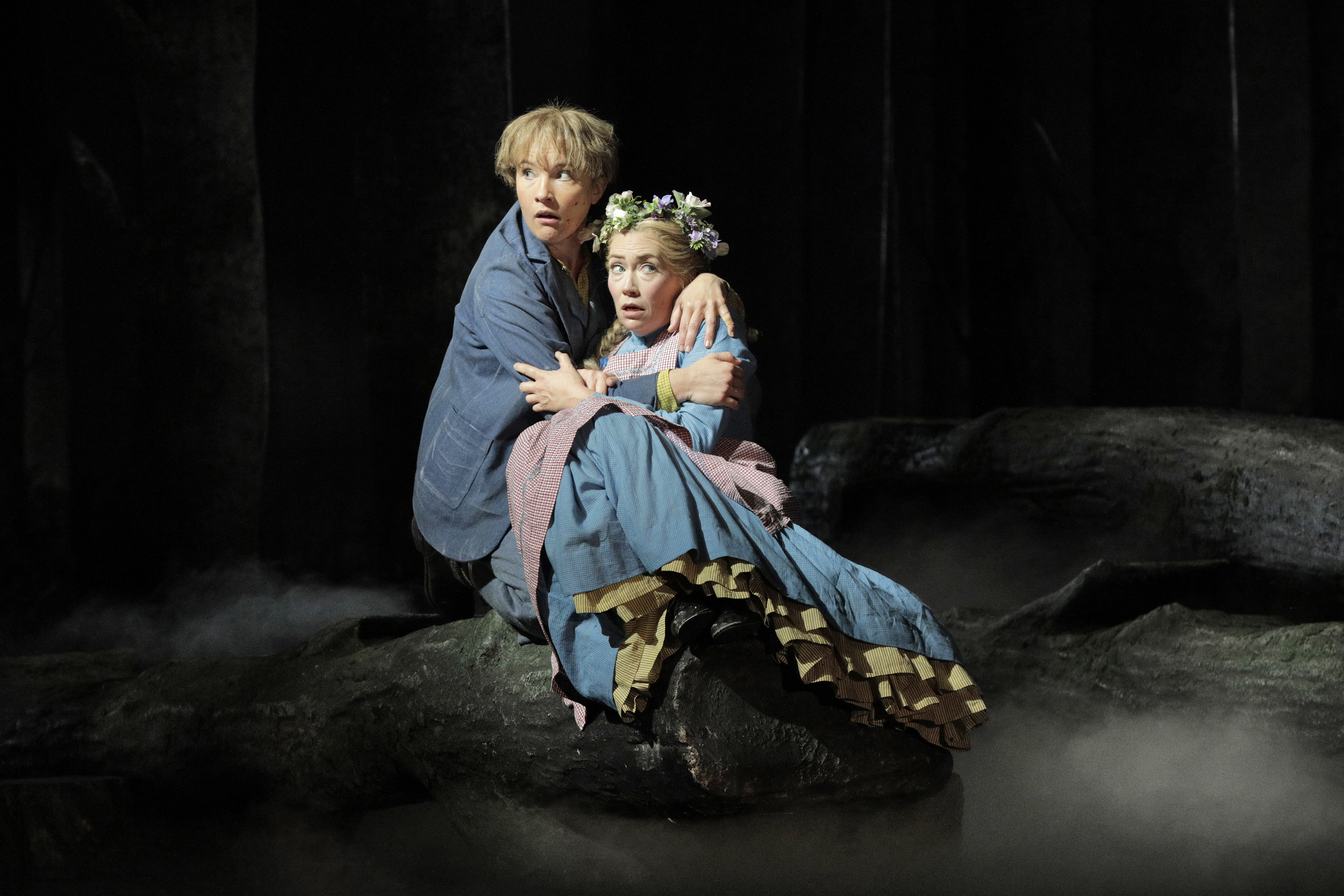
But the eeriest part of this passage is a simple two-note cuckoo call. Earlier in the act, it was an amusement for the children, who sang a trio with their unseen bird friend. In the context of the echo passage, the exact same cuckoo pitches are rendered strange and uncanny.
Humperdinck isn’t making fun of the children for their terror and ignorance. Rather, he’s allowing us as an audience to feel that same chill of dread that we did as children, gazing into the black forest and imagining what lies there. Nor does the composer trivialize childhood. On the contrary, instead of talking down to tykes, he treats their stories and songs as worthy of High Art. A juvenile fairytale is brought to life, not as a theatrical farce, but as a Wagnerian drama on the same dramatic and musical scale as the Ring cycle.
Humperdinck was a protégé of Wagner, having assisted the elder composer on the premiere of Parsifal. As a devoted disciple, he knew Wagner’s music inside and out and adopted many of his mentor’s compositional techniques. In Hansel and Gretel, authentic German nursery songs are employed like Wagnerian leitmotifs—i.e. symbolic melodies that reprise throughout the score. The music of Act I, for instance, develops symphonically from the tune “Suse, liebe Suse” that the siblings sing at the opera’s opening.
In Humperdinck’s hands, Hansel and Gretel’s ditties are elevated to epic Wagnerian leitmotifs. By doing so, the composer places his pint-sized protagonists on the same mythical level as heroes like the twins Siegmund and Sieglinde, who themselves wander through a hostile forest in Die Walküre. And in the pattern of Siegfried, who defeats the dragon Fafner, Hansel and Gretel use their wits to kill the Witch. In director Antony McDonald’s take on this confectionary assassination, they push the hag into a vat of melted chocolate.
However grisly, it’s crucial that we show moments like this to children. They need to be taught that evil does exist, but it can be conquered. In real life, the Witch might be an abusive grownup, luring with smiles and sugar. Even adult audiences—who were the intended readers for the Grimms rather than children—can recognize the archetypal truths at the core of the opera and apply them to their own experiences. Each of us has our own Witch to vanquish, perhaps a dark entity deep inside the forest of our mind.
Each of us has our own Witch to vanquish, perhaps a dark entity deep inside the forest of our mind.
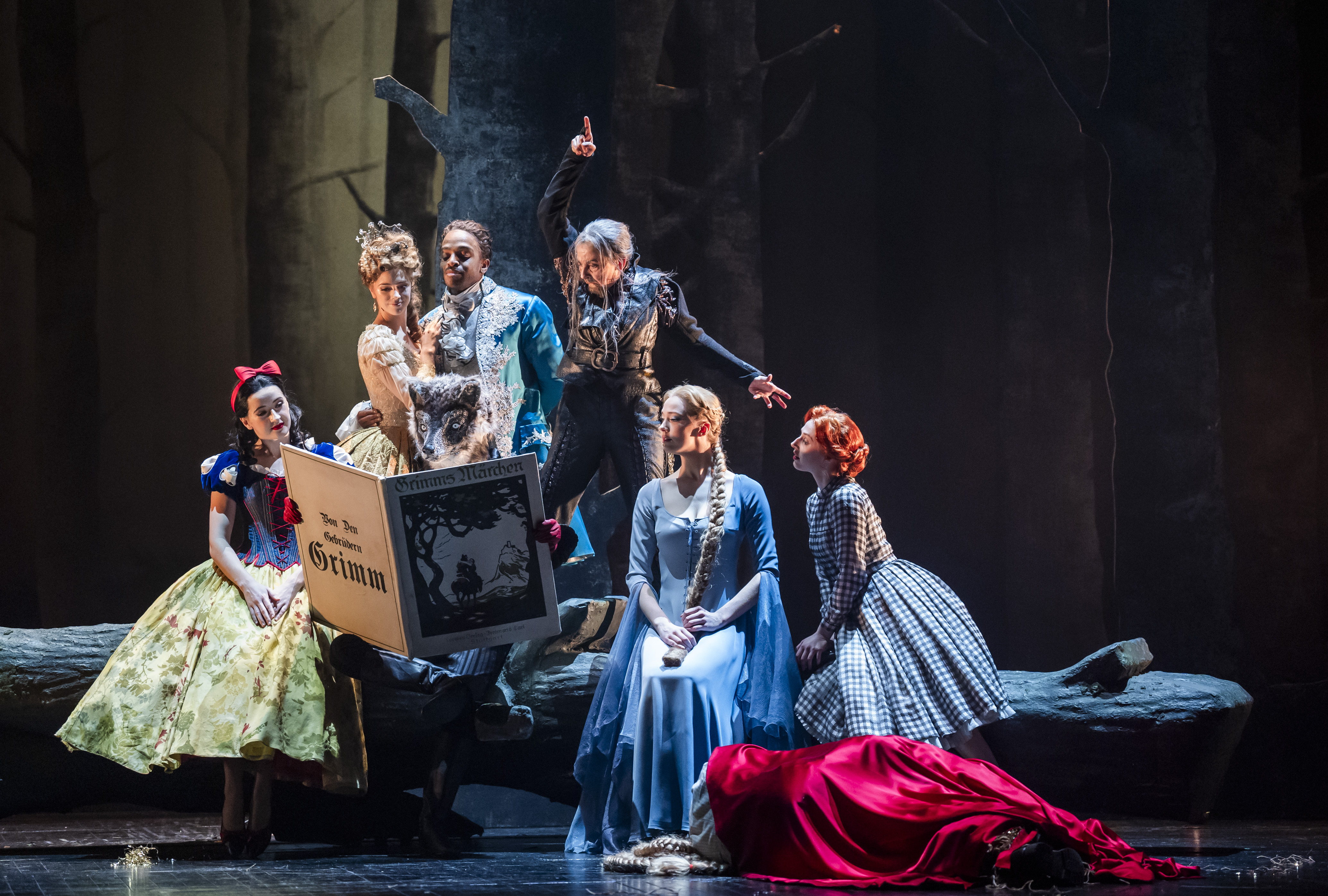
Humperdinck’s original opera features a dream ballet sequence in which Hansel and Gretel— frightened by the echoing forest—are protected by the 14 angels they summon in their evening prayer. Faith is crucial to the story, and the children are often comforted by their father’s credo that God comes to aid those in need. However, in McDonald’s staging, the angels are replaced with fairytale figures from Grimm who put the siblings to sleep.
Rumpelstiltskin lays a bed with his straw, Rapunzel cuts her long braid for their pillow, and Little Red Riding Hood covers them in her cloak. With Hansel and Gretel tucked in, the characters read from an edition of the Grimms’ collection that the children are seen leafing through in Act I. Armed with these stories—tales of courageous children who best wolves and witches—Hansel and Gretel are able to face their fears and sleep peacefully under the moonlit canopy of the forest.