The Edge of Enormity
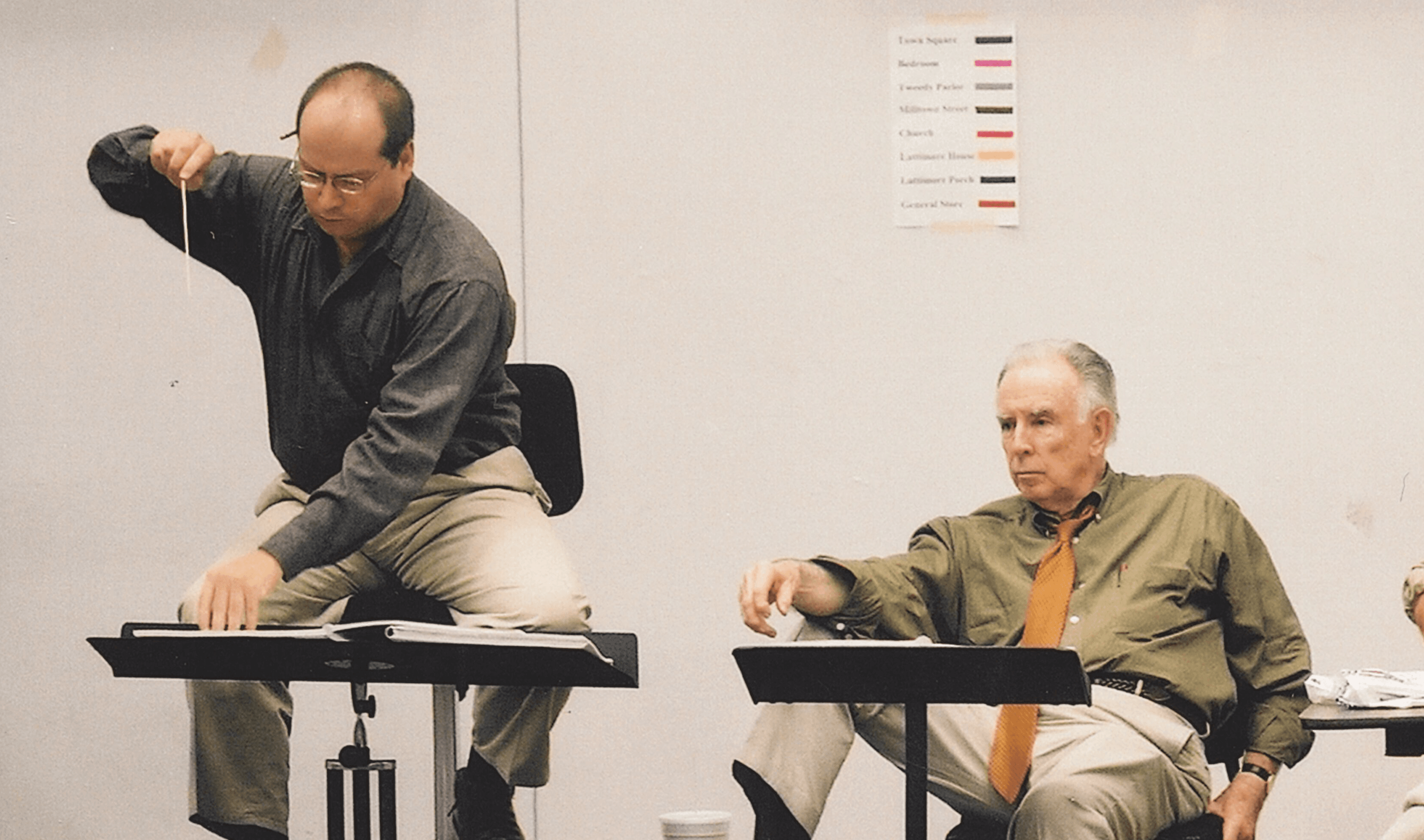
The ideas of great artists are so expansive, while the rest of us mortals are individually so small, like mice and men. There is an oppressive feeling of being a young artist, though it brings comfort in later years: that you are hovering constantly on the edge of enormity. This doesn’t mean the enormity of fame or success, but something deeper, the wealth of ideas contained within art. We first feel this when we encounter elder artists we revered but never imagined knowing. My professional life as Houston Grand Opera’s Music Director for nearly three decades has been privileged and enriched by wonderful mentors, and the composer Carlisle Floyd (1926–2021) was very high among them. It is joyous to remember him again as we prepare for his centenary, as well as our country’s quarter millennium in 2026, with performances of a new production of his opera Of Mice and Men, based on John Steinbeck’s acclaimed novel. This production will shed new light on Carlisle’s biggest operatic problem child, as he often called Of Mice and Men, the work he most revised, and the one he most loved.
Carlisle had a small public imprint for such a renowned person, largely because of his nature. He was an elegant and gracious gentleman, unfailingly polite, slow to anger. He always felt to me like a character created by a great Southern writer, the sort of person we sadly no longer have. He changed the face of an art that had barely existed when he was young, American Opera, a pair of words that prior to Carlisle would have been thought oxymoronic. He was so perfectly suited to the aesthetic of the novelist John Steinbeck, 24 years his senior, that one could easily imagine Carlisle composing large-scale operas on the epic Steinbeck novels The Grapes of Wrath and East of Eden. But he kept gravitating toward Of Mice and Men, the author’s rhapsodically tragic 1937 novella, a paean to the striving lives of migrant farm workers in what is still known as Steinbeck country, that beautiful stretch of central California along the Monterey coast.
Carlisle Floyd composed against the grain of his contemporaries. He was the same age as the enfant terrible German composer Hans Werner Henze, both of them born in 1926, a year filled with births of the renowned: Jerry Lewis, Marilyn Monroe, Mel Brooks, David Attenborough, Fidel Castro, and Queen Elizabeth II. Another contemporary of Carlisle’s was the French composer/conductor Pierre Boulez, also an avant-gardist with a taste for revolution akin to Wagner’s, and whose music was, like Henze’s, as far from Carlisle’s aesthetic as music could get. It isn’t just that these three composers occupied different countries; they seemed to be on different musical planets.
Musical composition splintered after the Second Viennese School, which was both a delayed reaction to Wagner, and an attempt to hold on to the cultural lines WWI had severed. Post-WWI composition created an “establishment” based in, or endorsed by, musical academia all over the world—Henze, Copland, and Boulez—as well as an anti-establishment, very much represented in the United States by Carlisle and his older contemporary Gian Carlo Menotti. Sitting between the established and the non was Leonard Bernstein, eight years older than Carlisle, whose most cherished compositions were for the commercial theater—West Side Story, On the Town, and Candide—but whose deepest desire was to be a symphonic and opera composer who honored both the Second Viennese School and what came before it: Mahler and Wagner.
Into this melee of theory and practice, the South Carolinian Carlisle began to compose operas, and Susannah, while not his first opera, was the first that landed with a large public, having played to enormous audience success at New York City Opera in 1956, soon after premiering at Florida State University. All eyes and ears leaned toward Carlisle as a new direction, much as they had to Puccini a half-a-century before. Carlisle began thinking of an opera based on Of Mice and Men as early as 1963, envisioning it as a vehicle for superstar bass-baritone Norman Treigle as George and heldentenor Richard Cassilly—later the leading Tannhäuser of his era—as Lennie.
The lodestar of American opera was composed 20 years before Susannah, Gershwin’s Porgy and Bess, but in the 1950s, Porgy and Bess was not widely considered to even be an opera, and if it was, it was felt that whatever Gershwin created could never be replicated. Floyd’s Susannah, though, portended something else: a new American operatic language that welcomed vernacular stories with vernacular music, far from the reach of academia. Porgy and Bess will always be interrogated because its creators were putting words into characters far from their own cultures and races, but Susannah had no such appropriation—it came right from Carlisle’s own world, and so did Of Mice and Men. Had Gershwin lived, he would have contributed mightily to the operatic world that Carlisle so influenced.
One has to harken back to the long 19th-century career of composer Giuseppe Verdi and his association with the major Italian companies to find a precedent, but even in that light, Carlisle’s HGO association was unique. Verdi’s career encompassed 54 years between his inaugural Oberto and his final glorious Falstaff. Carlisle composed his own quasi-Falstaff for HGO—the joyously autumnal Cold Sassy Tree, which we premiered in 2000. Carlisle’s association with HGO ultimately spanned more than 60 years, which at the time of his death was 85 percent of our entire history, by far the longest artistic influence over our company.
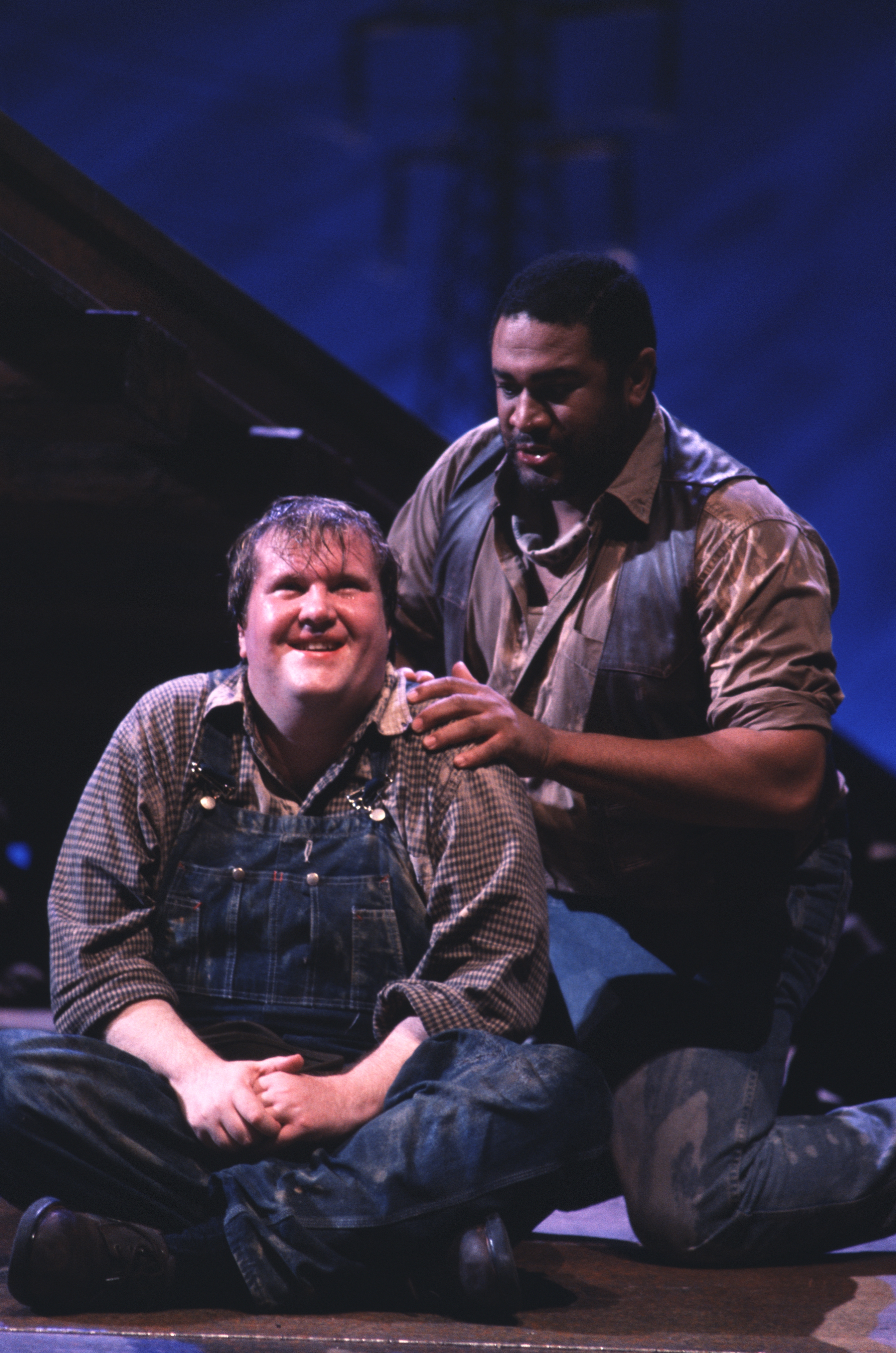
Working as a young reporter in California, John Steinbeck heard a tale of a ranch hand killing a landowner for firing a friend, and out of that Steinbeck conceived the story that propels Of Mice and Men, that of two friends Lennie and George, protectors of each other, looking for a home, an allegory of Depression-era America. The novel was immediately adapted into a hit Broadway play and quickly became a powerful 1939 film. Carlisle Floyd had Steinbeck’s blessing to compose an opera on Of Mice and Men, a commission from San Francisco Opera that ultimately fell apart—the opera premiered in Seattle, a complicated saga, but typical of how new operas were treated in the 1960s. As Carlisle did on all of his operas, he wrote the libretto for Of Mice and Men himself, which gives it and each of his operas a rare unity. Carlisle often joked that when the librettist and the composer fight, as they inevitably do, he always let the composer win—but of course, he was fighting with himself.
Of Mice and Men is Carlisle’s masterpiece, an epically moving opera that places the audience at the center of an impossible moral dilemma, but with deep humanity. There is no character in Of Mice and Men to whom we cannot relate, and we are swept along like a tide into this story because of Carlisle’s incredible score. The soaring music that brings Of Mice and Men to a close, the moment when the childlike Lennie imagines he has finally found his long-sought home, remains among the most moving in the operatic repertoire. In Steinbeck, the ending is shocking and provokes anger in the reader; in Floyd, it overwhelmingly cracks the heart. I will never forget the performances of the opera which I conducted at the 2001 Bregenz Festival in Austria (Von Mäusen und Menschen, as it was on our posters in German), and the audible tears I could hear behind me at opera’s end.
If you were lucky enough to know Carlisle Floyd, or luckier still to work with him, you found yourself understanding loyalty, kindness, and mastery, and the rarity of an artist being both spiritually gifted and full of practical craft. Though not a conductor himself, he knew exactly how to unlock a phrase of music as a conductor must, so he was an incredible mentor. He was of a generation who believed that if you had to profess a value, it was probably because you were lacking it. As proud as he was of his operas, his co-founding of the Butler Studio at Houston Grand Opera with David Gockley was one of his proudest achievements.
One felt the edge of enormity in Carlisle’s presence; his mind was expansive, lyrical, and gentle. There is a moment of supreme tenderness in his opera, Cold Sassy Tree, a short aria sung by Will Tweedy in innocent admiration of a young girl, Lightfoot, who protects him. This was always my most treasured place in this beautiful opera, with music that sits in my heart always, especially as we prepare to honor Carlisle in this year of his centenary.