Susannah: Quick Start Guide

THE OPERA IN ONE SENTENCE
When Susannah is discovered bathing naked in a creek, she’s slandered by the congregation and pressured by the preacher Olin Blitch to atone for sins she never committed.
BACKGROUND
Carlisle Floyd composed Susannah when he was a 28-year-old piano instructor at Florida State University, where the opera premiered in 1955. The libretto, written by Floyd himself, is loosely inspired by the story of Susanna and the Elders, an apocryphal chapter of the Book of Daniel. Floyd moved the action from ancient Babylon to 20th-century Tennessee. The fictional town of New Hope Valley resembles the kinds of communities in South Carolina where the composer grew up. As the son of a Methodist minister, the young Floyd was disturbed by the fire-and-brimstone sermons delivered by visiting revival preachers.
Later in life, Floyd recognized that Susannah could be read as an allegory for McCarthyism, which was at its height when he wrote the work. Floyd witnessed the hysteria firsthand at FSU, where students and faculty suspected of homosexuality were expelled or fired. Just as the citizens of New Hope Valley refuse to believe the heroine’s innocence, Floyd pointed out that McCarthyism was “a way of thinking
in which accusation becomes
tantamount to guilt.”
MUSIC
During the cinematic Opening Music, listen for a violent short-long rhythm that hints at the coming turmoil. As the curtain rises, a solo violinist plays a country fiddle tune for the square dance. It’s actually a quotation from Bach’s Violin Partita no. 3, with a little downhome syncopation added. Blitch ceremoniously introduces himself in “I am the Reverend Olin Blitch,” accompanied by a grandiose ensemble of brass instruments. In “Ain’t it a pretty night,” Susannah’s wide, yearning leaps convey her hopes of leaving New Hope Valley. But at the climax of the aria, listen for the foreboding short-long rhythm from the Opening Music. The lyrics for Sam’s “Jaybird” are taken from a real Southern folksong that Floyd’s grandfather used to sing. Later in Act I, he muses on the evils of human nature in his aria “It’s about the way people is made.” Listen for the orchestra’s slow and steady rhythm, which calls to mind a mournful funeral march.
The tune and text of the rousing chorus “Are you saved from sin” in Act II are by Floyd, but it’s a convincing imitation of classic revival hymns. Similarly, Susannah’s haunting “The Trees on the Mountains” isn’t a real folksong. Nevertheless, it resembles the kind of folk ballads that were brought to Appalachia by English and Scottish immigrants.
Blitch’s guilt-ridden prayer, “Hear Me, O Lord,” replicates a style of sermon-chanting typical of Southern preachers. After Sam shoots Blitch, a vengeful mob can be heard approaching from offstage. Listen for their wordless groaning and cries of “Git out’n the valley,” which are sung on a sinister motive that reappears throughout the score as a symbol for the townsfolk’s cruelty and slander.
FUN FACT
Handel composed an oratorio based on Susanna and the Elders, though, unlike Floyd’s opera, it is set in the original time and place. Susanna has also been a favorite subject of painters since the Middle Ages, with notable examples from Tintoretto, Rubens, Gentileschi, and Rembrandt.
SYNOPSIS
ACT I
On a sweltering July evening in New Hope Valley, Tennessee, a small Appalachian town gathers for a community square dance. While the church elders’ wives gossip about the beautiful young Susannah Polk, condemning her as a shameless girl raised by her hard-drinking brother, the newly arrived Reverend Olin Blitch joins the festivities. A charismatic revival preacher, Blitch has come to lead a series of religious meetings and bring sinners to repentance. He takes particular notice of Susannah and joins her in the dancing.
Afterward, Little Bat McLean, the timid and sheltered son of one of the town elders Mr. and Mrs. McLean, escorts Susannah home. Beneath a sky filled with stars, she confides her dreams of a life beyond the valley. Her brother Sam returns from hunting, and the siblings settle in for the night. The next day, while searching for a suitable site for a baptismal service, the elders unexpectedly discover Susannah bathing in a mountain stream. Unable to confront their own desires and shame, they instead resolve to punish her for what they deem scandalous behavior.
That evening, at a church potluck, rumors spread quickly. The elders and their wives accuse Susannah of corrupting the community’s young men. When she arrives, she is met with icy silence and open hostility. Hurt and bewildered, she leaves. Little Bat later reveals the reason for her sudden ostracism: under pressure from his parents, he falsely confessed that Susannah had seduced him. As calls grow louder for her expulsion from the valley, Susannah turns to Sam for answers. His only explanation is a bitter truth: people prefer to believe the worst.
INTERMISSION
ACT II
Days pass, and Susannah remains isolated from the community that has condemned her. Sam tells her that the townspeople are waiting for her to confess, but she insists she has done nothing wrong. Hoping to demonstrate her innocence, she agrees to attend one of Reverend Blitch’s revival meetings.
At the service, Blitch delivers a fiery sermon on sin and damnation, urging the congregation to seek forgiveness. When Susannah refuses to come forward, he singles her out and demands a public confession. Humiliated and overwhelmed, she cries out in protest and runs from the church.
Later that night, Blitch visits Susannah at her home. Finding her alone and emotionally exhausted, he again presses her to confess. Instead, he reveals his own loneliness and longing for human connection. What begins as spiritual counsel turns into exploitation as he takes advantage of her vulnerability and assaults her.
The following morning, a guilt-stricken Blitch arrives at church desperate for forgiveness. Having learned that Susannah was innocent all along, he pleads with the elders to believe her. Yet, unable to reveal the source of his knowledge, he fails to convince them. Susannah witnesses his confession and his remorse, but when he asks for forgiveness, she can only reply that she has forgotten what the word means.
By evening, Sam has returned from a hunting trip. When Susannah tells him what Blitch has done, he vows revenge and rushes off with his shotgun. Moments later, a gunshot echoes through the valley. Little Bat arrives with the news: Sam has killed Reverend Blitch at the baptismal creek.
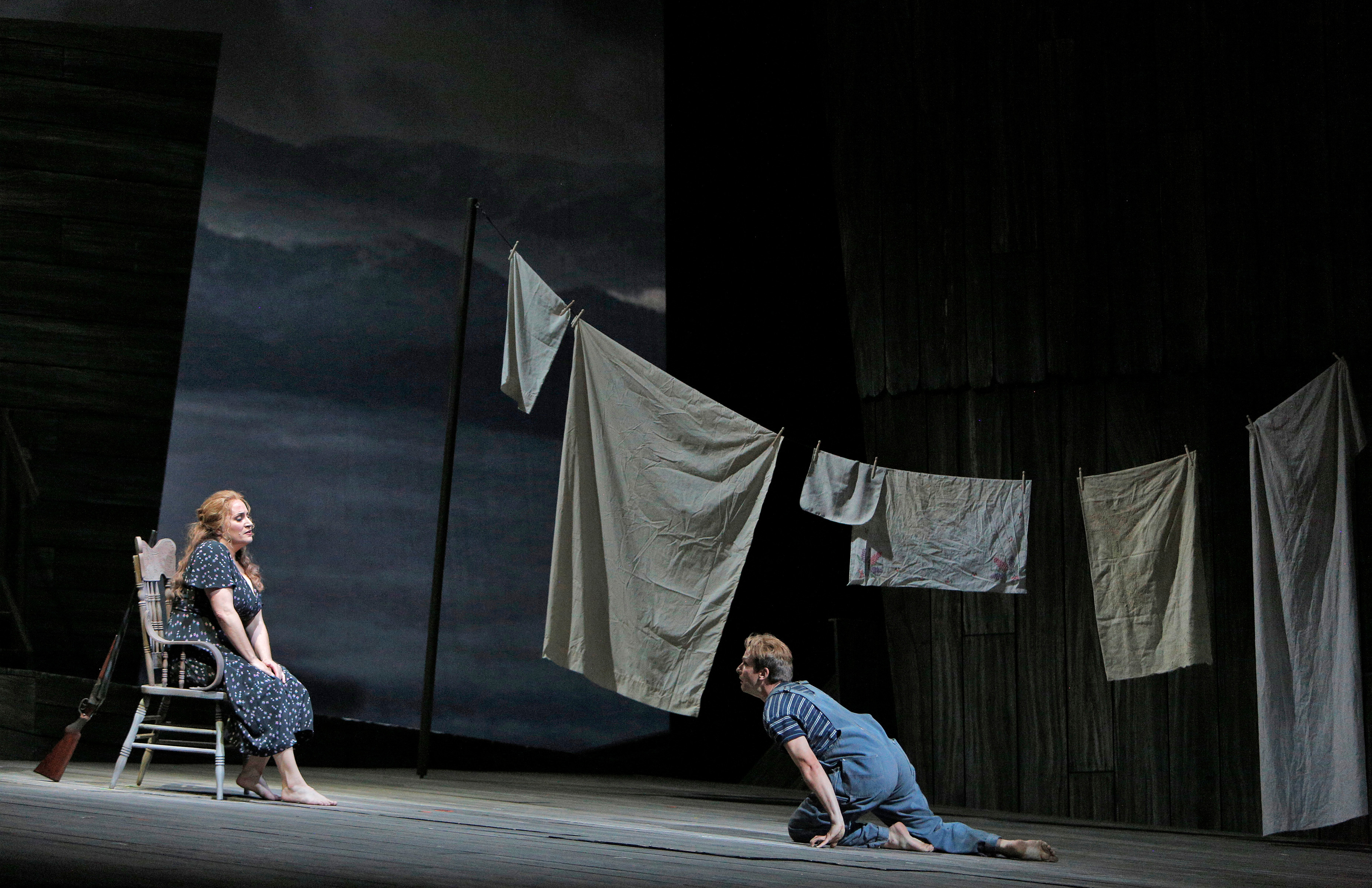
As the townspeople gather outside Susannah’s home, demanding that she leave New Hope Valley, she meets their threats with defiant contempt, driving them back at gunpoint. With her innocence destroyed and her faith in others shattered, Susannah remains alone at her home, transformed from an openhearted dreamer into a powerful yet deeply isolated figure, condemned to a life of self-imposed exile.
HGO PERFORMANCE HISTORY
HGO previously performed Susannah in the summer 1972, summer 1976, and 1995-96 seasons.