Quick Start Guide: The Barber of Seville

OPERA IN ONE SENTENCE
With the help of the clever barber Figaro, Count Almaviva carries out a series of schemes to liberate Rosina from the house of her possessive guardian, Dr. Bartolo.
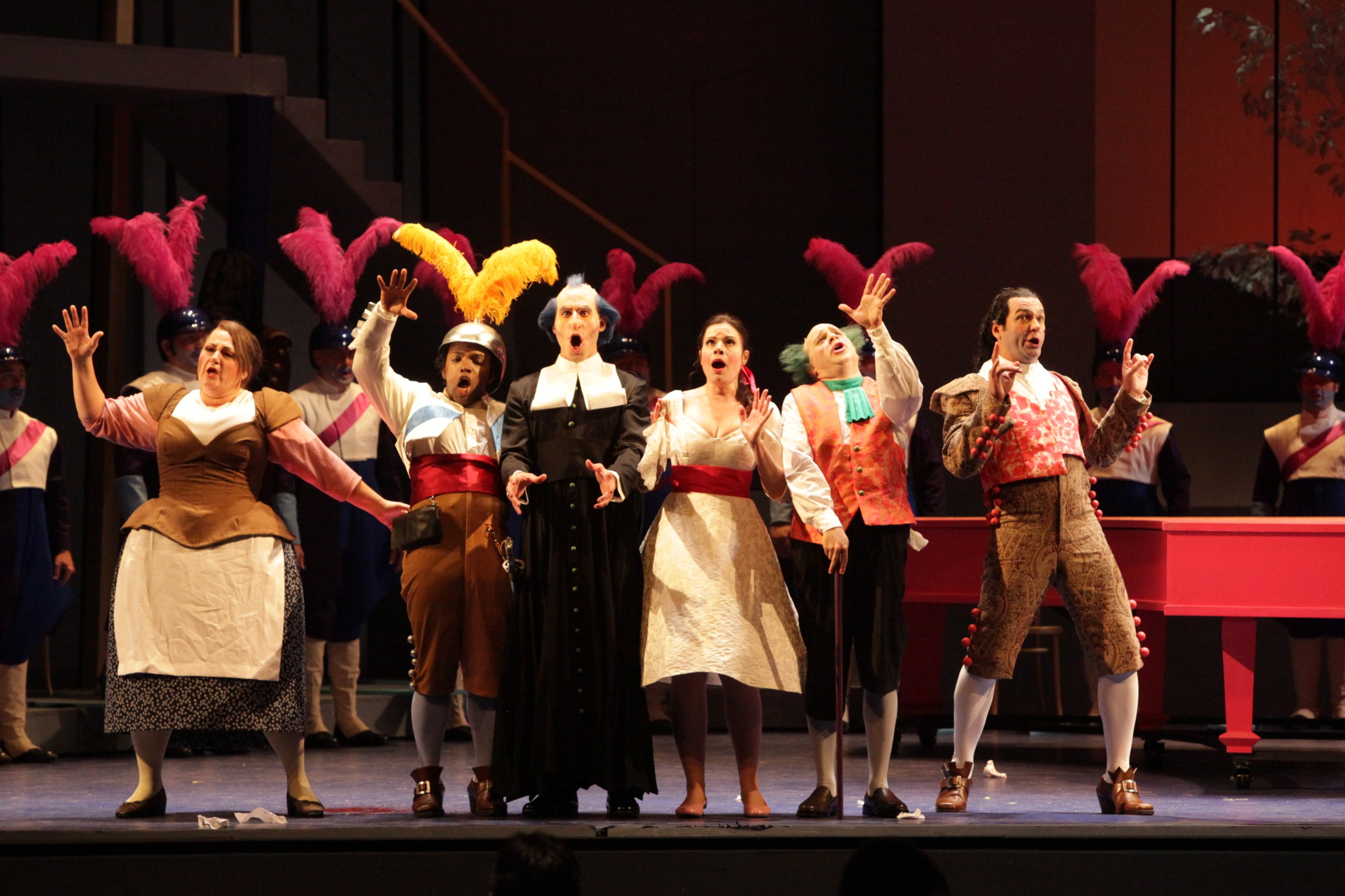
BACKGROUND
In 1775, French playwright Pierre-Augustin de Beaumarchais premiered his comedy The Barber of Seville. While politically subversive, it was wildly popular across Europe—Marie Antoinette herself played Rosina in a production at Versailles. The play spawned two sequels, including The Marriage of Figaro in 1784, which was set as an opera by Mozart two years later. While Barber was adapted by a handful composers, the standard version was, for decades, the 1782 opera by Giovanni Paisiello. It had such a devoted following that Paisiello fans attempted to sabotage the Rome premiere of Rossini’s 1816 “remake.” Though not particularly successful at the time, Rossini’s Barber gradually supplanted Paisiello’s now-forgotten setting.
Like most of Rossini’s operas, Barber was created on an impossibly tight deadline. Cesare Sterbini had just 12 days to pen the libretto, which closely follows the original Beaumarchais, and Rossini had about three weeks to compose. The work is an example of opera buffa, a comic genre that satirizes the relationships between servants and their masters. Opera buffa draws heavily on a form of Italian folk theater known as commedia dell’arte, whose farcical plots and stock characters are reflected in Rossini’s Barber.
WHAT TO LISTEN FOR
The beloved Barber overture was, in fact, recycled from two earlier Rossini operas. Such repurposing was common in the early 19th century to keep up with the demands of the entertainment industry. In Act I, Rossini conjures the opera’s Sevillian setting with Almaviva’s two vaguely Spanish-sounding serenades, both accompanied by guitar. When Figaro sings his self-introductory cavatina, “Largo al factotum,” listen for his iconic repetitions of “Figaro, Figaro, Figaro.” Rosina’s “Una voce poco fa” musically illustrates the sweet and spiteful sides of her personality. Listen for the moment when her charmingly naïve melody gives way to viperish staccato attacks and feisty coloratura—i.e. the virtuosic runs and ornaments that decorate Rossini’s vocal lines.
Don Basilio’s “La calunnia” is a prime example of the “Rossini rocket,” a long-range crescendo that, in this aria, represents the spread of a malicious rumor. Another Rossini trademark is found in Dr. Bartolo’s “A un dottor della mia sorte.” He rattles off his warnings to Rosina at breakneck speeds—a tongue-twisting technique known as patter. Act I ends with a freeze-frame finale in which all the characters express their befuddlement. At the big finish—a fast section called the stretta—listen for the tinkling triangle that represents a smithy hammering away at an anvil in their heads.
HGO’s production restores a seldom-heard Act II aria for Almaviva, his triumphant “Cessa di più resistere.” This showstopper has proved too difficult for most tenors and was cut from the opera after its premiere run. The number lived on primarily through Rossini’s Cinderella, where one of its themes was reused in the aria “Non più mesta.”
FUN FACT
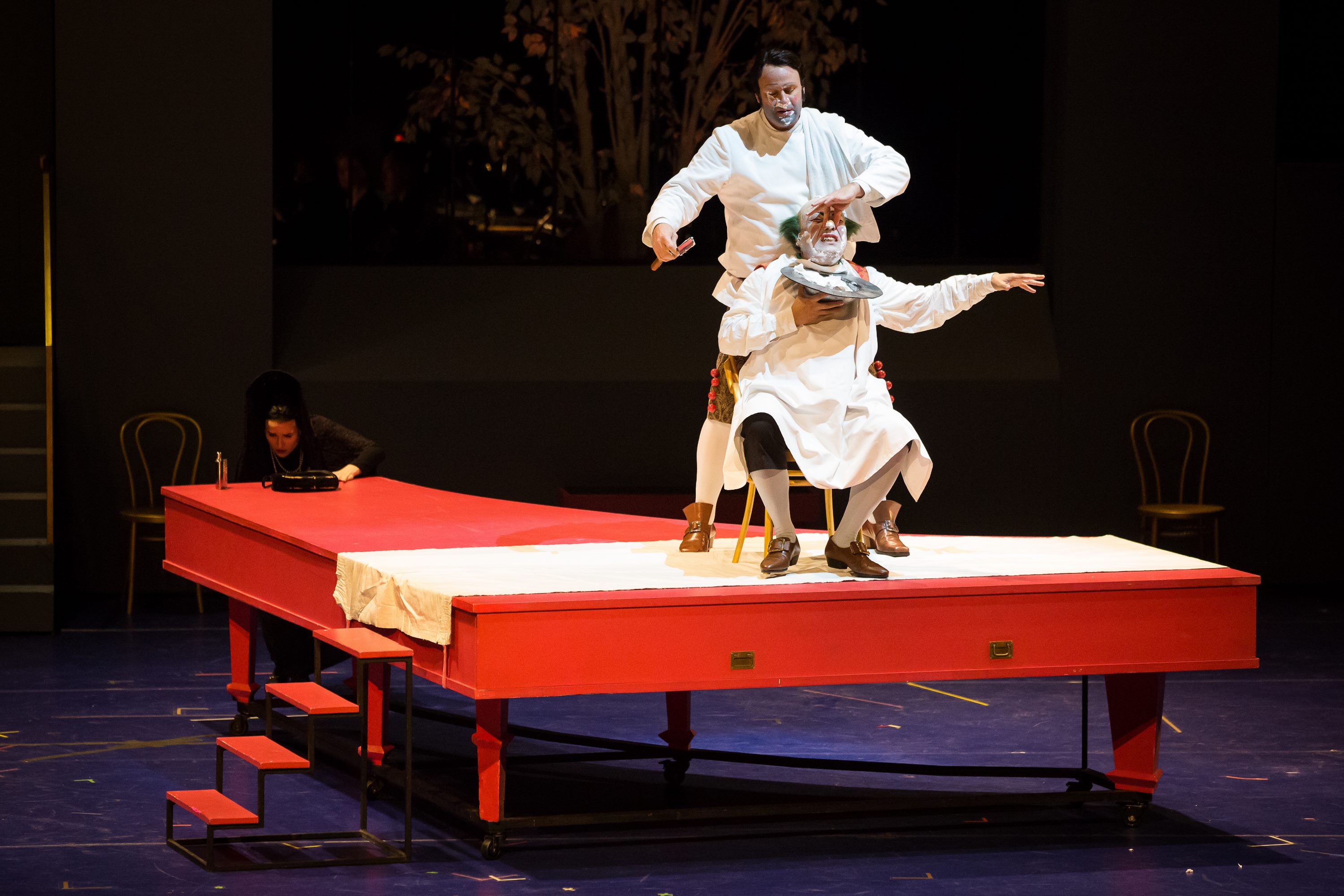
In his aria, Figaro describes himself as a “factotum.” The word, from the Latin for “do all,” refers to a servant with various responsibilities. Indeed, a barber in the 18th century had to be a jack-of-all-trades, since he usually doubled as a surgeon. Figaro mentions that in addition to shaving and cutting hair, he also practices bloodletting.
SYNOPSIS
SETTING: Seville, Spain; 18th century
ACT I
Just before dawn on a city street, Count Almaviva stands beneath a balcony to serenade a mysterious beauty who’s captured his heart. When she fails to appear, Almaviva and his servant, Fiorello, send the hired musicians on their way. Just then, Figaro the barber enters and introduces himself as a jack-of-all-trades with a specialty in matchmaking. Recognizing Figaro, Almaviva tells the barber about the young woman. Figaro explains that she’s Rosina, a ward of the greedy codger Dr. Bartolo, who means to marry her for her money. The count tries serenading Rosina again, introducing himself in his song as a commoner named “Lindoro.” This time she answers, but her amorous words are cut short. Resolved to rescue Rosina and take her for his bride, Almaviva asks Figaro for help. The barber—fired by the promise of payment—hatches a scheme: Almaviva will pose as a drunken soldier to infiltrate the house.
Meanwhile, inside, Rosina vows that “Lindoro” will be hers and that none will stand in her way. However, forces conspire against her. The music teacher Don Basilio informs Bartolo that Almaviva is pursuing Rosina. Basilio suggests they slander the count’s name to break up the pair, but Bartolo has an easier solution—he will marry her himself by tomorrow. Figaro, who has access to the house as Bartolo’s barber, has overheard all. He warns Rosina and recommends she send a note to “Lindoro”—which, by coincidence, she’s already written. Bartolo confronts Rosina and tells her she’ll be kept under lock-and-key. A knock at the door announces Almaviva, decked in his soldier disguise and insisting he’s been quartered at Bartolo’s residence. He raises such a ruckus that a regiment of real soldiers intervenes to arrest him. But they back down after Almaviva produces a paper proving his identity. Bartolo and the others, who have no idea what the document reads, are left dumbstruck at the strange scene they’ve witnessed.
INTERMISSION
ACT II
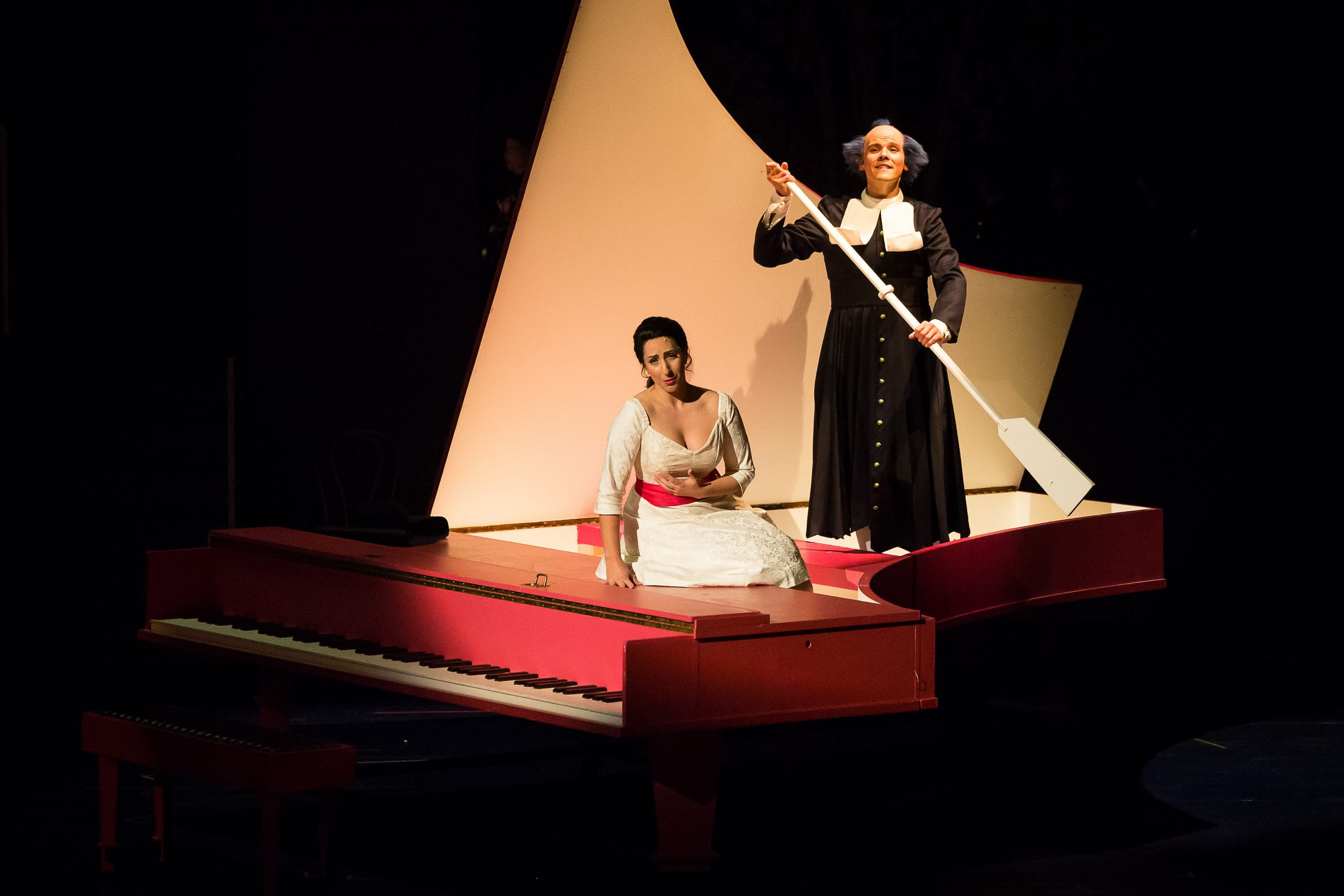
Later that day, Almaviva makes another attempt to reach Rosina, this time posing as Don Basilio’s student, “Don Alonso.” His master is ill, he explains, and has sent him in his stead to give Rosina her singing lesson. Hoping to gain Bartolo’s confidence, “Don Alonso” shows him Rosina’s letter, claiming he stole it from Almaviva. They can use it to trick Rosina into thinking that the count is unfaithful. Rosina enters for her lesson and, recognizing “Lindoro,” begs him to save her. Meanwhile, Figaro arrives, and while he’s preparing to give Bartolo a shave, he manages to swipe the key to Rosina’s window. Everything seems to be working out, when Don Basilio makes an unexpected appearance. Before Basilio can reveal that he’s never seen “Don Alonso” in his life, Almaviva convinces the music teacher that he’s deathly ill and sends him off to rest. Figaro proceeds to shave Bartolo, giving Almaviva a chance to fill Rosina in on the plan: he and Figaro will climb up to her window at midnight. Bartolo catches them whispering and, realizing he’s been duped, chases the conspirators away. Overwhelmed by all this mayhem, Bartolo’s housekeeper Berta muses on the crazy things people will do for love.
Armed with the letter that “Don Alonso” gave him, Bartolo convinces Rosina that “Lindoro” intends to betray her. Heartbroken, she admits to him the details of the rescue mission, and Bartolo instructs her to lock herself in her room. At midnight, Figaro and the Count climb a ladder to Rosina’s balcony and enter through her bedroom window. When Rosina rebukes “Lindoro” for his alleged deception, he reveals to her that he is really Count Almaviva and that he loves her passionately. The two reconcile, but when they turn to leave, they find that the ladder has been removed. Don Basilio enters with a notary intended for Rosina and Bartolo’s marriage. Taking advantage of the situation, Almaviva and Rosina sign the contract themselves. Bartolo barges in to apprehend the intruders, accompanied by the regiment of soldiers. Almaviva informs him that he no longer holds any power over Rosina, and Bartolo admits defeat while the others sing in praise of love.
HGO PERFORMANCE HISTORY
HGO previously performed The Barber of Seville in the 1963-64, 1968-69, 1975-76, 1976-77, 1979-80, 1983-84, summer 1985, 1992-93, 2003-04, 2011-12, and 2017-18 seasons.