Hansel and Gretel: Quick Start Guide

THE OPERA IN ONE SENTENCE
Sent into the forest to gather berries, Hansel and Gretel encounter a child-eating Witch, whom they bravely vanquish using their wits.
BACKGROUND
German librettist Adelheid Wette originally intended Hansel and Gretel as a children’s Christmas entertainment that would feature a few musical numbers by her brother, composer Engelbert Humperdinck. But the score gradually expanded into a full-length Märchenoper, or fairytale opera, which premiered in 1893. Wette’s text combines the original Brothers Grimm version with a later retelling by Ludwig Bechstein. Characters like the Sandman and Dew Fairy were added, and more gruesome elements were softened. The parents no longer purposefully abandon their children, for instance, and rather than cannibalistically devouring children, the Witch turns them into gingerbread first.
WHAT TO LISTEN FOR
A protégé of German Romantic composer Richard Wagner, Humperdinck borrowed many of his mentor’s musical techniques. After the sweeping prelude, listen for Hansel and Gretel’s “Suse, liebe Suse” (Susie, dear Susie). Humperdinck treats this genuine German nursery song like a Wagnerian leitmotif—i.e. a recurring theme that he develops in the orchestra. While the other numbers in Hansel and Gretel sound like real folk music, the melodies are mostly Humperdinck’s own invention. Listen for the children’s toe-tapping dance tune “Brüderchen, komm tanz mit mir” (Brother, come dance with me) and their father Peter’s lusty drinking song, with its “Ral-la-la-la” refrain. Act I ends with an orchestral interlude titled “The Witch’s Ride,” which is based on the broomstick theme Peter sings earlier. Its wild string runs and arpeggios are indebted to Wagner’s “Ride of the Valkyries.”
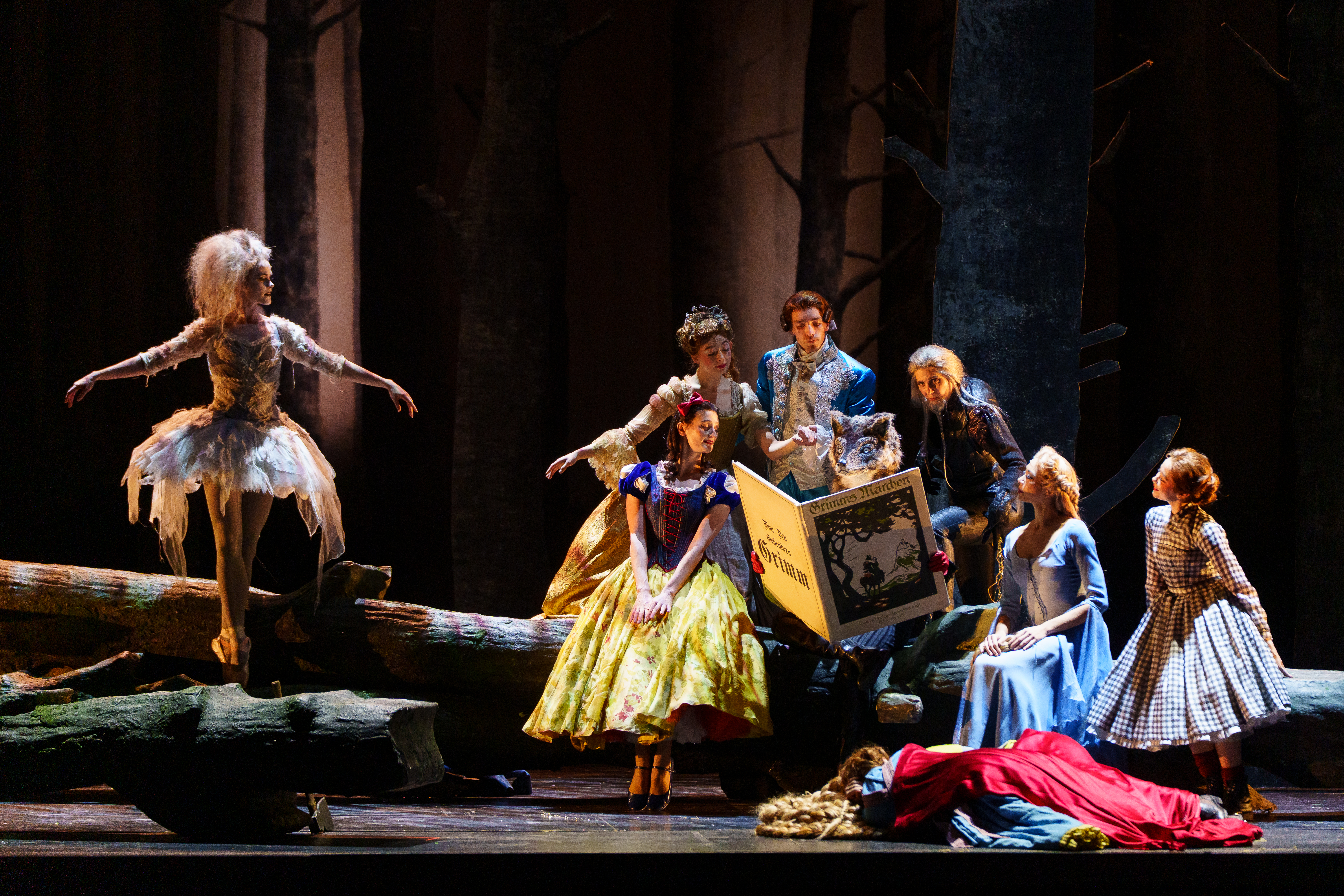
Act II opens with the only other authentic German folksong in the score, Gretel’s “Ein Männlein steht im Walde” (A little man stands in the woods). It’s actually a riddle: the little man with a crimson coat and black cap is a rosehip. Listen for the highlight of this act, the siblings’ heavenly “Evening Prayer.” Its melody serves as the basis for a pantomime, which originally featured 14 angels descending from heaven. In his production, director Antony McDonald replaces the celestial messengers with characters from other Grimms’ fairytales.
In Act III, the Dew Fairy delivers her self-introductory aria, which is the same tune as the Sandman’s number from the previous act. While the Witch gleefully prepares to consume two tasty children, listen for her galloping nonsense song “Hurr hopp hopp.” Once she’s been defeated and the gingerbread children are set free, everyone celebrates by dancing the jig from Act I. In the final passage, the whole ensemble joins Peter to recite his hopeful motto, which is sung to the theme from Hansel and Gretel’s “Evening Prayer.”
SYNOPSIS
SETTING: A long time ago in Germany
ACT I
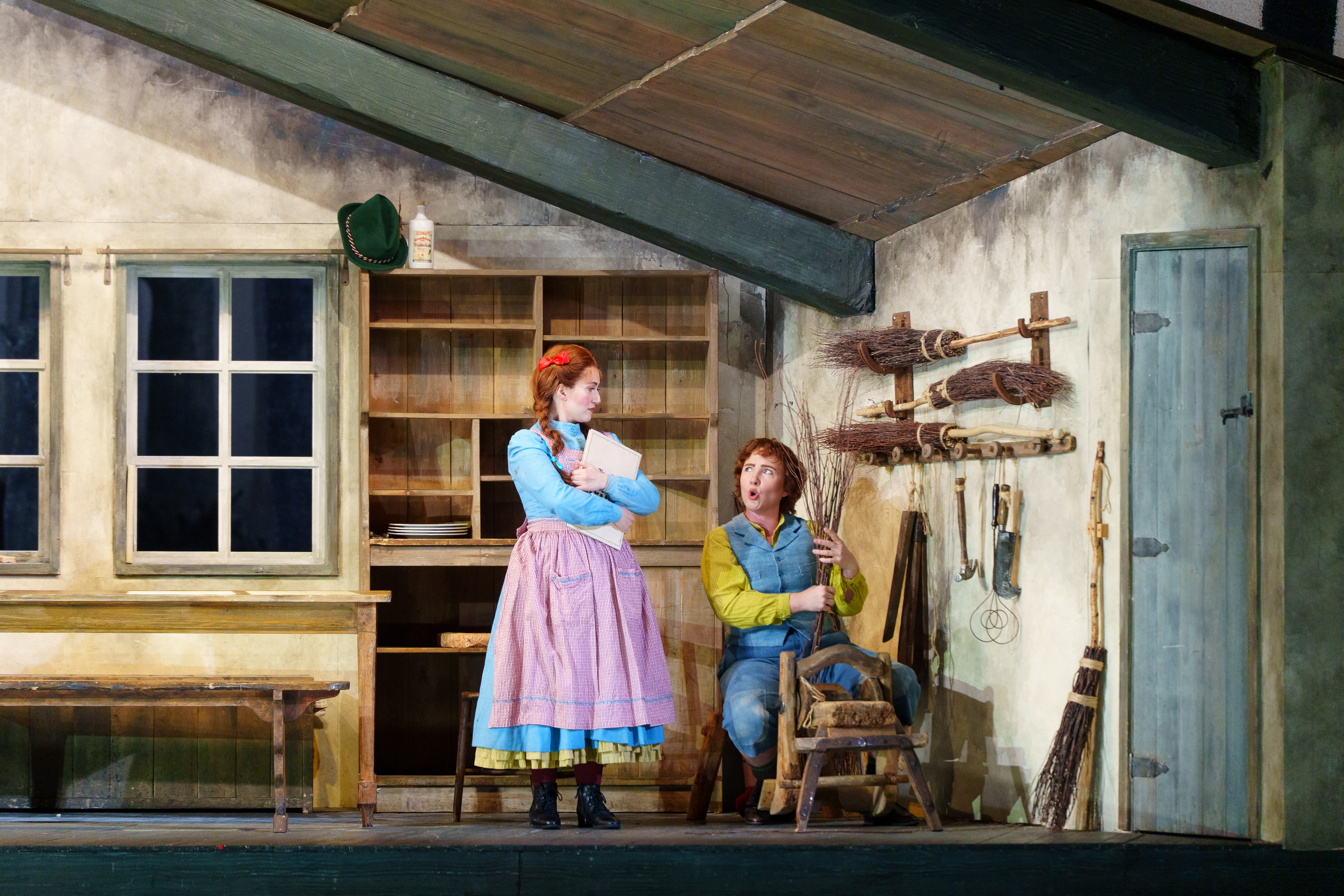
Once there was a poor broom-maker who lived with his wife and two children in a cottage on the edge of the forest. As our story begins, the children—whose names are Hansel and Gretel—are alone at home. Their mother left them chores to do while she was out. Instead, they get into mischief, singing and prancing about. But they can’t ignore the rumbling of their stomachs. The family has gone weeks with little to eat. Gretel reminds her brother of their father’s motto: the Lord provides for those in need. To distract them from their hunger, she teaches Hansel a funny dance.
At that moment, their mother Gertrude returns. She scolds the siblings for their laziness, and in her anger, she accidentally knocks over a pitcher of milk. With the family’s supper spoiled, Gertrude sends Hansel and Gretel out into the woods to gather strawberries. Left alone, she desperately prays for some money to feed her children. From afar, she hears her husband Peter approaching, drunkenly singing a lusty folksong. He’s sold dozens of brooms, and with all the money he earned, he bought the family a pantry-load of food.
But where are Hansel and Gretel? When Gertrude explains that they’re in the forest of Ilsenstein, Peter becomes terrified! Doesn’t she know that’s where the Gingerbread Witch lives? The old crone flies around on a broomstick, hunting children and baking them into gingerbread in her magic oven. Worried sick, the parents rush off to save Hansel and Gretel from being gobbled up.
ACT II
In the forest, Gretel makes a flower chain while Hansel handles a basketful of berries. “Cuckoo-cuckoo,” goes a bird, and the children sing back to it. But night is descending, and the children realize they are lost. They call out into the forest, and strange voices echo back. In the darkness, they imagine all sorts of frightening spirits coming toward them, and they cry out for their parents. Suddenly, a strange little man appears from among the trees. He’s the Sandman, and he sprinkles his magic sand to help the children fall asleep. After saying their prayers, Hansel and Gretel bed down for the night, protected by friendly characters who guard over them.
INTERMISSION
ACT III
The next morning, the Dew Fairy flutters in and sprinkles dewdrops on the children to awaken them. Rubbing sleeping sand from their eyes, Hansel and Gretel can hardly believe what they see: a cottage made from sugar and cake! As they begin to devour bits of the abode, a voice is heard from inside: “Nibble, nibble, mousey, who’s nibbling at my housey?” A friendly old lady emerges and coaxes the brother and sister with the promise of more treats. But it turns out this is the Gingerbread Witch! When the children try to escape, she freezes them in place with a spell.
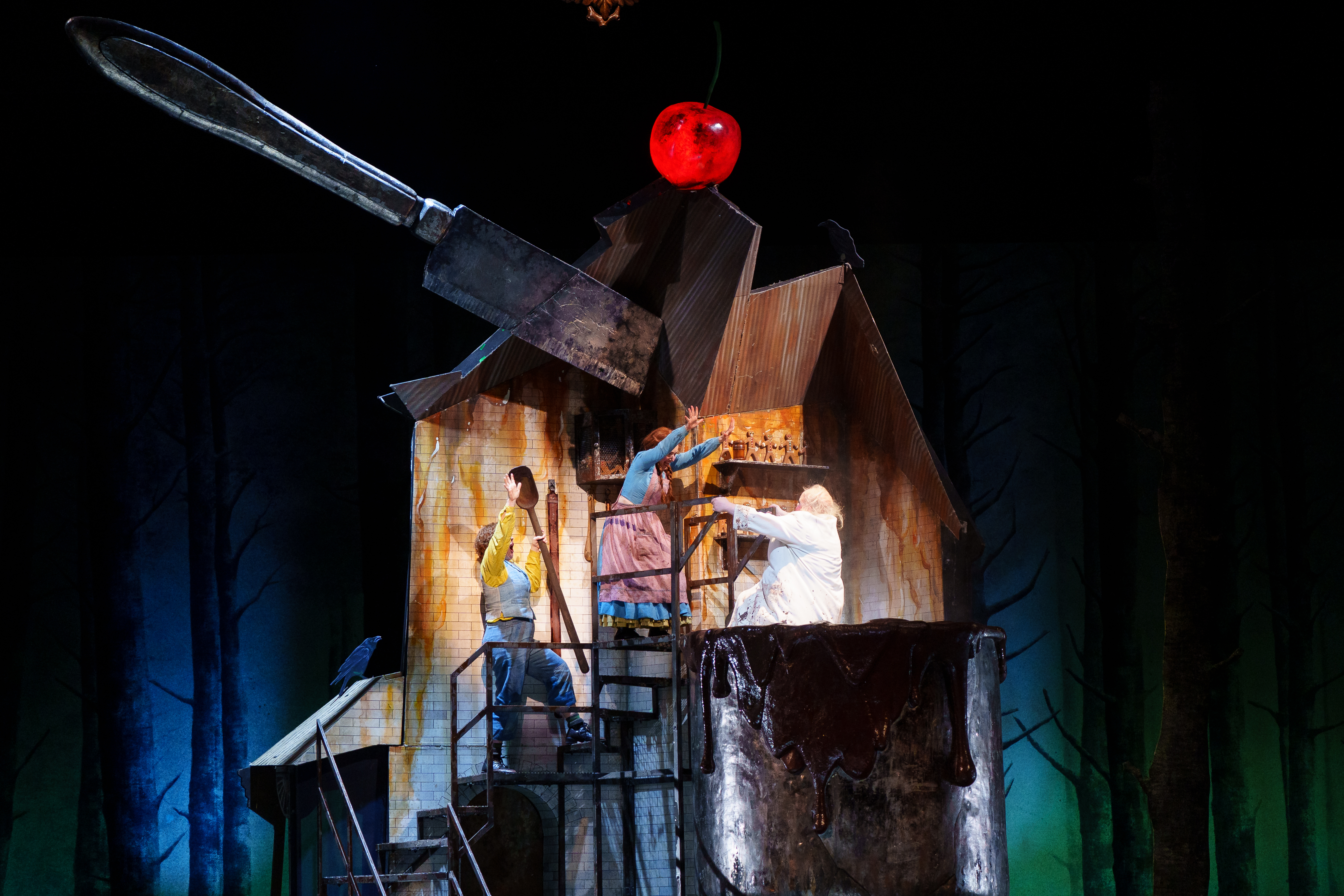
The Witch imprisons Hansel and instructs Gretel to set the table while she gleefully prepares to bake both siblings. But clever Gretel has a plan. She uses the Witch’s magic wand to free Hansel. When the hag asks her to check on the oven, Gretel plays dumb and asks for a demonstration. With their captor distracted, brother and sister push her in, vanquishing the Witch once and for all!
But who are all these other children who have assembled, with their eyes shut tight? These are all the boys and girls the Witch turned into gingerbread. With a touch of the hand and a wave of the wand, they’re awakened! Everyone sings and dances in celebration, and Hansel and Gretel’s parents arrive, thrilled to be reunited with their precious little ones. Peter reminds them all that, “When need is more than we can stand, God extends his loving hand!”