Out of Character: Jamie Barton

Watch the YouTube video of mezzo-soprano Jamie Barton performing the Witch’s aria from Hansel and Gretel at the 2013 BBC Cardiff Singer of the Year competition. Even over a screen, you’ll be held in awe—both at Barton’s jaw-dropping mastery of Humperdinck’s music, and her sheer wicked joy in singing it.
You’ll also wonder: was there ever a moment of doubt that Barton would dominate the prestigious competition, taking home its top prize and sending her career into the stratosphere? “I love a witch,” she says.
“I love a witch! And the wonderful thing about opera witches is that they are very often the most powerful person on stage. They are very much their own person. Give me an independent, strong woman any day—any, any day.”
While the Witch’s aria has been a competition and audition staple of Barton’s, and she has sung the role in English at both Indiana University and the Aspen Music Festival, she has never performed the full opera in the original German, with a professional company. And so, this moment—when Barton takes the Wortham stage as the opera’s villain—has been a long time coming.
“I’m so excited,” she says. “I’ve been hoping for this. When the offer came in and it was from HGO, I was like, yes. I don’t know if I have anything on the calendar at that time, but if I do, we need to cancel it!” Read on to hear more from Barton on this iconic role and her extraordinary career.
Take us back to the beginning of your relationship with Humperdinck’s opera.
Well, my story with the Witch goes all the way back to grad school at Indiana University. In fact, it was her aria that really got me singing above the staff, which, hilariously, is something I specialize in now. My tessitura sits a little bit lower than a lot of mezzos who sing really, really high, like the Joyce DiDonatos, the Isabel Leonards. I was scared of singing anything above the top of the staff, and my voice teacher at the time, Brian Horne, said, “okay, we’ve got to get you out of your head with this. Let’s try an aria that’s going to require you to go there, because there’s a high B-flat at the end of it.” And I ended up just falling in love with it.
How do you approach the character?
When I auditioned for the role at Indiana University, I was crossing every finger I had that they would consider me for the Witch. They ended up casting me, and I got to start delving into the character. My personal interpretation of her is very heavily indebted to Mad Madam Mim from The Sword in the Stone, the witch in the Disney movie from way back. It’s so chaotic. The evil is there, but it’s kind of comedic-chaotic. I loved getting to sing something that wasn’t the typical queen or love interest. I get to be completely out-of-the-box and do whatever I want to.
Patrick Summers has said there is no opera more beautiful than this one.
I fully agree. It doesn’t matter if you’re a child or you’re a hundred. It’s paced so beautifully. Humperdinck did an incredible job with the orchestration. And it’s catchy! The tunes that come from this, you’ll walk out humming. So if somebody’s says, “I want to go see my first opera,” Hansel and Gretel is always one of my first suggestions. It is delightful—the very essence of that word. I love it so much, and I love hearing that Patrick loves it too
You are one of the leading Wagnerians in all of opera. Did singing Humperdinck help prepare you for that?
Humperdinck and Wagner had a real relationship. Wagner was a mentor of his. So there are a lot of Wagnerian nfluences on Hansel and Gretel, and Humperdinck was my entrance into Wagner in many ways. It’s that expression of the German text, especially— very Wagnerian. And funnily enough, the first Wagner that I ever did was at HGO, in the Butler Studio Showcase. HGO was also the first place that really gave me my start in the Ring cycle—the first place that hired me as Fricka. So my Wagner journey is very entwined with HGO.
Tell us more about your time with the Butler Studio.
I never in a million years thought that I would place in the Concert of Arias or get invited to join the program. And then it happened. Coming to HGO was absolutely the right step. I needed to come down to Houston and, just, bake a little bit extra. So it was two years of me getting to do exactly that, and I made vocal leaps and bounds in that time. And the connections that I still have with the house—these are still the people that I turn to. Patrick Summers has been a mentor of mine since that time. Even in my early days, before Cardiff, when I was still trying to get a foothold in this career, he was sending me encouragement. HGO is not just a company where I work. It is a family.
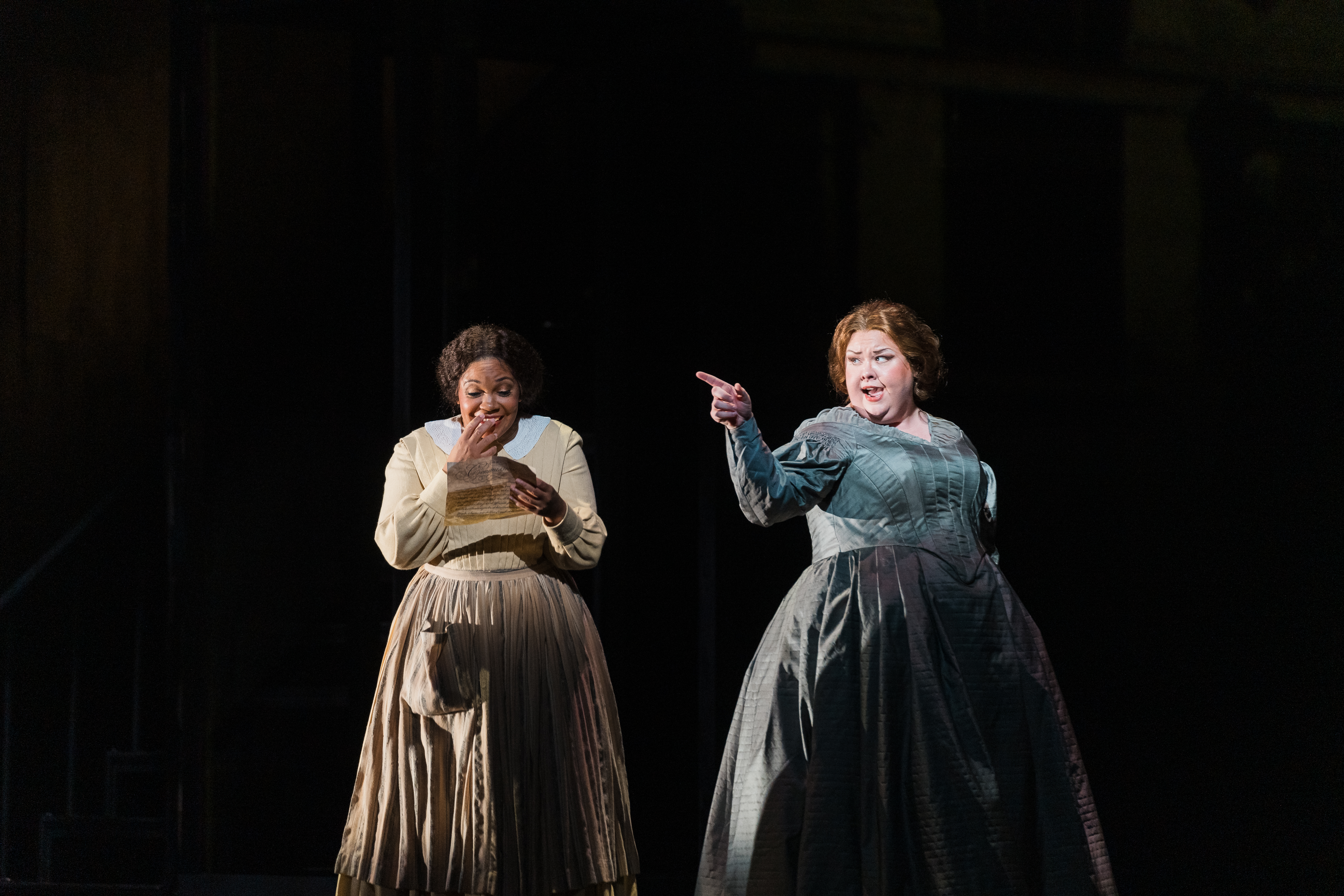
Give me an independent, strong woman any day−−any, any day.”
Among your many Houston roles, you originated Elizabeth Van Lew in Jake Heggie’s Intelligence, HGO’s world premiere from 2023. And now the company’s in-house label has a new recording out. What has that experience meant to you?
Years before the show opened, Jake and I were sitting at a café in San Francisco, and he told me about the story of Elizabeth Van Lew and Mary Jane Bowser. I had never heard this piece of American history. And he said, “so I’m writing the opera, and HGO is doing it, and I want you to be Elizabeth.” And I damn near cried. To have one of my favorite composers say, “I want to write an opera and for you to sing one of the leads”—it’s a gift to this day.
Intelligence was challenging. The story ended up being a little bit different than I thought it was going to be. In the end, Elizabeth’s not a hero. She is a woman with a lot of learning to do, and I ended up connecting with her through that. I think that is part of her humanity. We are all on learning journeys, and we can try our best and still fall short.
Can you trace your journey to opera for our audience?
I grew up in the middle of nowhere, in a Georgia valley. It was this very smallvery close-knit community. My grandparents and also my great aunt and uncle would host what they would call “pickin’s and grinnin’s”—when everybody brings their instruments, maybe people bring some potluck, all the kids are running around, and everybody who plays is usually in the living room, and they’re just jamming together, going through the hymnal or something like that, but it’s all bluegrass instruments. I was the nerd kid who was inside, not running around outside, trying to figure out, how do they know what to play? How do they know what harmony to sing? So many questions.
None of my family are professional musicians. I’m the first one. The virtuosic nature of bluegrass absolutely relates to the compositional and virtuosic nature of classical music. That’s 1000% a thing. But really, it was the love of music—whether it be bluegrass or classic rock or, later, musical theater—all of these little inroads brought me to, eventually, classical music, which I fell in love with listening to NPR at night. And it was the openness to experiencing different kinds of music that led me down the path of curiosity, to where I am now
Why is it important to you to use your voice not only on stage, but also to advocate for causes you believe in?
Because I come from the working poor, I’ve had to reckon with myself, as to whether I wanted to go forward with being an opera singer, or get out of this and go do social justice or advocacy work. In the end, I came to the realization that I had a platform—that people literally wanted to listen to my voice. And so I made an agreement with myself, that if I were to continue in this career that I love very, very much, then I was absolutely going to be using my voice, not only on stage but off stage, for what I believed in.
And what I believe in is empowerment. I believe in people finding and loving exactly who they are without shame. And that can go for a myriad of different subjects, whether it’s fatphobia or queer culture or income disparity. If I have an opportunity to help guide someone toward believing in themselves and loving themselves, then I’ve done a better job than I could do in any opera on any stage. So that is part of what I joyously get to call my job.