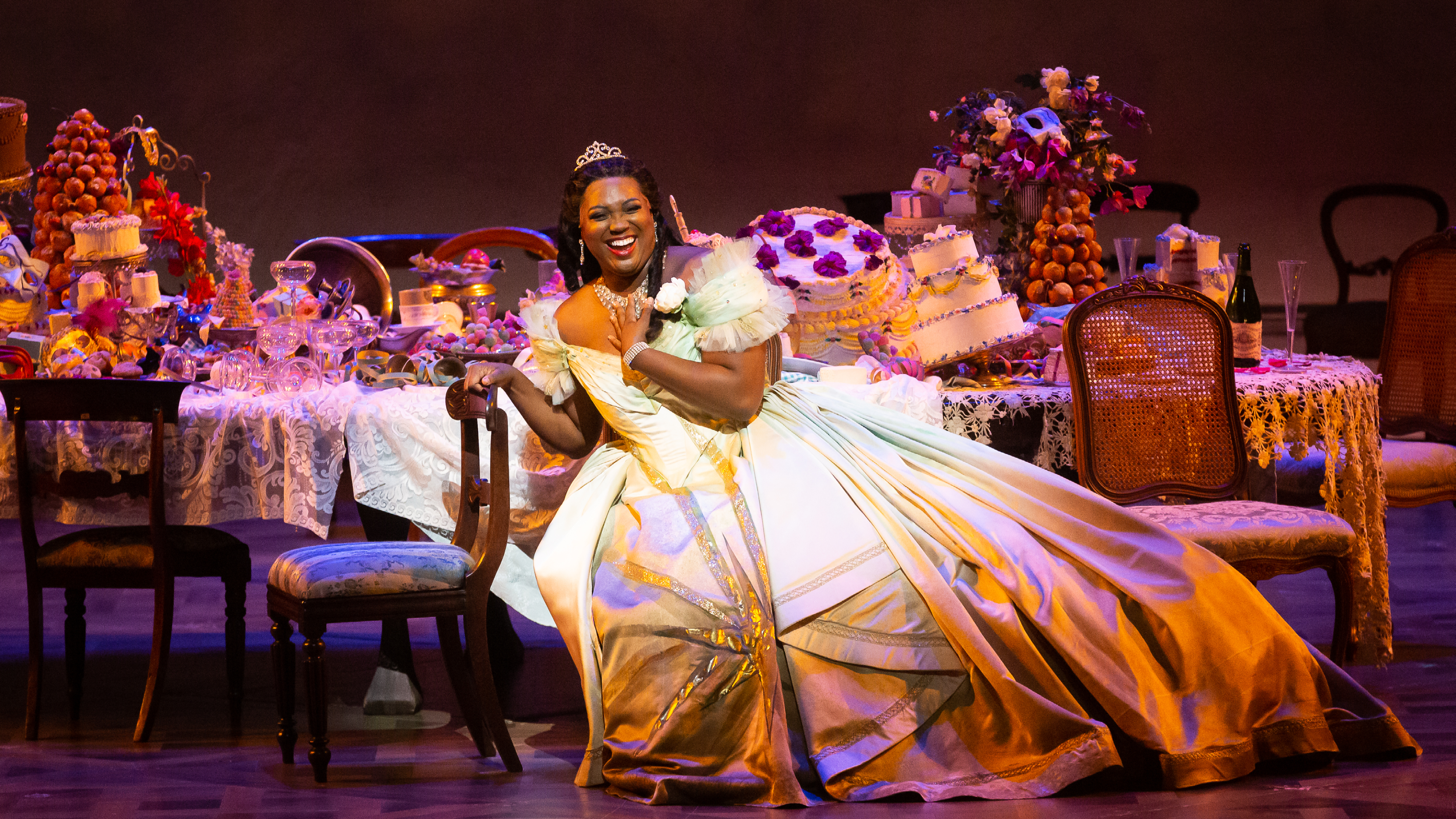
Out of Character: Angel Blue

The Wall Street Journal recently called Angel Blue’s Aida at the Met “sensational.” The New York Classical Review said her performance was “superb.” And the New York Times described her as a “shining soprano.”
Yet Blue herself hasn’t read a word of those stories. Her friends, mom, or husband might tell her about them, but she never reads her own reviews. “I know a lot of artists say that,” she says, “but it’s true. The last time I really read a review was 2010.” That piece upset her so much, she explains, it threw her off as a performer for the rest of the show’s run. And Blue will never allow anything to stand between her and her artistry.
In fact, the celebrated soprano is so intent upon avoiding distraction, she keeps a separate phone for social media. Which is why, in 2021, when a friend texted her regular phone to congratulate her on her first Grammy nomination, she thought it was a joke. “I went and looked on the social media phone,” she laughs, “and it was full of messages, everybody telling me that we were nominated."
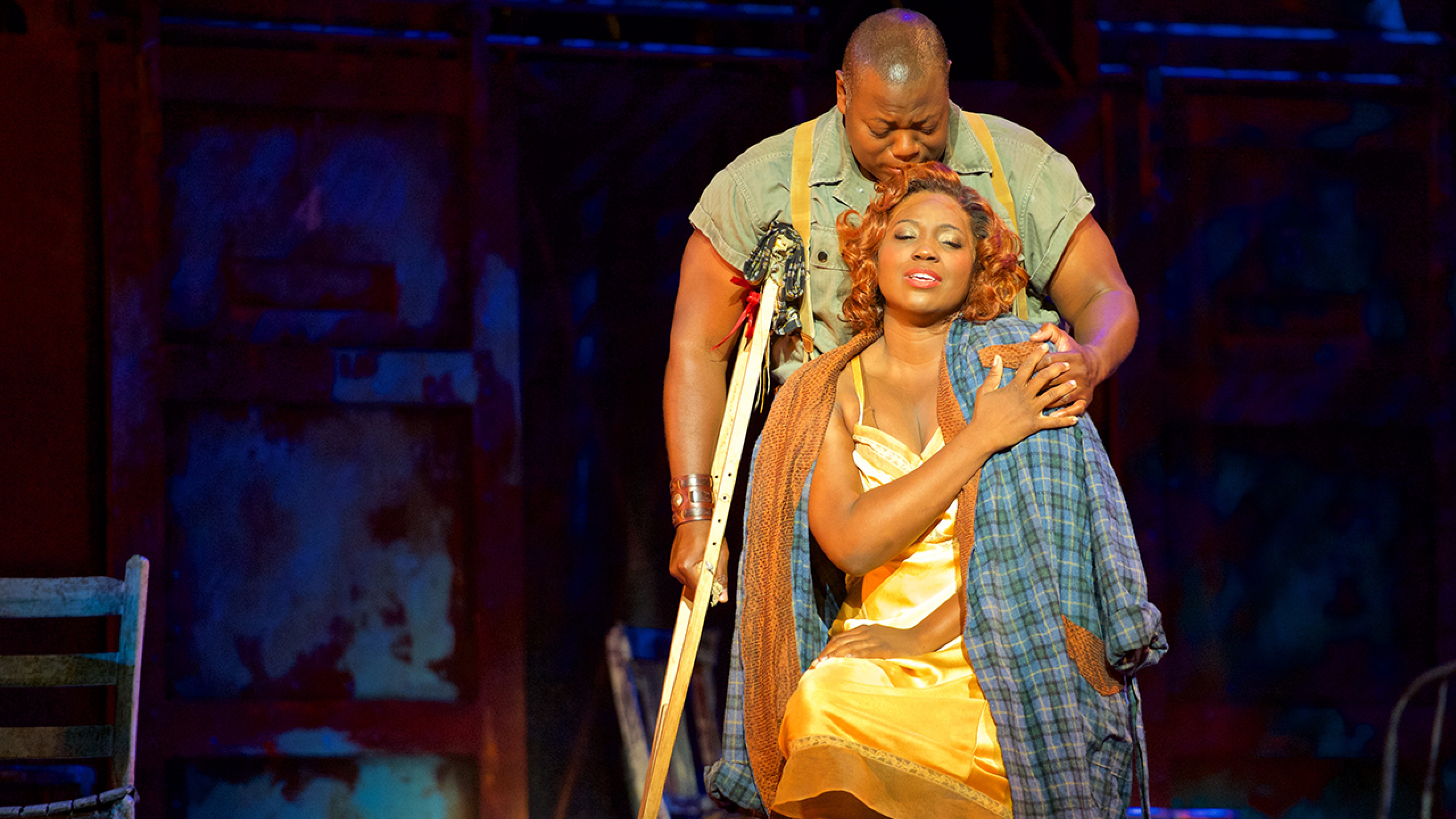
That nomination, and eventual win (she’s since won another), was for Best Opera Recording for her Bess in Porgy and Bess at the Met, and it solidified Blue as the defining Bess of her generation. Now, as she returns to Houston to sing the iconic role—following her show-stopping HGO debut in 2022, as Violetta in La traviata—she shares more about her journey, her passion for opera, and her deep connection to the Gershwins’ American masterpiece.
How did you decide on opera as a career?
It’s been my dream since I was a little girl. This is going to sound maybe a little crazy, but when I was 7 or 8, I used to put on records of my favorite singers in my bedroom. And I would take the sheet off of my bed, and I’d put it around my shoulders like it was a shawl, because this is what I had seen on PBS—on Great Performances, these grand divas have these big shawls. I would let the whole record play, and I would stand there with my hands up, and I’d wait for the applause. When the audience started applauding, I’d start bowing in front of my mirror. And I still feel like I’m that 4-year-old, 7-year-old, 8-year-old, 15-year-old Angel in a grown woman’s body, just living out her dreams, you know? And I’m thankful. I’ve worked really hard to be here, and I have to keep working hard to stay here.
How did coming from a musical family influence your path?
My grandfather was a coal miner in West Virginia, and he was a part of a barbershop quartet. He was a baritone, and his favorite opera singer was Enrico Caruso. So my dad grew up listening to Caruso and the old, old, great Italian opera singers like Luisa Tetrazzini. And he decided to study opera at what was then called Cleveland Institute of Music. He loved Leontyne Price—he saw her perform in person. He loved Richard Tucker. He loved all of the opera, and he passed that on to me.
When I was 4 years old, I told him that I wanted to be an opera singer, because I saw this concert of this lady in the light. That’s what I called her. It was Turandot, and I said I wanted to be like her. And my dad smiled and said, “you can absolutely be like the lady in the light.”
Music was everything in our household. We had a family band, really, when we would travel for my dad’s work, because he was a pastor. I played bass, my brother was on drums, my mom played piano, and my sister and my dad sang. Music was a huge, huge part of our lives. It really brought us together as a family, that and our faith.
Tell us about your journey with Porgy and Bess.
The opera itself has played a big role in my life. I started out singing Clara. Every time I would sing for an audition, I would sing “Summertime.” When San Francisco Opera was doing Porgy and Bess, I flew up to San Francisco from Los Angeles, where I’m from. And I was invited to be Clara in this huge production by Francesca Zambello. I was 26, and just like a deer in headlights at that point. But it was just an amazing experience. Then I sang Clara at the Berlin Philharmonic, the Boston Symphony Orchestra, Seattle Opera, and La Scala.
I first sang Bess in 2018 at Seattle Opera. I took Bess from there to the Napa Valley Festival in California, in concert, and then the Metropolitan Opera. I also sang Serena on a recording with Marin Alsop and the Philadelphia Orchestra. So it’s been an interesting journey. I know what a great work Porgy and Bess is, how important it is to the United States and to our culture, but also just the story itself being so universal. It resonates with people no matter where they’re from.
As an artist, did you ever fear being pigeonholed into Porgy roles?
No, I didn’t. It’s funny. I think my situation was a little bit different, where I felt like, “darn it, they’re doing Porgy and Bess again. How come they didn’t hire me?” But I understand the concern of being pigeonholed. I think that often, it’s like, “oh, we’re doing Porgy and Bess. We need Black artists. Let’s get them. Here they are. Go.” And then maybe the companies don’t think, “oh, we’re doing Der Rosenkavalier next season. So-and-so sounds like she would be a really good Sophie. Let’s audition her for Sophie.” Or: “we’re doing Le nozze di Figaro. Well, you know what? The young man who sang Jake, he really sounded like he’d be a great Count.” Sometimes I think it’s a disconnect—these artists you can put in other places. They can be in other operas.
Do you feel a personal connection to this story?
My parents were pastors, so I saw a lot of interesting stuff. I saw people who were strung completely out on drugs who would roll into church on Sunday. And there would be someone in the church like Serena who’s like, “shame on you.” Then there are people like my mom who would go up to them and not judge them at all and say, “do you need some water? What can I get for you?” Bess is somebody. And if there was a way for me to help her in any way, I would love to. When I look at these characters—even Violetta, who I’m singing right now, I think she’s just a normal person. Art imitates life.
Is HGO’s Grammy-winning Porgy and Bess album from 1976 in your rotation?
I’ve listened to it religiously. What’s great is that the singers aren’t just singing. They’re acting. And I think that’s what I love the most about it. I can almost see Clamma Dale when she’s in this argument with Crown. I can almost see her getting thrown around. You can hear it in her voice. It’s just a really beautiful recording.
The conductor of that ’76 Porgy was John DeMain, who was also at the podium when you sang Bess in Seattle.
He taught me the role! He’s hilarious. He would say, “Angel.” And I said, “yes, Maestro?” And he would say, “just ten minutes. Just ten minutes. Ten minutes.” And we’d go off, and we’d have a pianist, and he would say, “this section goes like this.” And he’d say, “the Gershwins, they really want it to start swinging right here. So this part is straight, and this part is swung. Let’s try it.” So everything, all of the nuances of the piece, John taught me.
Which singers from the past do you most enjoy as Bess?
I love Audra McDonald. The version they did on Broadway was slightly different, but she’s just as classically trained as I am. Of course, Clamma Dale, for the level of intensity that she gives to Bess. Laquita Mitchell sounded great. She portrayed Bess in a way that was softer than I had ever thought of her. And that’s beautiful, because Bess has all of these many different facets to her character, and it’s very hard to show all of them in one evening. Marquita Lister is a wonderful Bess. But my Bess is a little different than theirs.
How so?
In large part, because I find Bess to be a hard woman, a woman who is very stubborn. And I think she is similar to me in that way—I want this, I’m going to go get it. But what she chooses to go get isn’t something that’s good for her. So I think that my Bess is—she’s a little bit harsher. A little bit more—for lack of a better word, she’s a little bit more gangster when I’m playing her.
Why do you think this opera is so enduringly popular?
I brought my great-uncle to see Porgy and Bess before he passed away. He was 89. And his exact words were, that’s the only opera I can tap my toe to. So I think that’s one of the reasons, as simple as that may sound. I mean, it’s Gershwin. He’s an icon and a legend in our country, and his opera is no different. It’s a real story, and it grabs our hearts. It makes us think, hopefully, about loving each other, caring for one another, and also being gracious and kind to those who don’t have as much. Porgy and Bess is us. It’s about Black people in the South, but it’s our story—not just Black people’s. I mean us, the United States. It’s our story. It’s our music.