Rossini, Opera’s Cartoon Composer

It’s through cartoons that most of us are introduced to opera. Granted, animators tend to subject the art form to brutal parody. But even a caricature can plant the seeds of a future opera fanatic.
One Saturday morning, a child hears a helmeted Elmer Fudd belting, “Kill the wabbit!” Years later, this infectious melody resurfaces in a film or commercial. Memories of Bugs Bunny in drag atop a voluptuous stallion trigger a sudden curiosity. Where did that theme originally come from? Some online searching opens a wabbit—er, a rabbit hole. After sitting transfixed through a recording of “The Ride of the Valkyries,” a new Wagnerian is born.
But once one has experienced the sophisticated musical storytelling of Wagner’s Ring cycle, it’s easy to dismiss a cartoon lampoon like What’s Opera, Doc? as embarrassingly juvenile. A hardened opera snob might cringe at the idea that they ever found entertainment in this mockery of the genre. “It is so sad,” Elaine tells Jerry in Seinfeld. “All your knowledge of high culture comes from Bugs Bunny cartoons.”
Bugs Bunny deserves a second chance. There is, in fact, something authentically operatic about his animated shenanigans.
If our concept of opera is defined by Wagner, then of course Bugs has nothing to do with the art form—aside from reducing it to a hilarious stereotype. But opera isn’t all myth and melodrama. Operatic comedies in the screwball spirit of Looney Tunes do exist. This spring, HGO is presenting the greatest of them, Rossini’s Barber of Seville.
Like your first exposure to Wagner, your introduction to Rossini may have been via Bugs Bunny. Namely, the 1950 Warner Bros. short Rabbit of Seville, which features the overture to Barber as its soundtrack. (A side note: technically, Rossini recycled the overture from two earlier operas, but it’s now inextricably linked to Barber.) As the cartoon commences, Bugs flees into the backstage of a theater to escape Elmer, who follows in hot pursuit. The curtain rises, and the two eternal enemies find themselves starring in a production of The Barber of Seville.
The overture begins, and Bugs pops onstage, decked in a white barber’s jacket. “How do?,” he sings on the initial “ta-da” chords. While the opening Andante is purely orchestral in Rossini’s score, Bugs adds his own lyrics to welcome Elmer into the barbershop. The music then transitions into the Allegro main theme, with its sighing string motive, and Bugs abandons his singing to focus on his “client.”
What brings the libretto to cartoonish
life—what “animates” it, you will—is Rossini’s manic music."
With Elmer rendered immobile in the barber’s chair, Bugs performs a series of ridiculous scalp treatments on his would-be assassin. Each of his actions is perfectly synced with Rossini’s music. At one point, he builds a fruit salad on Elmer’s bald head, tossing its contents in time with the cellos and basses’ steady strokes. Accompanied by a downward-skipping orchestral figure, Bugs prances around the chair to present a mirror to Elmer, who bursts into rage on a fortissimo chord.
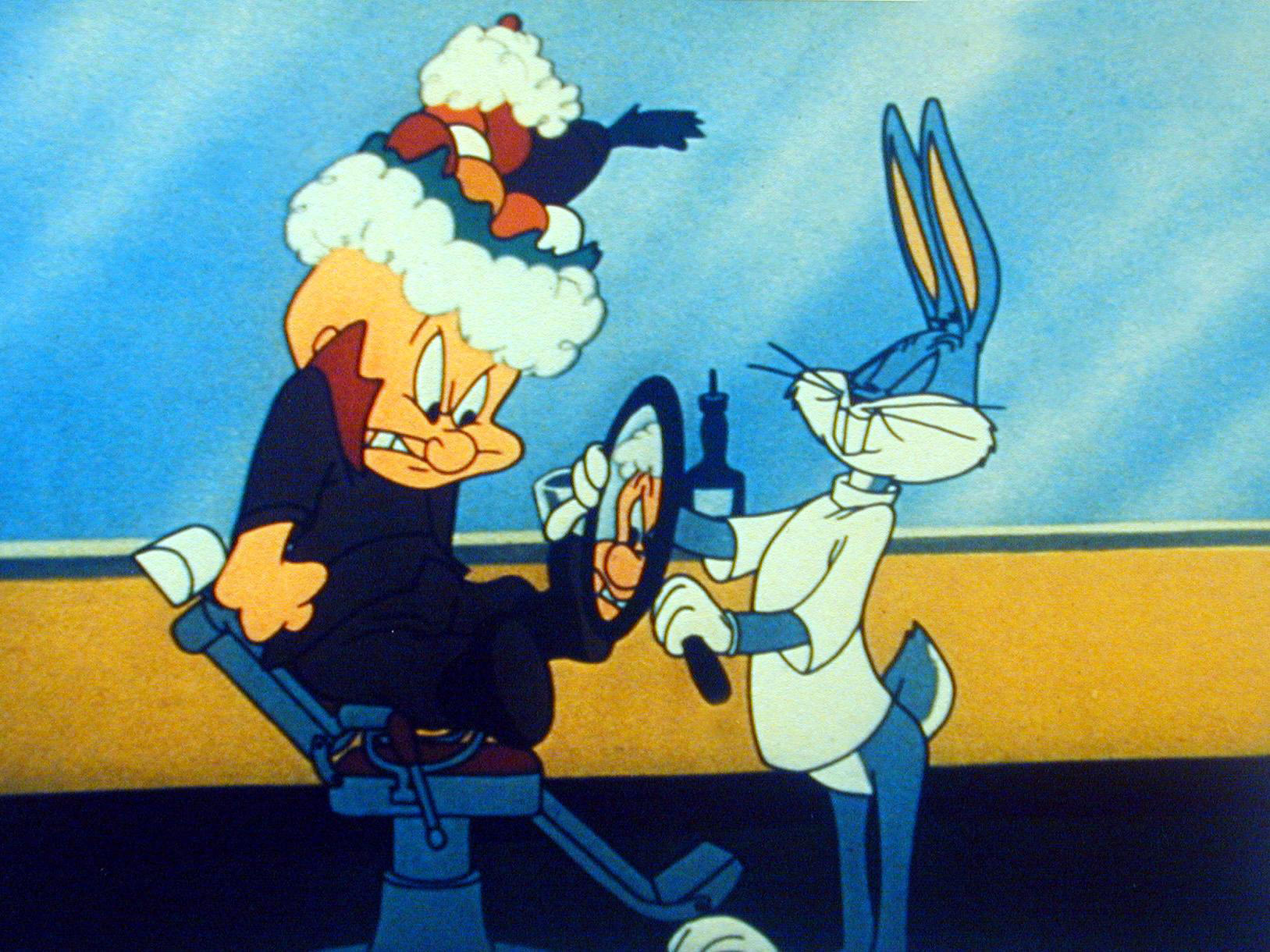
This coordination of music and onscreen movement is referred to as “mickey-mousing” in the movie business. While it’s generally frowned upon in film scoring as overly artificial, the technique is an essential component of animation. A slinking clarinet run or a drooping trombone glissando helps to accentuate a character’s exaggerated gestures. Composers might incorporate mickey-mousing into their original soundtracks for pre-animated segments. Or, vice versa, animators might “choreograph” their cartoon to line up with a pre-recorded track.
This latter practice was elevated to new heights by Disney in 1940 with Fantasia. But the concept was nothing new. From the first major sound cartoon, Disney’s Steamboat Willie of 1928, animation largely followed the same basic formula: animals performing antics in time with music.
Nor was Disney’s use of classical music novel. Animation studios had long mined the standard repertoire for lively pieces. Liszt’s Hungarian Rhapsody no. 2 for piano, with its pounding chords and finger gymnastics, was a favorite. Both Bugs and Tom the cat perform ridiculous renditions in separate cartoons released less than a year apart.
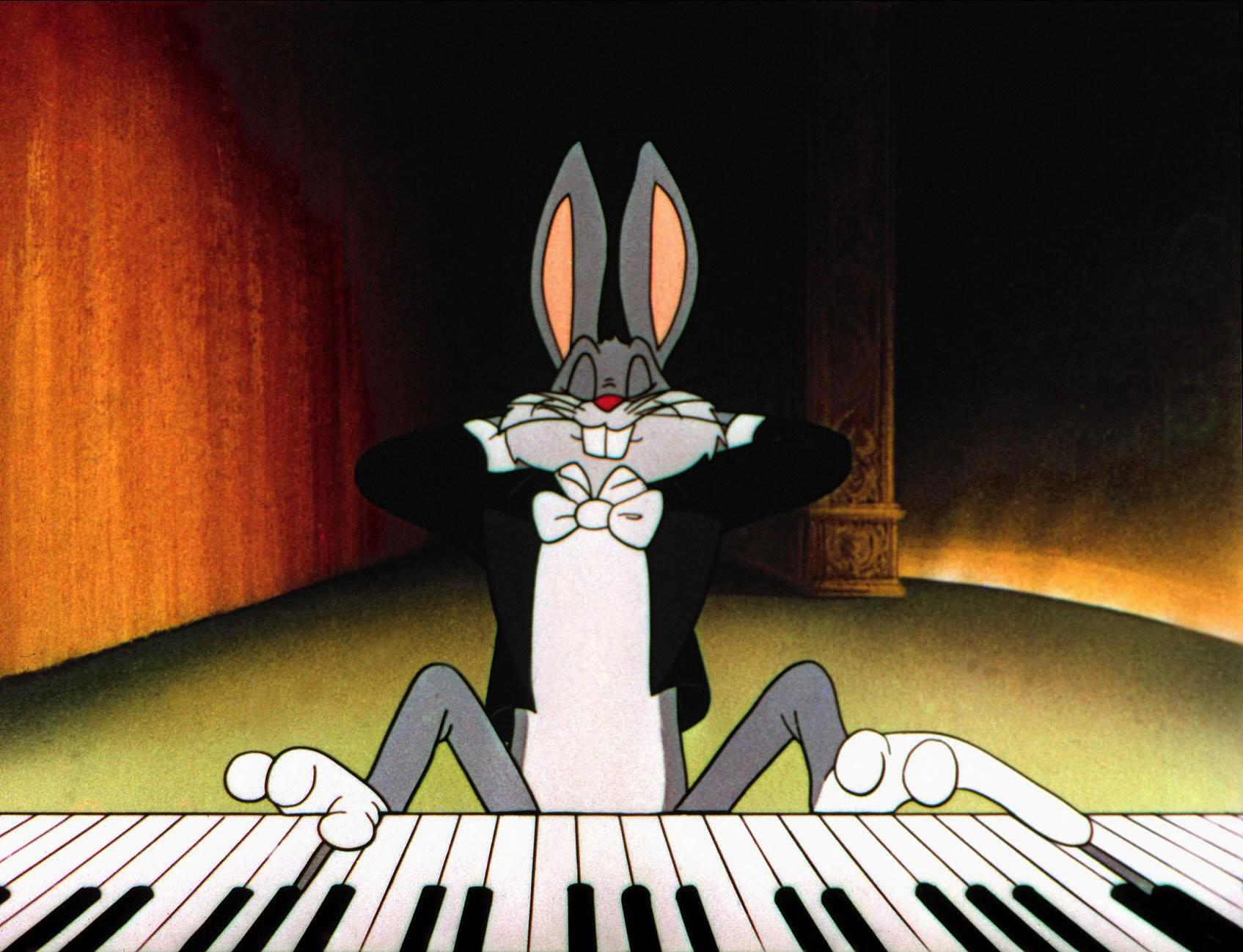
Like the Liszt, Rossini’s music is ideal for mickey-mousing. His operatic scores vibrate with kinetic energy. We can point to some stylistic features in a work like The Barber of Seville that lend themselves to cartoon movement: The fast tempos and rapid passagework, especially the singers’ coloratura runs and tongue-twister patter. The driving, almost mechanical rhythms. The abrupt, accented offbeats. The short, burst-like motives that repeat in sequence. The long-range buildups, known as “Rossini rockets,” that crescendo toward raucous climaxes.
With all its bouncing, darting, scurrying, and fluttering, Rossini’s music practically screams out for an animator to translate it into a crazy cartoon scenario. Which brings us to HGO’s production of The Barber of Seville, from Catalan director Joan Font. Font’s staging is visually reminiscent of animation: the garish color scheme, the wacky costumes, the fright wigs, the clown makeup, the giant pink piano. But beyond the design, what makes the production truly cartoonish is the way the onstage performers physically interact with the music.
While associate director Xevi Dorca has choreographed some vaudeville dance moves for the soloists, he deals mostly with their movement: how they walk, how they gesture, how they pose. Taking cues from Rossini’s music, Dorca treats the singers like living, breathing cartoons who mickey-mouse across the stage.
In the opening number, the choristers tiptoe in time with pizzicato strings. When the main characters try to send Don Basilio on his way, they wave him toward the door on each repetition of “Buona sera.” And when Almaviva accompanies Rosina on the piano, he hops up and down the keyboard in time with the orchestra—just like Bugs or Tom playing Hungarian Rhapsody.
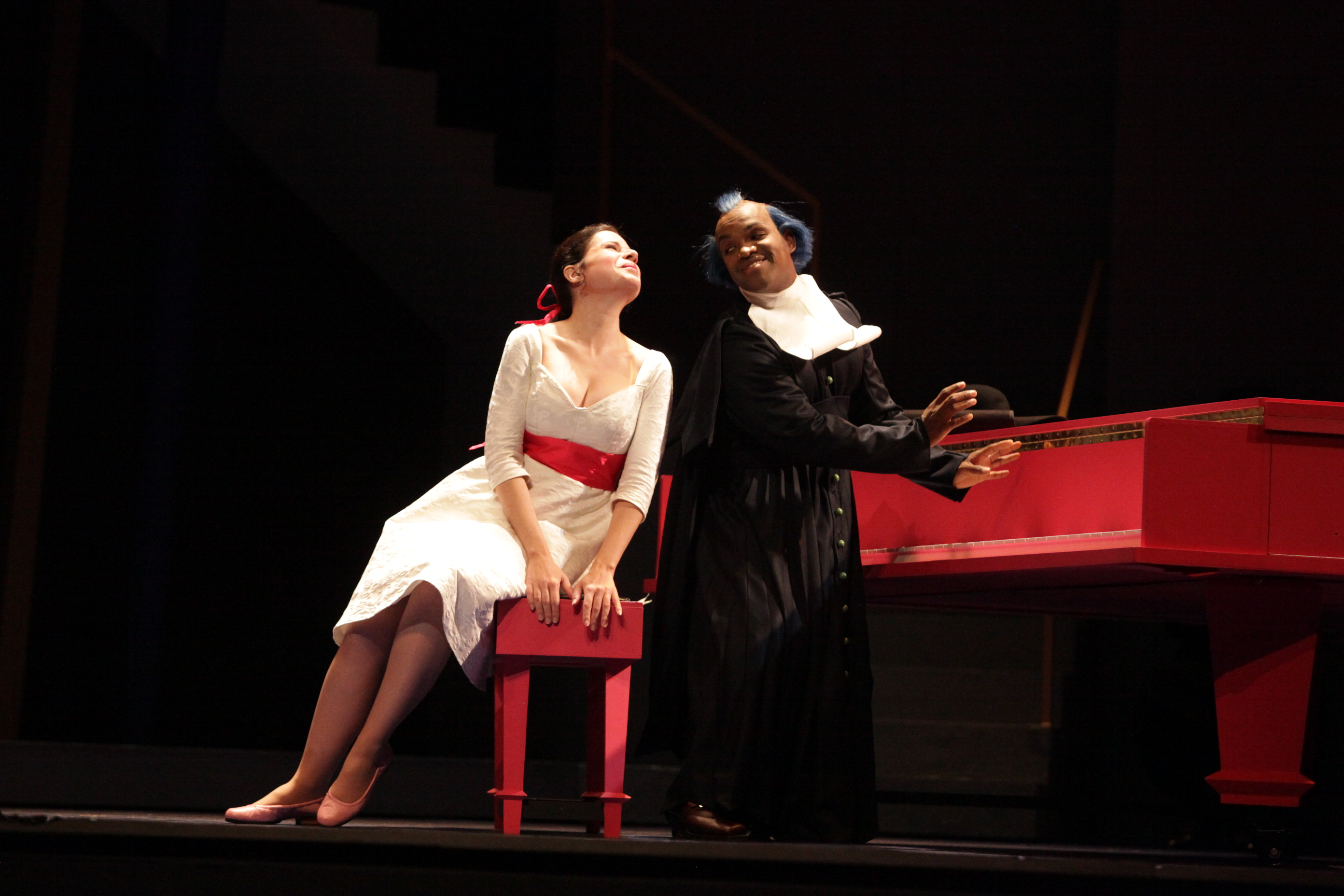
“Joan tells me what is important in a scene—what we have to show—then from this I create the movements,” explains Dorca. “When I have to move the principals or the chorus or the supers, the music tells me how this has to go. I don’t think too much—I just go into the rehearsal room, and through the music, we create the scenes. Rossini is very easy to follow, because the accents are very clear and he finishes his ‘sentences’ very clearly.
Much of the mickey-mousing in Font’s production is assigned to the troupe of mimes who serve as Doctor Bartolo’s servants. As the soloists sing their arias, these colorful pranksters act out the text in the background. During Figaro’s “Largo al factotum,” for instance, they become body doubles for the barber, demonstrating all the different tasks he performs across Seville. (By the way, this iconic aria has been sung by the likes of Daffy Duck, Sylvester, Woody Woodpecker, and Michigan J. Frog.)
Font and Dorca’s cartoonish staging illuminates a crucial point: the world of Rossini’s Barber isn’t far removed from the world of Bugs Bunny. We find further similarities if we look at the libretto by Cesare Sterbini, based on a play by French satirist Pierre-Augustin de Beaumarchais. As in a Looney Tunes short, the opera’s implausible plot is secondary. The story is only there to set up comic hijinks like Almaviva’s disguises, which call to mind Bugs’s habit of crossdressing.
The tone of Barber is cartoonishly irreverent and mischievous, and there is even a number in the music-lesson scene that parodies serious opera, in the manner of What’s Opera, Doc? Sterbini’s buffa characters, which are indebted to the stock characters of commedia dell’arte theater, are two-dimensional caricatures. We can predict their behavior, just as we know that Elmer will always hunt Bugs and Bugs will always humiliate Elmer.
But what brings the libretto to cartoonish life—what “animates” it, if you will—is Rossini’s manic music. That’s not to say that the composer is attempting to flesh out believable, emotionally complex humans through his score. On the contrary, his music makes the characters of Barber appear even more outrageous. Take the Act I finale, when Rossini reduces them to blithering idiots who repeat the same perplexed lines over and over—like Porky Pig stuck in one of his stuttering episodes.
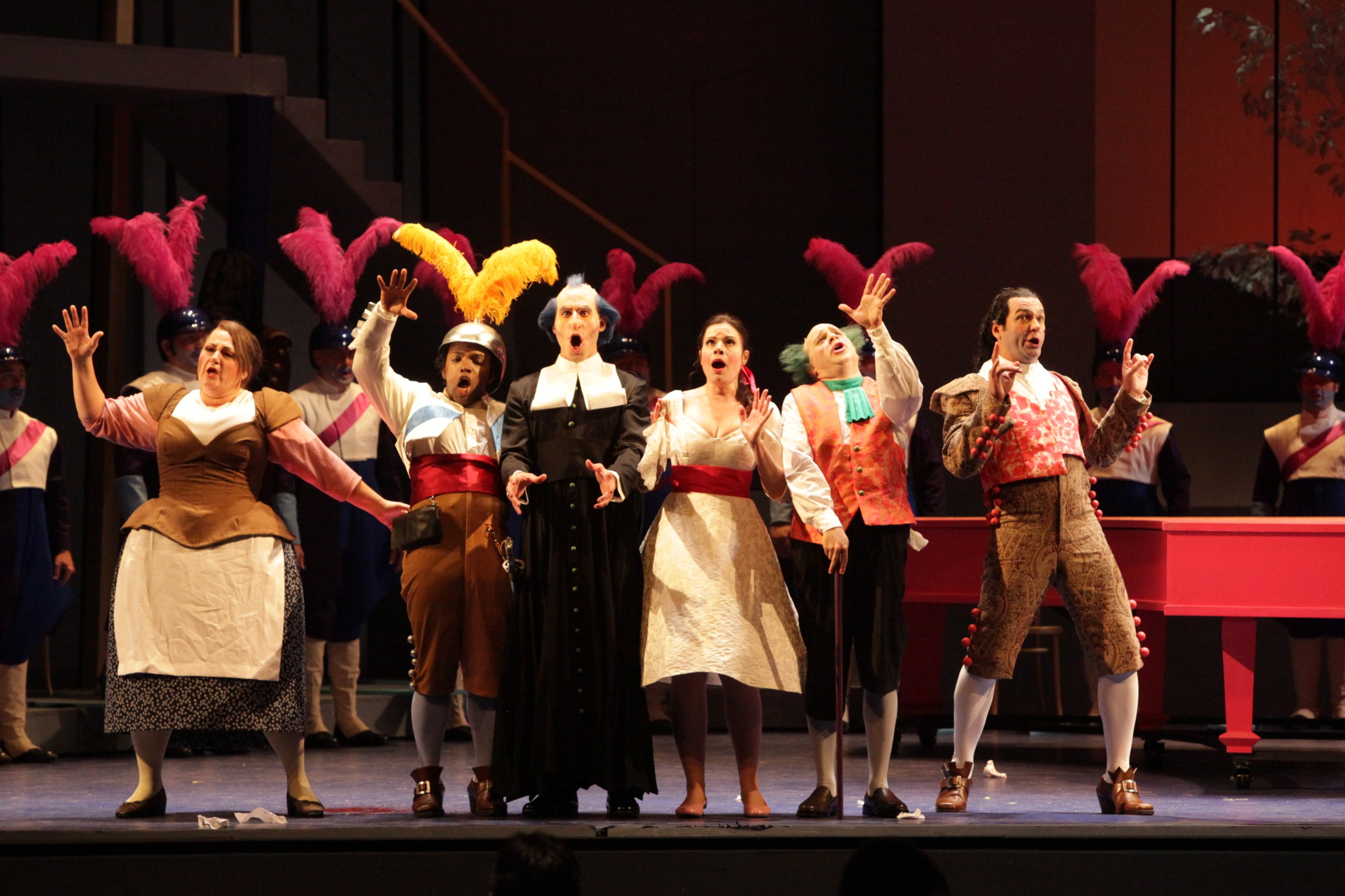
The characters remain cartoons, but cartoons that are brimming with dynamism. Propelled by the momentum of Rossini’s music, they seem to zip and zing at impossible speeds—even when the singers themselves remain stationary. We get the same childlike joy out of watching Bugs as we do from hearing a performance of Barber precisely because they occupy the same frenetic universe. Rossini’s music is cartoon music, just composed a century too early.
So don’t be ashamed if your love affair with opera began with Bugs Bunny. He may be a stinker, but he’s no philistine.
Cue the music. That’s all folks!