“I'm on my way”
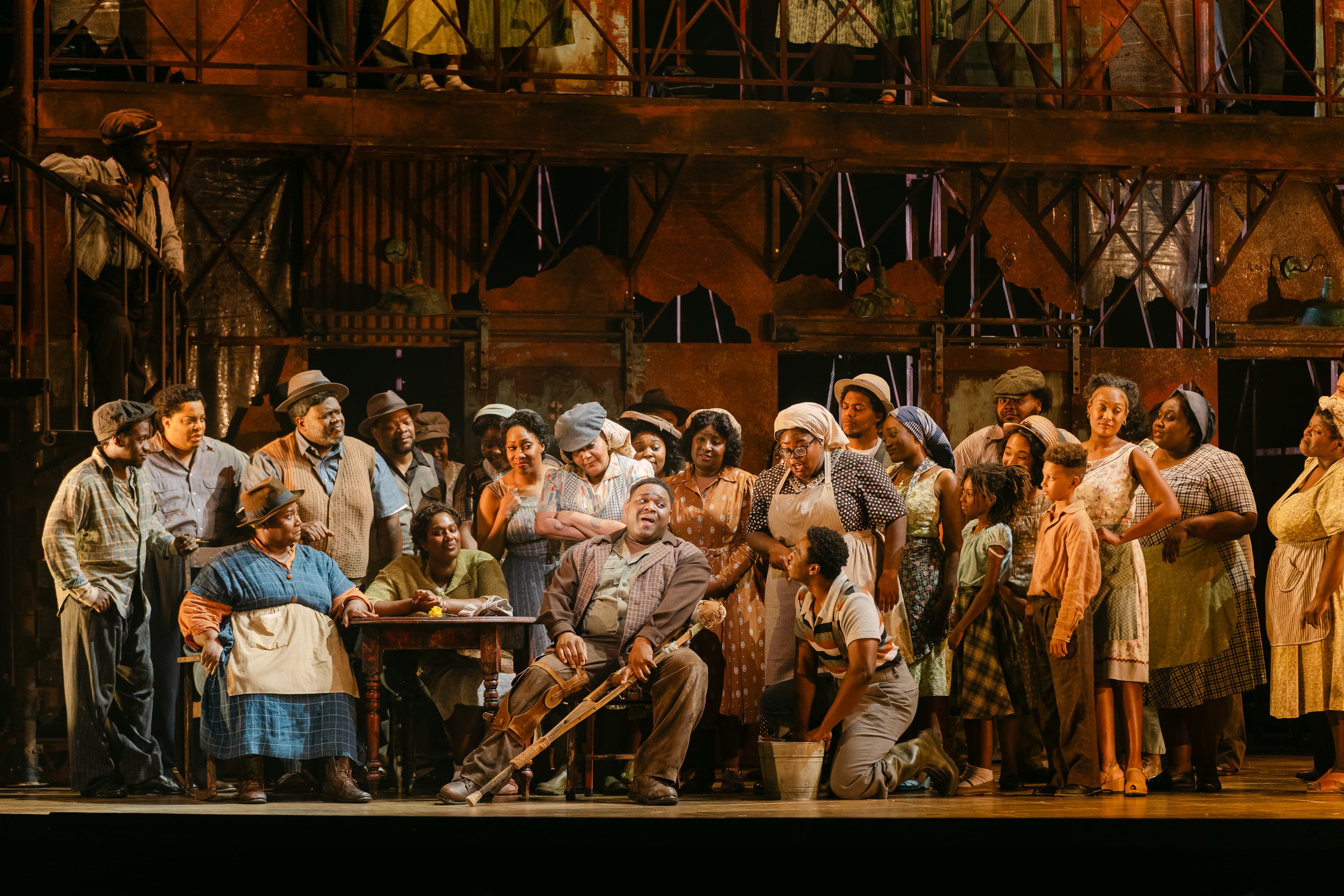
Trace the century-long history of Porgy and Bess, from the book and play that inspired the Gershwin brothers’ opera to major adaptations and productions, including Houston Grand Opera’s pivotal 1976 staging.
South Carolina author DuBose Heyward publishes his novella Porgy, about a disabled beggar living in a Charleston slum.

Heyward and his wife Dorothy bring the book to the stage as a successful play with traditional spirituals interspersed throughout the drama.

Collaborating with Heyward, brothers George and Ira Gershwin adapt the play into a “folk opera.” After its Boston tryout, it opens on Broadway with Todd Duncan and Anne Brown in the title roles.

A major revival opens on London’s West End starring William Warfield, Leontyne Price, and Cab Calloway. It goes on to tour across the U.S., Europe, South America, and even the Soviet Union.

Otto Preminger directs the sole big-screen version of Porgy, starring Sidney Poitier, Dorothy Dandridge, Sammy Davis Jr., and Pearl Bailey.

Houston Grand Opera restores the work to its creators’ original vision with a groundbreaking new staging by Jack O’Brien. The production—with Donnie Ray Albert and Clamma Dale in the title roles—moves to Broadway and wins both a Tony and a Grammy.

Trevor Nunn, director of Cats and Les Misérables, stages a celebrated Porgy at the Glyndebourne Festival. In 1993, it’s adapted into a TV movie featuring Willard White and Cynthia Haymon.

Hope Clarke stages a new Porgy for HGO—the first production of the opera by an African American director. It tours to Japan, La Scala, and the Paris Opera.

A controversial Broadway revival, starring Norm Lewis and Audra McDonald, reimagines the Gershwins’ opera as something closer to a musical.

Francesca Zambello’s 2005 production, revived nearly a dozen times across the U.S., finally makes its way to HGO—the company’s first Porgy in 30 years.

Porgy and Bess is set in Charleston, South Carolina, a colonial port situated at the point where three rivers flow into the Atlantic. Learn how the city’s rich African American culture—as well as Black communities on surrounding sea islands—inspired the opera’s story and its musical language.

Heyward’s fictional Catfish Row was based on a real-life tenement complex on Church St. known as Cabbage Row. Porgy himself was inspired by a disabled peanut seller named Samuel Smalls who got around Charleston in a goat-drawn cart.

During a 1934 visit to South Carolina, George Gershwin traveled to James Island to observe the Gullah—a Lowcountry community with strong ties to their West African heritage. Although the characters in Porgy belong to this culture, they don’t speak in the Gullah dialect. The only authentic word in the libretto is “buckra,” meaning “white person.” The banjo, which features in Porgy’s “I Got Plenty o’ Nuttin’,” is a traditional Gullah instrument originating in West Africa.

In the summer of 1934, George Gershwin and Porgy librettist DuBose Heyward took up residence on Folly Island, where the composer could absorb the local music. He found inspiration in a form of worship known as “shouting,” which—despite its name—is not a vocal style. As Heyward explains: “This is a complicated rhythmic pattern beaten out by feet and hands as an accompaniment to the spirituals.”
Referred to in the opera as “Kittiwah,” this barrier island was named for an indigenous group native to the region. It was long home to plantations where enslaved Africans harvested cotton and cut lumber from the island’s dense forests.
