FAUST: QUICK START GUIDE

THE OPERA IN ONE SENTENCE
Faust sells his soul to the devil for youth and love, but in his pursuit of pleasure, destroys the life of the chaste Marguerite.
BACKGROUND
The Faust legend originated in 16th-century Germany, where an astrologer and magician by the name Faustus may have actually lived. Fictional tales of his dealings with demons and his fantastical adventures were popularized by a 1587 novel and Christopher Marlowe’s play of the 1590s. Countless adaptations of the story followed, but the most influential was the verse play by German poet Johann Wolfgang von Goethe, published in two volumes in 1808 and 1832. His philosophical retelling, which was the first to include the character of Marguerite, fired the imaginations of Romantic artists.
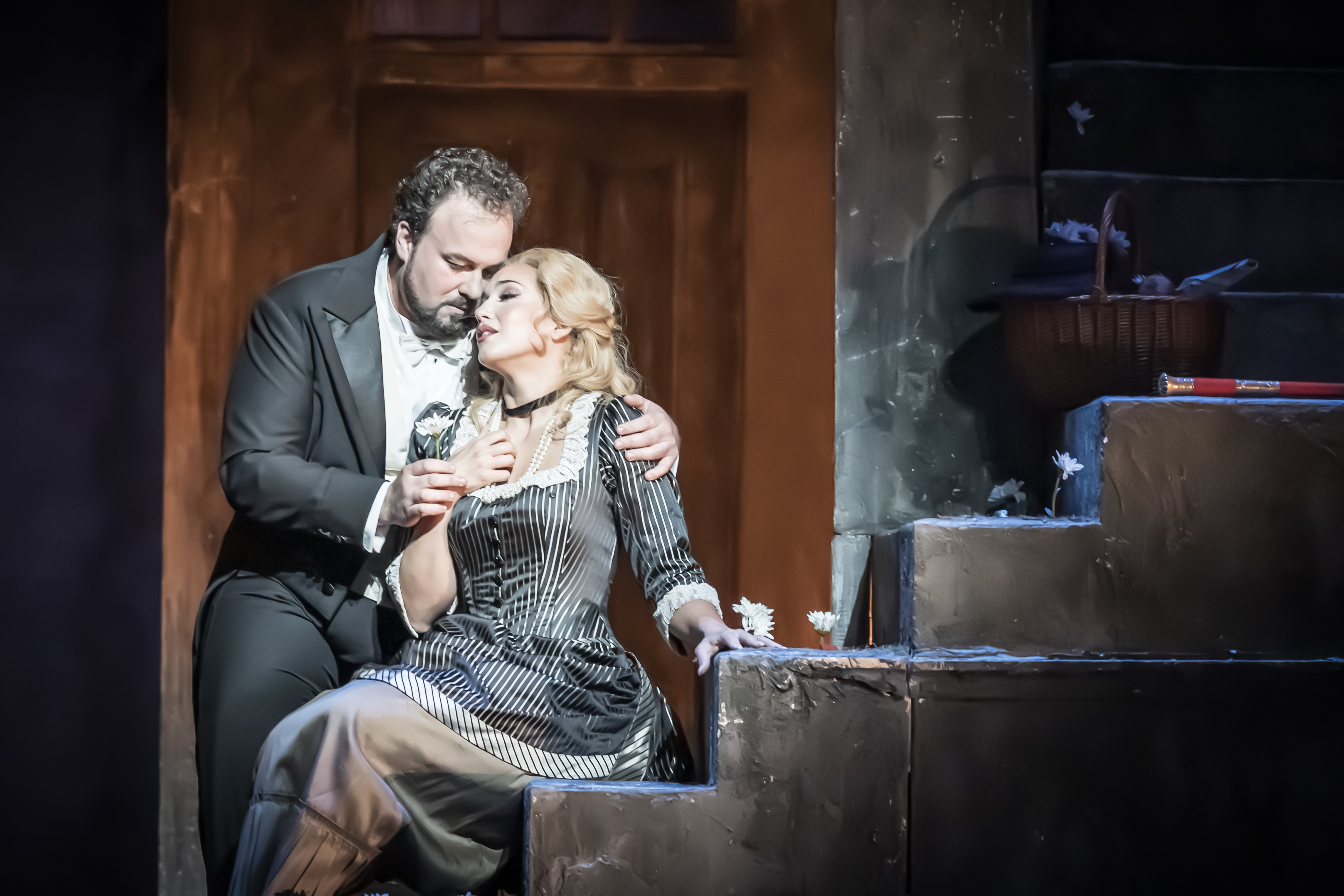
Nearly every major composer of the 19th century penned their own take on Goethe’s play. The best known of these remains French composer Charles Gounod’s 1859 opera. Jules Barbier’s libretto is based on Michel Carré’s play Faust et Marguerite, which in turn is adapted from the Goethe. HGO’s production, created by Scottish director David McVicar, moves the opera’s action from 16th-century Germany to 1870s Paris and reimagines Faust as a composer in the pattern of Gounod himself.
WHAT TO LISTEN FOR
Listen closely during the brooding orchestral interlude to Act I—one of its themes returns in Act II as Valentin’s aria “Avant de quitter ces lieux” (Before departing this place), a prayer for the sister he’s leaving behind as he goes off to war. It’s followed by Mephistopheles’s diabolical “Song of the Golden Calf,” a whirling bacchanale in praise of the false idols humanity worships. The act ends with the chorus “Ainsi que la brise légère” (Like the light breeze), a buoyant waltz number that frames Faust’s fateful first meeting with Marguerite.
In “Faites-lui mes aveux” (Convey my confessions to her) from Act III, Siebel’s adolescent infatuation with Marguerite bursts forth in joyful 6/8 phrases. Compare it with Faust’s more restrained expression of love, his aria “Salut! demeure chaste et pure” (Greetings, chaste and pure abode), in which he tenderly addresses the home where Marguerite resides. During Marguerite’s “Song of the King of Thulé,” listen for the rustic woodwind accompaniment that lends this fairytale number a folksy or medieval quality. It transitions into Marguerite’s iconic “Jewel Song”—listen for the virtuosic trills and coloratura runs that represent Marguerite’s girlish laughter as she dons glittering bracelets and necklaces. During her soaring, starlit duet with Faust, “Il se fait tard, adieu!” (It’s getting late, farewell), listen for the passage where Marguerite plays “he loves me, he loves me not.”
The Act IV “Scene in the Church” features a spooky organ accompaniment and the terrible cries of unseen demons. Valentin and his comrades return from war to the strains of the soldiers’ chorus “Gloire immortelle de nos aïeux” (Immortal glory of our ancestors), a rousing military march. During the climactic trio at the end of Act V, listen for Marguerite’s three repetitions of the glorious melody “Anges purs, anges radieux” (Pure angels, heavenly angels), each time sung a step higher—as if Marguerite is ascending toward heave
FUN FACT
In Gaston Leroux’s 1910 novel The Phantom of the Opera, the phantom sabotages the prima donna Carlotta’s performance as Marguerite when his favorite singer, Christine Daaé, is cast in the smaller role of Siebel. Faust also features in Edith Wharton’s 1920 novel The Age of Innocence, which opens on a production of the opera at the Academy of Music in New York starring real-life soprano Christine Nilsson.
SYNOPSIS
ACT I
Disillusioned with life, the aged Faust prepares to poison himself. Before drinking, he summons the devil, who arrives in the form of a dashingly dressed gentleman bearing the moniker Mephistopheles. He offers his infernal services to Faust, who wishes for youth and love. But there’s a price: Mephistopheles will do Faust’s bidding on earth, but “down there,” Faust belongs to the devil. When Faust hesitates, Mephistopheles tempts him with a vision of the lovely and chaste Marguerite. Set on finding this enchanting girl, Faust eagerly signs the contract in his own blood and swallows the poison, which Mephistopheles has transformed into an elixir of youth.
ACT II
On a busy city square, citizens drink and chatter. Among them is the soldier Valentin, preparing to leave his sister Marguerite and go off to war. He displays the protective medallion she gave him and says a prayer for her. Some students ask for a drinking song, and Mephistopheles, who has been lurking nearby, obliges with a wild ballad. However, his satanic behavior disturbs the onlookers. When Mephistopheles proposes a toast to Marguerite, Valentin takes offense and draws his sword, but his weapon magically breaks. Sensing something hellish afoot, Valentin brandishes two swords in the form of a cross to ward off Mephistopheles. The devil joins Faust again, who is yearning to finally meet Marguerite. She emerges from a crowd of dancers and revelers, and Faust offers her his arm, but she bashfully declines his advances.
ACT III
That evening, outside Marguerite’s house, Siebel tries to gather a posy for Marguerite. But Mephistopheles has placed a curse on him so that every flower he picks wilts. Siebel manages to reverse the curse with holy water and leaves a little bouquet before exiting. However, Mephistopheles has a far more enticing gift—a casket full of jewels, which he places in front of Marguerite’s door while he and Faust withdraw. Marguerite comes home, fondly recalling the handsome stranger she met. Just then, she spies the casket and can’t help trying on its glittering treasures. She’s joined by her neighbor, Dame Marthe, who assures her the jewelry must come from an ardent admirer. Mephistopheles and Faust reenter, and the devil distracts Marthe so that Faust can be alone with Marguerite. They profess their love for one another and part for the night—that is, until Faust overhears Marguerite pining for him at her window and joins her inside.
INTERMISSION
ACT IV
Marguerite, pregnant with Faust’s child, goes to church to beg God for mercy for her sins. As she prays, she’s accosted by the voices of Mephistopheles and his demonic horde, who tell her she’s damned forever. Meanwhile, Valentin has returned from war and rushes to see his sister. Faust, too, has longed to see Marguerite, whom he abandoned after impregnating. Mephistopheles sings a serenade to call the girl, but Valentin comes out instead. Having learned that Faust corrupted his sister, Valentin challenges him to a duel. But because Valentin, disgusted with Marguerite, has torn off his protective medallion, Mephistopheles is able to use his power to help Faust mortally wound him. Marguerite returns from church to find her brother dying. With his last breath, Valentin blames his death on her debauchery and curses her.
ACT V
On Walpurgis Night, when witches and spirits run amok, Mephistopheles tries to take Faust’s mind off Marguerite by resurrecting beautiful queens and courtesans of the past. But Faust sees a vision of Marguerite in prison with a red ribbon—as thin as an axe blade—around her throat. He insists that Mephistopheles take him to her. Driven to insanity, Marguerite has murdered the child she bore by Faust and is awaiting execution. Faust urges her to flee with him, but she refuses. Her life waning, Marguerite asks God for forgiveness and prays for angels to lift her heavenward. As she dies, Mephistopheles triumphantly announces that she is damned, but a chorus of angels proclaims the truth: she has been saved.
HGO PERFORMANCE HISTORY
HGO previously performed Faust in the 1961-62, 1966-67, 1975-76, 1985-86, 1990-91, 1996-97, 2006-07, 2016-17 seasons.