An American in Europe
Like all great artists of the 1920s, composer George Gershwin made a trip to Paris. Le jazz was all the rage in France, and Americans like Gershwin who could perform it were a hot commodity. Gershwin memorialized his continental sojourn with the 1928 orchestral piece An American in Paris, which infused the European tone poem with the musical vocabulary of jazz.
A century later, conductor James Gaffigan is following in Gershwin’s footsteps. In 2023, he became an American in Paris himself, leading the Jazz at Lincoln Center ensemble in works by Wynton Marsalis. Presently, Gaffigan is an American in Berlin serving as music director of Komische Oper. He’s in demand across the continent as an interpreter of repertoire by U.S. composers—including An American in Paris.
Gaffigan, who conducted the Eleanor McCollum Competition Concert of Arias last winter, only recently took on Porgy and Bess for the first time. Unsurprisingly, it was across the Atlantic, in a 2019 production at Dutch National Opera. Now stateside for his second Porgy, the Rice University graduate is an American back in Houston. Ahead of his HGO mainstage premiere, Gaffigan discussed Gershwin’s groundbreaking synthesis of jazz and classical forms in Porgy and why the work remains the quintessential American opera.
How familiar were you with Porgy and Bess before you conducted it for the first time in Amsterdam?
I would say I knew the famous tunes. I heard pop stars or favorite jazz musicians like Ella Fitzgerald singing them. But I’d never heard them as part of the opera. So I actually came to learn this music without ever seeing a live production. I really thought this was closer to a musical. And what I discovered is, Porgy and Bess is as deep and as rich as Wagner’s Die Walküre.
What do you admire most about the score?
I love the depth of character reflected in the music. I couldn’t believe how complex all the characters are. Gershwin develops characters just like Wagner does, with leitmotifs. You know, the Valkyries have this BUM-ba-dum rhythm. I would say Gershwin does something similar with rhythms.
Crown’s music, for instance, is really rough. He’s one of the most terrifying characters of opera. His music is so rhythmic and relentless. During his fight with Porgy, your heart’s pounding. And what’s so scary to me is the song Crown has, “A Red-Headed Woman.” The tune is so good, but it’s such a creepy setting for it—everyone’s watching him get out of control. I get chills thinking about that scene.
What’s very unusual about Gershwin is that some of his music that people might find happy, others find sad.
“Summertime” is a great example. It traces an emotional journey over the three times it appears in the opera.
Absolutely. I always thought that this song could mean so many different things at different times. I have my own memory of how a certain piece of music that I love was played at someone’s funeral. It was Brahms’s Requiem—the movement for solo soprano. The music suddenly took on the most tragic feeling, just because of this event in real time.
You’ve conducted Gershwin’s works with major orchestras across Europe. Do they get his jazz-rooted style, or does it take an American ensemble to truly play Gershwin well?
It all depends on the place. For example, there’s always been a love for jazz in Holland. Whereas, I remember doing Bernstein excerpts with another European orchestra, and it was like pulling teeth! How do you explain swinging? You could use all the words in the world, but the players either get it, or they don’t.
Do you think singers performing in Porgy should have a background in popular Black genres like jazz or gospel?
I think it’s important for the chorus. In the storm scene, their music is like a Baptist church sermon. You need to have experienced something like that in your life, where people are mourning or praising the Lord.
You’re referring to the “Six Simultaneous Prayers” during the hurricane. Each of the six choristers is assigned a different overlapping melody. How do you even rehearse that?
When I did it in Amsterdam, we made a plan. Because this is something that needs to be structured. Like in nature: something could look beautifully vague, but inside is structured in a very meticulous way. To make it sound chaotic, you need to make sure they’re not just all on top of each other. So we had plans of repetition—I would show a number at some point, and people knew the next section was happening. It should be organized chaos.
What about the soloists—how much training in jazz do they need?
I don’t think it’s as important for the soprano playing Bess to have any jazz background. That’s the most challenging role by far, because it requires a real operatic singer with a huge voice, like Angel Blue. Porgy needs to be able to swing. Sportin’ Life needs some jazz. Each character is different.
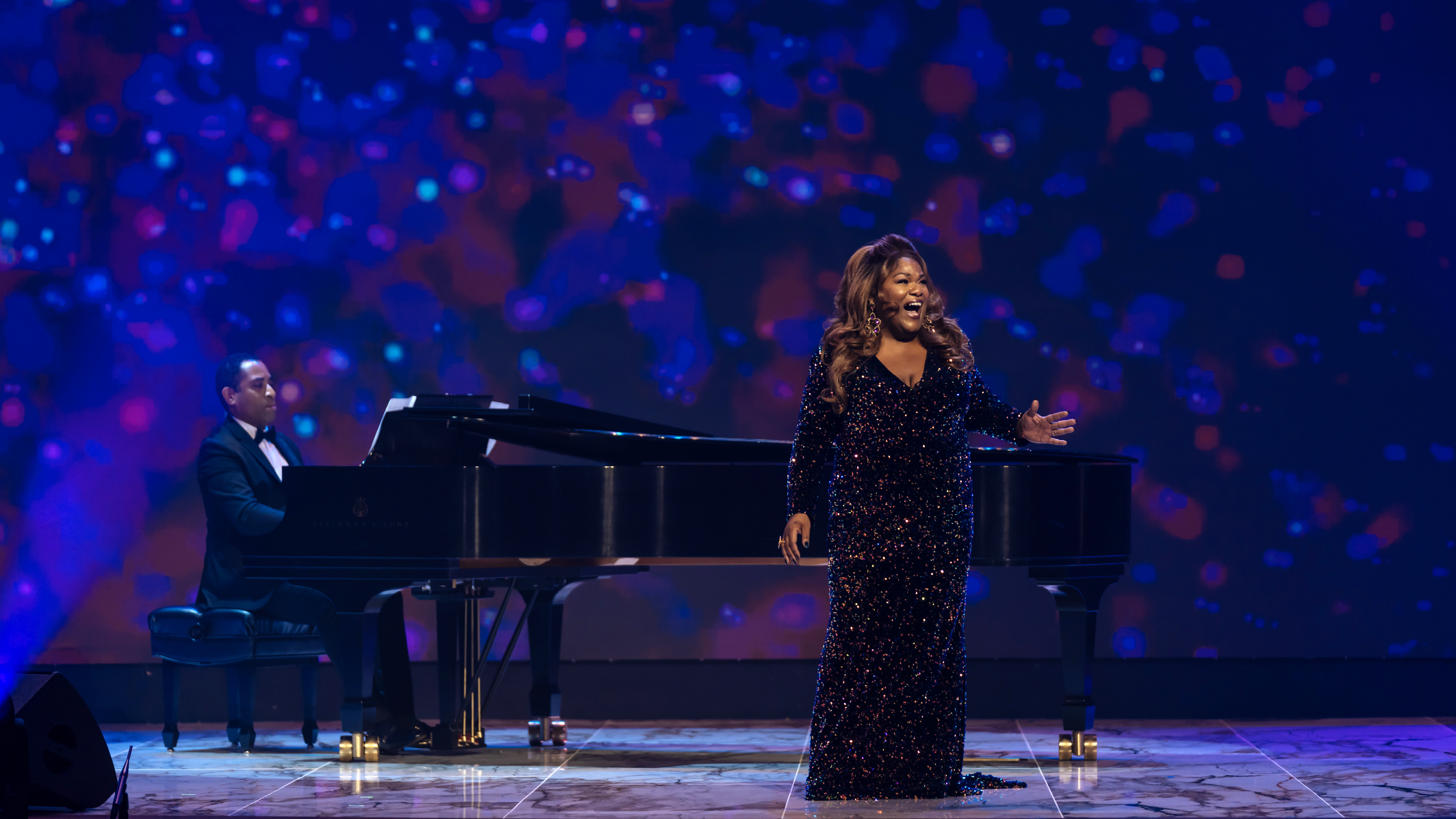
Latonia Moore, who plays Serena in HGO’s production, grew up singing in the choir at New Sunrise Baptist Church here in Houston. What was it like working with her on Porgy in Amsterdam?
She was incredible. Serena is extremely challenging to cast because of this kind of gospel or jazz quality. And Latonia can belt, but she can also sing Aida. She made me cry every night when she sang “My Man’s Gone Now,” which is just this heartbreaking two minutes of music.
How much do you allow singers to improvise?
Gershwin would have been all about it. But I think there are boundaries. And within these boundaries, you have a certain amount of freedom. I don’t believe in changing any pitches or rhythms. But if there’s a fermata and a little moment to shine—like for the Strawberry Woman or the Crab Man, for example. Gershwin wanted these people selling their wares to have their own individual stamp.
What challenges does the score present?
Balance is always an issue, especially all the percussion stuff. I think rhythms, especially jazz rhythms, can’t be haphazard. It needs to be a hundred percent tight. And then it gets more transparent, and you hear the amazing orchestration—all the layers. Other music is very forgiving. I would even say some Wagner, if it’s played by a B-level orchestra, still sounds pretty damn good. But with Porgy, if it’s sloppy, it loses all its amazing potential.
What Gershwin succeeds in doing is taking jazz and not making it cheesy in an operatic setting. He makes no apologies for his musical language.